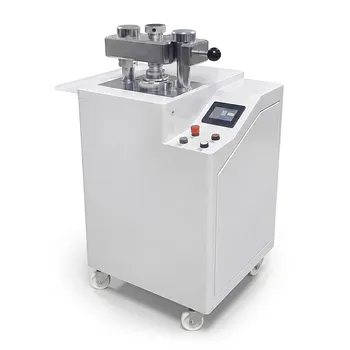
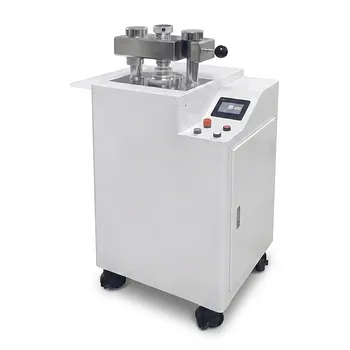
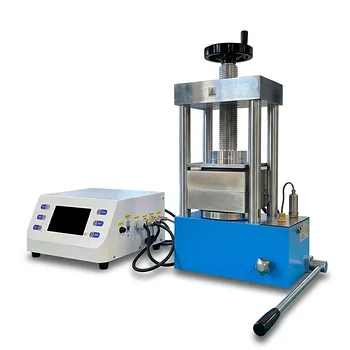
The laboratory manual hydraulic press is the primary tool for consolidating loose zirconium powder into solid "green compacts" with precise dimensions and density. This mechanical process transforms high-purity powder into standardized cylindrical pellets—typically around 10 mm in diameter—by applying controlled uniaxial pressure, such as 20.7 MPa. These pellets serve as the essential foundation for subsequent heat treatment, sintering, and corrosion experiments, where physical consistency is required for accurate data.
A laboratory manual hydraulic press acts as a critical bridge between raw powder and a structured material, ensuring that zirconium pellets possess the uniform internal density and geometric stability necessary for high-precision metallurgical research.
The Mechanics of Material Consolidation
From Loose Powder to Structured Solid
The press uses a piston-and-cylinder arrangement to apply high pressure to zirconium powder held within a precision mold. This mechanical force effectively excludes air trapped between particles and increases the contact area between them. The result is a "green body" that has sufficient mechanical strength to be handled and measured before further processing.
Precision Control of Dimensions
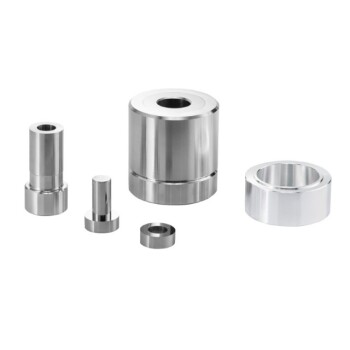
By using specialized hard alloy dies, such as those made of tungsten carbide, the press produces pellets with specific diameters and thicknesses. Standardized dimensions, like a 1 mm thickness, are vital for ensuring that every sample in an experimental set reacts identically to external stimuli. Consistency in size allows researchers to calculate mass and volume with high degrees of certainty.
Establishing Uniform Green Density
The press allows operators to apply a constant, repeatable load to the powder mass. This precise pressure control determines the "green density" of the pellet, which is the density of the material before it undergoes any heat treatment. A uniform initial density is the most important factor in predicting how much a pellet will shrink during the sintering process.
Ensuring Experimental Integrity and Reliability
Standardization for Comparative Research
In corrosion and heat treatment studies, the validity of the results depends on the samples being as identical as possible. A manual hydraulic press ensures that each zirconium pellet has a consistent mass and volume. This uniformity maintains highly comparable experimental conditions across multiple samples, preventing "noise" in the data caused by physical variations.
Minimizing Microscopic Defects
High-precision pressure control helps to ensure a uniform internal density gradient throughout the pellet. By minimizing internal voids and microscopic defects during the pressing stage, the risk of deformation or cracking during subsequent high-temperature sintering is significantly reduced. This leads to structurally stable polycrystalline materials suitable for mechanical property analysis.
Foundation for Advanced Post-Processing
Consistently pressed pellets are necessary for advanced surface treatments, such as nanosecond or femtosecond laser ablation. Because the press creates a dense, uniform surface, these lasers can more accurately create micro-nanostructured surfaces. These specialized surfaces are often used to study superhydrophobic properties or nuclear-grade material coatings.
Understanding the Trade-offs
Manual Operation vs. Repeatability
While a manual press offers the operator tactile control over the pressing cycle, it is susceptible to human error. Variations in the speed at which pressure is applied or the duration the load is held can lead to subtle differences in pellet density. For highly sensitive experiments, these small variations may impact the reproducibility of the results.
Die Wear and Contamination
The high pressures required to compact zirconium—often involving several tons of force—can lead to wear on the mold and plunger. If the die material is not harder than the zirconium powder, microscopic particles from the mold can contaminate the pellet. This is why high-purity applications often require specialized tungsten carbide or hardened steel tooling.
Pressure Limitations of Manual Units
Manual hydraulic presses have a maximum force capacity that may limit the size or density of the pellets produced. If a pellet requires extremely high pressure to reach a specific density, a manual unit may not be able to provide the necessary force safely. Operators must ensure the required MPa for their specific zirconium alloy falls within the press's calibrated range.
How to Apply This to Your Project
Making the Right Choice for Your Goal
To achieve the best results with a manual hydraulic press, your approach should be dictated by your specific research objective.
- If your primary focus is corrosion testing: Prioritize consistent pressure application and die cleanliness to ensure every pellet has an identical surface-to-volume ratio.
- If your primary focus is sintering and densification: Focus on calculating the exact green density required to achieve your target final shrinkage rate.
- If your primary focus is material purity: Utilize high-grade tungsten carbide dies to prevent cross-contamination between the mold and the zirconium powder.
By mastering the precise application of pressure, you transform raw powder into a reliable medium for advanced metallurgical discovery.
Summary Table:
| Key Role | Primary Benefit | Technical Application |
|---|---|---|
| Material Consolidation | Transforms powder to solid "green compacts" | High-purity powder compaction |
| Dimension Control | Ensures standardized size and thickness | Precision tungsten carbide dies |
| Density Uniformity | Predicts sintering shrinkage rates | Repeatable uniaxial pressure |
| Defect Reduction | Minimizes internal voids and cracking | Uniform internal density gradients |
Elevate Your Metallurgical Research with KINTEK
Achieve the highest precision in sample preparation with KINTEK’s high-performance laboratory hydraulic presses. Specifically designed for demanding applications like zirconium metal pelletizing, our range of manual, automatic, and isostatic presses—paired with our ultra-durable tungsten carbide and hardened steel dies—guarantees the uniform green density and geometric stability your research requires.
From nuclear-grade material studies to advanced sintering experiments, KINTEK provides the reliability and technical support your lab needs to succeed.
Ready to optimize your pelletizing process? Contact our laboratory equipment experts today to discuss the ideal solution for your specific powder compaction needs!
References
- Yeon Ju Lee, Young‐Sang Youn. Decreasing Hydrogen Content within Zirconium Using Au and Pd Nanoparticles as Sacrificial Agents under Pressurized Water at High Temperature. DOI: 10.3390/ma16186164
This article is also based on technical information from Kintek Solution Knowledge Base .
Related Products
- Automatic Laboratory Hydraulic Pellet Press Machine for Lab Use
- Laboratory Manual Hydraulic Pellet Press for Lab Use
- Laboratory Manual Hydraulic Pellet Press for Lab Use
- Automatic Laboratory Hydraulic Press for XRF & KBR Pellet Press
- Automatic XRF Pellet Press 40 Ton Hydraulic Sample Preparation Press for Fluorescent Spectroscopy Analysis
People Also Ask
- What is the role of a laboratory hydraulic pellet press and stainless steel molds in the fabrication of RuO2/NbC anodes?
- What role does a laboratory pellet press play in the enhancement of biomass energy products? Optimize Fuel Efficiency
- What is the purpose of using a laboratory pellet press when evaluating the electronic conductivity of carbon powders? Guide
- How does a laboratory hydraulic pellet press contribute to SiCw/2024 aluminum composite preforms? Optimize Densification
- What is the significance of applying 200 MPa of pressure with a laboratory hydraulic pellet press for composite ceramics?