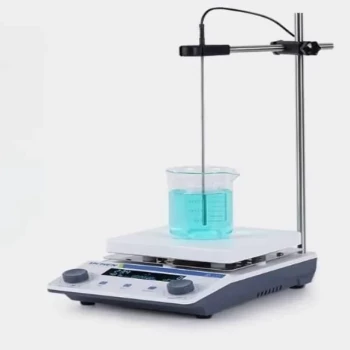
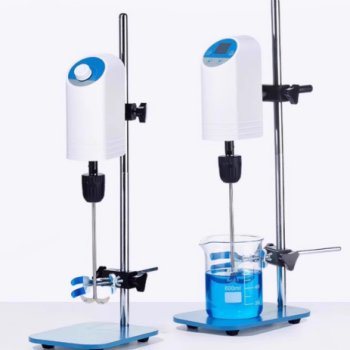
A magnetic stirrer serves as the critical engine for deep mixing during the formulation of nano-filler reinforced epoxy coatings. It blends the primary epoxy resin and curing agents with specific additives—including nano-titanium dioxide, zinc phosphate, and red lead—to create a unified composite solution.
Core Takeaway By providing continuous stirring power under constant temperature conditions, the magnetic stirrer drives the uniform dispersion of particles throughout the polymer matrix. This mechanical action is the primary defense against particle clumping, ensuring the structural integrity necessary for a high-performance protective coating.
The Mechanics of Effective Dispersion
Achieving Homogeneity
The fundamental role of the magnetic stirrer is to integrate solids into a liquid base. It forces the nano-scale and micro-scale particles to distribute evenly throughout the epoxy resin, rather than settling or floating.
Preventing Agglomeration
Nano-fillers have a natural tendency to cluster together, forming clumps known as agglomerates. The continuous power provided by the stirrer breaks these clusters apart, ensuring that the fillers remain individual and distinct within the mixture.
Facilitating Chemical Interaction
Beyond physical mixing, the device ensures the curing agents are thoroughly blended with the resin. This deep mixing is essential for the chemical reactions that will eventually harden the coating to occur uniformly across the entire surface.
The Role of Thermal Stability
Maintaining Constant Temperature
The process relies on stirring under constant temperature conditions. The magnetic stirrer often operates in conjunction with a heat source to maintain this stability.
Optimizing Viscosity
Epoxy resins can be thick and difficult to mix at room temperature. By integrating heat with continuous stirring, the system ensures the mixture remains fluid enough for the "deep mixing" process to be effective.
Common Pitfalls to Avoid
Inadequate Mixing Duration
If the stirring process is cut short, the dispersion of the nano-titanium dioxide and other fillers will be incomplete. This results in weak spots in the final coating where the polymer matrix lacks reinforcement.
Viscosity Limitations
While magnetic stirrers are effective for deep mixing, they rely on a magnetic coupling that can be broken by extreme resistance. If the epoxy is too viscous (thick) or the temperature drops too low, the stir bar may decouple, halting the continuous stirring power required for success.
Making the Right Choice for Your Goal
To ensure the highest quality protective coating, apply the following principles to your preparation protocol:
- If your primary focus is coating durability: Ensure the stirring process is continuous and vigorous enough to prevent any visible agglomeration of the zinc phosphate or red lead fillers.
- If your primary focus is process consistency: strictly control the temperature to facilitate the deep mixing of the resin, preventing viscosity changes that could interrupt the dispersion process.
The success of a nano-filler reinforced coating depends entirely on the uniformity achieved during this initial mixing stage.
Summary Table:
| Function | Description | Key Benefit |
|---|---|---|
| Deep Mixing | Integrates epoxy resin, curing agents, and nano-additives | Ensures a unified composite solution |
| Particle Dispersion | Distributes nano-scale particles throughout the matrix | Prevents settling and ensures structural integrity |
| De-agglomeration | Breaks down clusters of nano-fillers | Maintains individual particle performance |
| Thermal Stability | Stirring under constant temperature conditions | Optimizes viscosity for better fluid movement |
| Chemical Activation | Uniform blending of curing agents | Ensures consistent hardening across the surface |
Elevate Your Material Research with KINTEK Precision
Achieving the perfect nano-filler dispersion requires more than just stirring—it requires precision control. KINTEK specializes in high-performance laboratory equipment designed for the most demanding epoxy and polymer applications. From our advanced magnetic stirrers and homogenizers to our specialized crushing and milling systems, we provide the tools you need to prevent agglomeration and ensure coating integrity.
Whether you are developing protective coatings or conducting advanced battery research, our comprehensive range—including high-temperature furnaces, vacuum reactors, and PTFE consumables—is engineered to meet your exact specifications.
Ready to optimize your formulation process? Contact our technical experts today to discover how KINTEK's equipment can enhance your lab's efficiency and results!
References
- Israa Abdulsatar Esmael, Faris Moayed Ahmed. Studying the Effect of Nano Filler on Epoxy Properties used in storage tank Low Carbon Steel Protection. DOI: 10.52716/jprs.v10i4.387
This article is also based on technical information from Kintek Solution Knowledge Base .
Related Products
- Laboratory Small Constant Temperature Heated Magnetic Stirrer Heater and Stirrer
- Custom PTFE Teflon Parts Manufacturer for Magnetic Stirring Bar
- High Performance Laboratory Stirrers for Diverse Applications
- Three-dimensional electromagnetic sieving instrument
- Custom PTFE Teflon Parts Manufacturer for PTFE Stirring Bar Recovery Rod
People Also Ask
- What role does a magnetic stirrer with heating play in ZnO nanoparticle synthesis? Precision Control for Quality Results
- What role does a constant temperature heating magnetic stirrer play in MFC-HAp synthesis? Achieve Material Homogeneity
- What is the function of a laboratory magnetic stirrer in Ni–Cr–P electrodeposition? Optimize Ion Transport & Coating
- Why is a laboratory magnetic stirrer required for benzoic acid esters? Boost Reaction Speed & Yield with High RPM
- What role does a laboratory magnetic stirrer play in TiO2 and TiO2-Ag sol preparation? Master Chemical Kinetics