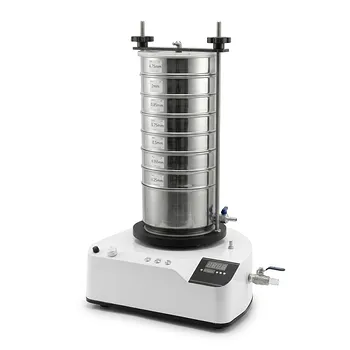
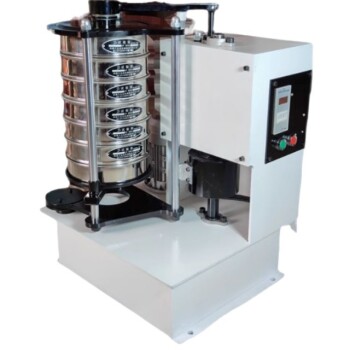
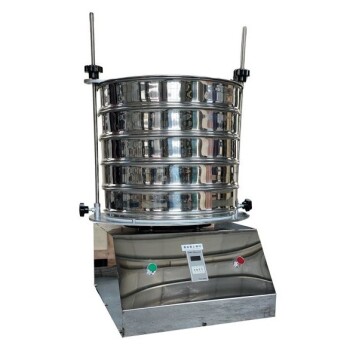
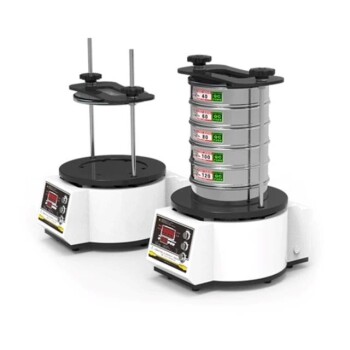
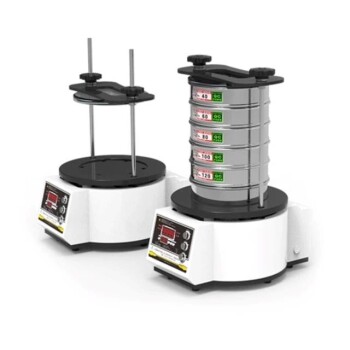
Precise particle size control is the cornerstone of refractory material quality. A standard laboratory sieving system employs multi-stage screening using precision-woven wire meshes—typically with specifications such as 75μm, 200μm, and 600μm—to categorize crushed fireclay. This process ensures the uniformity of the raw material, which is a critical prerequisite for achieving the necessary plasticity, density, and structural integrity in the final refractory products.
By transforming variable crushed ore into distinct, uniform fractions, the sieving system stabilizes the entire manufacturing process. It serves as the primary control point that dictates the workability of the raw mixture and the physical strength of the finished material.
The Mechanics of Material Consistency
Multi-Stage Particle Separation
The core function of the system is not just to filter, but to classify. By utilizing a stack of specific mesh sizes (e.g., 75μm, 200μm, and 600μm), the system separates the crushed fireclay into precise particle size distributions.
Ensuring Uniformity
Crushing processes are inherently chaotic, producing a wide range of fragment sizes. Sieving acts as a quality gate, ensuring that only particles within a specified range proceed to the mixing stage.
Removal of Oversized Particulates
Effective sieving eliminates oversized particles that can act as stress concentrators or structural flaws. Just as in alloy powder processing, removing these anomalies is essential for creating a consistent matrix in the final composite.
Impact on Processing and Performance
Optimizing Mixture Plasticity
The plasticity of the fireclay mixture—its ability to be shaped without cracking—is heavily dependent on particle size. The sieving system ensures the presence of appropriate fine fractions that improve the cohesion and workability of the clay.
Maximizing Molding Density
To achieve high density, particles must pack together tightly. A controlled distribution of particle sizes allows smaller particles to fill the voids between larger ones, resulting in a compact, low-porosity structure after molding.
Enhancing Final Physical Strength
The ultimate goal of pretreatment is product durability. By ensuring a uniform, dense internal structure through sieving, the final refractory product exhibits superior physical strength and resistance to thermal stress.
Understanding the Trade-offs
The Risk of Over-Processing
While finer particles generally improve plasticity, an excess of "fines" (very small particles) can lead to issues. It may increase the specific surface area too much, requiring excessive water or binders, which can cause shrinkage during drying.
Throughput vs. Precision
High-precision sieving is often a bottleneck in the workflow. Using tighter mesh specifications increases the accuracy of the particle distribution but significantly reduces the throughput rate of the raw material processing.
Screen Maintenance and Accuracy
Wire meshes are subject to wear and "blinding" (clogging). If the sieving system is not regularly maintained, the effective aperture size changes, leading to inconsistent data and compromising the repeatability of the experiment.
Making the Right Choice for Your Goal
When configuring your sieving protocol for fireclay, align the mesh selection with your specific performance targets.
- If your primary focus is Plasticity and Molding: Prioritize the retention of finer fractions (e.g., passing 75μm) to enhance the workability and cohesion of the wet mixture.
- If your primary focus is Final Density and Strength: Focus on a balanced distribution (using 200μm and 600μm stages) to optimize particle packing and minimize void space in the finished product.
Strict adherence to a standardized sieving protocol turns unpredictable raw ore into a reliable, engineered component for high-performance refractories.
Summary Table:
| Key Feature | Functional Impact | Benefit for Fireclay |
|---|---|---|
| Multi-Stage Screening | Precise particle size classification | Ensures uniform material fractions |
| Size Distribution Control | Optimized particle packing | Increases molding density & low porosity |
| Oversized Removal | Elimination of structural anomalies | Prevents stress concentrators & flaws |
| Fine Fraction Retention | Enhanced material cohesion | Improves mixture plasticity & workability |
Elevate Your Refractory Research with KINTEK
Precision starts with the right particle distribution. KINTEK specializes in high-performance laboratory equipment, offering advanced sieving equipment and crushing/milling systems designed to ensure the integrity of your fireclay raw materials. From optimizing plasticity to maximizing structural density, our expertise extends across a comprehensive range of solutions—including high-temperature furnaces (muffle, vacuum, CVD), hydraulic presses for pelletizing, and high-temperature high-pressure reactors.
Don't let inconsistent raw materials compromise your results. Partner with KINTEK for reliable, engineered tools tailored to your laboratory's needs. Contact us today to find the perfect sieving solution!
References
- Y. L. Shuaib-Babata, Getachew Adem Mohammed. Characterization of Baruten Local Government Area of Kwara State (Nigeria) fireclays as suitable refractory materials. DOI: 10.4314/njt.v37i2.12
This article is also based on technical information from Kintek Solution Knowledge Base .
Related Products
- Laboratory Vibratory Sieve Shaker Machine for Dry and Wet Three-Dimensional Sieving
- Laboratory Vibratory Sieve Shaker Machine Slap Vibrating Sieve
- Laboratory Test Sieves and Sieving Machines
- Laboratory Wet Three-Dimensional Vibratory Sieve Shaker Machine
- Vibratory Sieve Shaker Machine Dry Three-Dimensional Vibrating Sieve
People Also Ask
- How does a laboratory vibratory sieve shaker facilitate the microstructural study of gas-atomized alloy powders?
- What role does a laboratory vibrating sieve shaker play in the LiFePO4 powder processing workflow? Ensure Batch Quality
- Why use a vibratory sieve shaker for PET powder? Achieve Precise Particle Size Control for Chemical Research
- What is the principle of vibratory sieve shaker? Achieve Accurate Particle Size Analysis
- What is the function of a vibratory sieve shaker? Achieve Precise Particle Size Analysis