Knowledge What is the role of a laboratory oven in ZnO-Au nanocomposites? Achieve Precision Drying and Material Stability
Author avatar

Tech Team · Kintek Solution

Updated 1 day ago

What is the role of a laboratory oven in ZnO-Au nanocomposites? Achieve Precision Drying and Material Stability


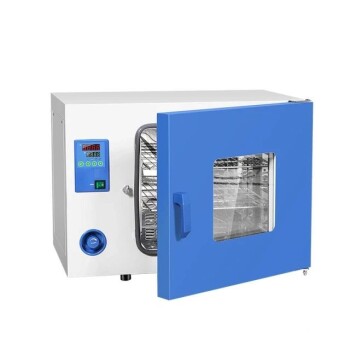
In the final preparation of ZnO-Au nanocomposites, an industrial-grade laboratory oven serves as a precision tool for stabilizing the material structure. Its primary function is to maintain a constant temperature of approximately 65°C to dry the wet products immediately following the washing process. This controlled environment effectively removes moisture without subjecting the delicate nanoparticles to the destructive effects of high-heat thermal processing.

Core Takeaway The laboratory oven acts as a preservation stage, removing free and physically adsorbed water while protecting the material's nanoscale features. By capping the temperature at 65°C, it prevents particle sintering and phase changes, ensuring the composite retains the specific physical structure required for subsequent experimental use.

The Mechanics of Controlled Drying

Precise Moisture Elimination

The synthesis process leaves the ZnO-Au products wet, necessitating the removal of excess liquid.

The oven targets free water (bulk surface water) and physically adsorbed water (water molecules clinging to the surface).

By maintaining a steady 65°C, the oven facilitates gentle evaporation. This ensures the material is thoroughly dried without the aggressive boiling or rapid dehydration that could alter surface chemistry.

Establishing Physical Stability

The goal of this stage is not just dryness, but structural permanence.

The drying process solidifies the final formation of the material.

This creates a stable physical structure, ensuring that the nanocomposite is consistent and reliable for future characterization or application.

Protecting Nanoparticle Integrity

Preventing Sintering

Nanoparticles have high surface energy and are prone to clumping together under heat, a process known as sintering.

If sintering occurs, the unique properties of the "nano" scale are lost as particles fuse into larger aggregates.

The laboratory oven's controlled, moderate heat avoids this, keeping the ZnO and Au particles distinct and active.

Avoiding Phase Changes

Materials can change their crystal structure or chemical phase when exposed to excessive temperatures.

Such changes can fundamentally alter the reactivity or optical properties of the ZnO-Au composite.

The 65°C threshold is specifically selected to be safe enough to avoid these unwanted phase transformations.

Understanding the Trade-offs

The Risk of Excessive Heat

It is a common error to increase drying temperatures to speed up the process.

However, exceeding the recommended temperature (e.g., pushing well beyond 65°C) risks severe agglomeration.

Once particles agglomerate or the phase changes, the damage is irreversible, rendering the sample useless for high-precision applications.

The Necessity of Uniformity

Using a standard oven without industrial-grade stability can lead to temperature fluctuations.

Inconsistent heating results in uneven drying, where some parts of the sample may sinter while others remain damp.

Industrial-grade precision is vital to ensure that the entire batch experiences the exact same thermal history.

Making the Right Choice for Your Goal

To maximize the quality of your ZnO-Au nanocomposites, align your drying strategy with your specific objectives:

  • If your primary focus is Morphology Retention: strictly maintain the temperature at 65°C to prevent the nanoparticles from fusing or changing shape.
  • If your primary focus is Chemical Purity: ensure the drying duration is sufficient to remove all physically adsorbed water, preventing moisture from interfering with weight measurements or surface reactions.

The laboratory oven is not merely a drying device; it is the final gatekeeper that locks in the structural integrity of your nanocomposite before application.

Summary Table:

Parameter Specification/Role Benefit for ZnO-Au Nanocomposites
Optimal Temperature 65°C (Controlled) Prevents particle sintering and unwanted phase changes
Primary Function Precision Drying Removes free and physically adsorbed water effectively
Structural Impact Stabilization Locks in the physical structure and morphology of the composite
Risk Mitigation Uniform Heating Avoids thermal fluctuations that cause uneven sample quality

Elevate Your Nanomaterial Synthesis with KINTEK Precision

Maintaining structural integrity at the nanoscale requires more than just heat—it requires industrial-grade precision. KINTEK specializes in high-performance laboratory equipment designed to meet the rigorous demands of advanced material research.

Whether you are synthesizing ZnO-Au nanocomposites or developing next-generation catalysts, our comprehensive range of laboratory ovens, high-temperature muffle and vacuum furnaces, and specialized reactors ensures your samples achieve perfect stability every time. From crushing and milling systems to high-pressure autoclaves and electrolytic cells, KINTEK provides the tools global researchers trust for consistency and durability.

Ready to optimize your drying process? Contact our technical specialists today to find the ideal thermal solution for your lab!

References

  1. Maria Ștefan, Alexandra Fălămaș. Enhanced Plasmonic Photocatalysis of Au-Decorated ZnO Nanocomposites. DOI: 10.3390/inorganics11040157

This article is also based on technical information from Kintek Solution Knowledge Base .

Related Products

People Also Ask

Related Products

Laboratory Scientific Electric Heating Blast Drying Oven

Laboratory Scientific Electric Heating Blast Drying Oven

The desktop fast autoclave sterilizer is a compact and reliable device used for rapid sterilization of medical, pharmaceutical, and research items.

High Temperature Muffle Oven Furnace for Laboratory Debinding and Pre Sintering

High Temperature Muffle Oven Furnace for Laboratory Debinding and Pre Sintering

KT-MD High temperature debinding and pre-sintering furnace for ceramic materials with various molding processes. Ideal for electronic components such as MLCC and NFC.

Vacuum Heat Treat and Pressure Sintering Furnace for High Temperature Applications

Vacuum Heat Treat and Pressure Sintering Furnace for High Temperature Applications

Vacuum pressure sintering furnaces are designed for high temperature hot pressing applications in metal and ceramic sintering. Its advanced features ensure precise temperature control, reliable pressure maintenance, and a robust design for seamless operation.

Benchtop Laboratory Freeze Dryer for Lab Use

Benchtop Laboratory Freeze Dryer for Lab Use

Premium benchtop laboratory freeze dryer for lyophilization, preserving samples with ≤ -60°C cooling. Ideal for pharmaceuticals & research.

Vertical Laboratory Tube Furnace

Vertical Laboratory Tube Furnace

Elevate your experiments with our Vertical Tube Furnace. Versatile design allows for operation under various environments and heat treatment applications. Order now for precise results!

1200℃ Muffle Furnace Oven for Laboratory

1200℃ Muffle Furnace Oven for Laboratory

Upgrade your lab with our 1200℃ Muffle Furnace. Achieve fast, precise heating with Japan alumina fibers and Molybdenum coils. Features TFT touch screen controller for easy programming and data analysis. Order now!

Lab-Scale Vacuum Induction Melting Furnace

Lab-Scale Vacuum Induction Melting Furnace

Get precise alloy composition with our Vacuum Induction Melting Furnace. Ideal for aerospace, nuclear energy, and electronic industries. Order now for effective smelting and casting of metals and alloys.

Graphite Vacuum Furnace High Thermal Conductivity Film Graphitization Furnace

Graphite Vacuum Furnace High Thermal Conductivity Film Graphitization Furnace

The high thermal conductivity film graphitization furnace has uniform temperature, low energy consumption and can operate continuously.

Custom PTFE Teflon Parts Manufacturer for PTFE Mesh F4 Sieve

Custom PTFE Teflon Parts Manufacturer for PTFE Mesh F4 Sieve

PTFE mesh sieve is a specialized test sieve designed for particle analysis in various industries, featuring a non-metallic mesh woven from PTFE filament. This synthetic mesh is ideal for applications where metal contamination is a concern . PTFE sieves are crucial for maintaining the integrity of samples in sensitive environments, ensuring accurate and reliable results in particle size distribution analysis.

Graphite Vacuum Continuous Graphitization Furnace

Graphite Vacuum Continuous Graphitization Furnace

High-temperature graphitization furnace is a professional equipment for graphitization treatment of carbon materials. It is a key equipment for the production of high-quality graphite products. It has high temperature, high efficiency and uniform heating. It is suitable for various high-temperature treatments and graphitization treatments. It is widely used in metallurgy, electronics, aerospace, etc. industry.

Custom PTFE Teflon Parts Manufacturer for Culture Dish and Evaporation Dish

Custom PTFE Teflon Parts Manufacturer for Culture Dish and Evaporation Dish

The PTFE culture dish evaporating dish is a versatile laboratory tool known for its chemical resistance and high-temperature stability. PTFE, a fluoropolymer, offers exceptional non-stick properties and durability, making it ideal for various applications in research and industry, including filtration, pyrolysis, and membrane technology.

Twin Screw Extruder Plastic Granulation Machine

Twin Screw Extruder Plastic Granulation Machine

Twin screw extruder plastic granulation machine is designed for the mixing and processing experiments of engineering plastics, modified plastics, waste plastics and masterbatches.

Large Vertical Graphite Vacuum Graphitization Furnace

Large Vertical Graphite Vacuum Graphitization Furnace

A large vertical high-temperature graphitization furnace is a type of industrial furnace used for the graphitization of carbon materials, such as carbon fiber and carbon black. It is a high-temperature furnace that can reach temperatures of up to 3100°C.

Graphite Vacuum Furnace Bottom Discharge Graphitization Furnace for Carbon Materials

Graphite Vacuum Furnace Bottom Discharge Graphitization Furnace for Carbon Materials

Bottom-out graphitization furnace for carbon materials, ultra-high temperature furnace up to 3100°C, suitable for graphitization and sintering of carbon rods and carbon blocks. Vertical design, bottom discharging, convenient feeding and discharging, high temperature uniformity, low energy consumption, good stability, hydraulic lifting system, convenient loading and unloading.

Automatic Laboratory Hydraulic Press for XRF & KBR Pellet Press

Automatic Laboratory Hydraulic Press for XRF & KBR Pellet Press

Fast and easy xrf sample pellet preparation with KinTek Automatic Lab Pellet Press. Versatile and accurate results for X-ray fluorescence analysis.

Vacuum Cold Trap Chiller Indirect Cold Trap Chiller

Vacuum Cold Trap Chiller Indirect Cold Trap Chiller

Boost vacuum system efficiency and prolong pump life with our Indirect Cold Trap. Built-in chilling system with no need for fluid or dry ice. Compact design and easy to use.

Dental Porcelain Zirconia Sintering Ceramic Furnace Chairside with Transformer

Dental Porcelain Zirconia Sintering Ceramic Furnace Chairside with Transformer

Experience top-notch sintering with Chairside Sintering Furnace with Transformer. Easy to operate, noise-free pallet, and automatic temperature calibration. Order now!

Custom PTFE Teflon Parts Manufacturer for PTFE Measuring Cylinder 10/50/100ml

Custom PTFE Teflon Parts Manufacturer for PTFE Measuring Cylinder 10/50/100ml

PTFE measuring cylinder are a rugged alternative to traditional glass cylinders. They are chemically inert over a wide temperature range (up to 260º C), have excellent corrosion resistance and maintain a low coefficient of friction, ensuring ease of use and cleaning.

Laboratory Oscillating Orbital Shaker

Laboratory Oscillating Orbital Shaker

Mixer-OT orbital shaker uses brushless motor, which can run for a long time. It is suitable for vibration tasks of culture dishes, flasks and beakers.

Platinum Sheet Electrode for Laboratory and Industrial Applications

Platinum Sheet Electrode for Laboratory and Industrial Applications

Elevate your experiments with our Platinum Sheet Electrode. Crafted with quality materials, our safe and durable models can be tailored to fit your needs.


Leave Your Message