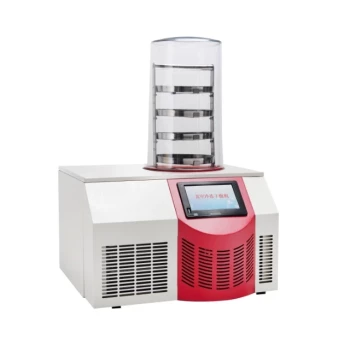
An industrial vacuum drying oven serves a critical preservation function in the molten salt synthesis of Y3Si2C2, specifically during the post-washing phase. Its primary role is to remove residual moisture from the filtered powder by utilizing negative pressure to drastically lower the boiling point of water.
The definitive value of this process is the ability to dry materials at low temperatures (around 50°C). This prevents thermal oxidation, protecting the reactivity of ultrafine powders that would otherwise degrade under standard high-heat drying methods.
The Physics of Preservation
To understand why this equipment is necessary, one must look at how it alters the physical environment of the drying process.
Lowering the Boiling Point
Standard drying relies on heat to evaporate water, typically requiring temperatures at or above 100°C at sea level.
The vacuum oven creates a negative pressure environment. This reduces the vapor pressure required for boiling, allowing water to evaporate rapidly at much lower temperatures.
Efficiency at 50 Degrees Celsius
In the specific context of Y3Si2C2 synthesis, the process allows for effective drying at approximately 50 degrees Celsius.
This moderate temperature is sufficient to remove moisture without subjecting the material to intense thermal stress.
Material Challenges with Y3Si2C2
The nature of the Y3Si2C2 powder dictates the need for this specialized equipment.
Vulnerability of High Surface Area
The synthesis process produces "ultrafine" product powders.
These powders possess a high specific surface area, meaning a large amount of the material's surface is exposed to the environment relative to its volume.
Preventing Thermal Oxidation
High surface area equates to high reactivity. If these powders were dried in a conventional oven at high temperatures, the exposed surfaces would react with residual oxygen, leading to thermal oxidation.
Vacuum drying mitigates this risk by keeping the temperature low and reducing the oxygen content in the chamber.
Impact on Downstream Applications
The role of the vacuum oven extends beyond simple moisture removal; it ensures the material actually works for its intended purpose.
Ensuring Reactivity for Joining
The ultimate goal of synthesizing Y3Si2C2 often involves subsequent joining processes.
By preventing oxidation during the drying phase, the vacuum oven maintains the powder's inherent reactivity, ensuring it performs correctly in later manufacturing steps.
The Risks of Conventional Drying
It is important to understand what happens if this specific tool is substituted with standard equipment.
The High-Temperature Hazard
A standard convection oven would require significantly higher temperatures to achieve the same dryness in a reasonable timeframe.
At those temperatures, the ultrafine Y3Si2C2 powder would likely undergo rapid surface oxidation, rendering the batch impure or unusable.
Loss of Process Control
Without the ability to control pressure, you lose the ability to decouple temperature from evaporation speed.
Vacuum drying provides the precise control needed to balance drying speed with material safety.
Making the Right Choice for Material Quality
When managing the post-processing of molten salt synthesis products, your equipment choice dictates the final quality of the powder.
- If your primary focus is Chemical Purity: Rely on vacuum drying to prevent the formation of unwanted oxides on the particle surface.
- If your primary focus is Material Reactivity: Ensure your process temperature stays near 50°C to preserve the high-energy state of the ultrafine powder for future joining tasks.
By utilizing vacuum negative pressure, you transform a potentially destructive drying step into a process of material preservation.
Summary Table:
| Feature | Industrial Vacuum Drying Oven | Conventional Drying Oven |
|---|---|---|
| Drying Temperature | Low (approx. 50°C) | High (≥ 100°C) |
| Pressure Environment | Negative Pressure (Vacuum) | Atmospheric Pressure |
| Oxidation Risk | Minimal (Low oxygen & temp) | High (Thermal oxidation) |
| Material Impact | Preserves high surface area reactivity | Degrades material via surface oxides |
| Best For | Ultrafine & heat-sensitive powders | Stable, bulk materials |
Maximize Material Purity with KINTEK Precision Solutions
Don't let thermal oxidation compromise your synthesis results. KINTEK specializes in advanced laboratory equipment designed for the most demanding material science applications. Our industrial vacuum drying ovens provide the precise pressure control and temperature uniformity needed to preserve the reactivity of ultrafine powders like Y3Si2C2.
Beyond drying, KINTEK offers a comprehensive range of solutions for your research and production needs, including:
- High-Temperature Furnaces: Muffle, tube, and vacuum furnaces for precise molten salt synthesis.
- Material Processing: Crushing and milling systems, and hydraulic presses for pellet preparation.
- Specialized Reactors: High-temperature high-pressure reactors and autoclaves.
- Lab Essentials: Ceramics, crucibles, and cooling solutions like ULT freezers.
Ready to elevate your lab's efficiency and material quality? Contact our technical experts today to find the perfect equipment for your specific application.
References
- Yu Teng, Qing Huang. Near-seamless joining of Cf/SiC composites using Y3Si2C2 via electric field-assisted sintering technique. DOI: 10.1007/s40145-022-0593-3
This article is also based on technical information from Kintek Solution Knowledge Base .
Related Products
- 56L Vertical Laboratory Vacuum Drying Oven
- 23L Laboratory Vacuum Drying Oven
- Laboratory Scientific Electric Heating Blast Drying Oven
- Benchtop Laboratory Vacuum Freeze Dryer
- Dental Porcelain Zirconia Sintering Ceramic Vacuum Press Furnace
People Also Ask
- Why is a laboratory vacuum drying oven recommended for rice straw residues? Protect Your Biomass Integrity
- What role does a laboratory vacuum drying oven play in the preparation of modified multi-walled carbon nanotubes?
- What is the importance of using a laboratory vacuum drying oven? Preserving Slow-Release Microcapsule Integrity
- Why is a Laboratory Vacuum Drying Oven recommended for PBAT microspheres? Protect Sensitive Polymer Integrity
- What role does a laboratory vacuum drying oven play in processing nanoparticle powder samples? Protect Sample Integrity