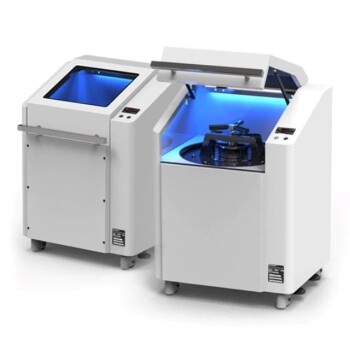
The ultrasonic cleaner acts as the critical final barrier against microscopic contamination before coating deposition. During the pretreatment of magnesium alloys, it utilizes cavitation effects within solvents like acetone and isopropanol to dislodge grease, polishing debris, and impurities that mechanical cleaning cannot reach. This step is essential for creating the pristine surface profile required for advanced coating techniques.
Core Takeaway By generating high-pressure waves through cavitation, ultrasonic cleaning removes microscopic contaminants that compromise adhesion. This ensures the magnesium alloy substrate forms a strong, uniform bond with subsequent Atomic Layer Deposition (ALD) or Physical Vapor Deposition (PVD) layers.
The Mechanism of Decontamination
Cavitation Effects
The cleaner operates by transmitting high-frequency sound waves through a liquid medium. This process creates cavitation bubbles—microscopic voids that form and collapse rapidly.
When these bubbles collapse near the magnesium alloy surface, they generate high-pressure waves. These waves effectively blast away stubborn contaminants, such as grinding debris and microscopic dust particles.
Solvent Synergy
The physical impact of cavitation is combined with the chemical action of specific solvents. For magnesium alloys, acetone and isopropanol are the standard choices.
These solvents dissolve organic contaminants like grease, oils, and residual cutting fluids. Simultaneously, the ultrasonic agitation prevents these dissolved impurities from redepositing on the specimen.
Why Surface Purity is Non-Negotiable
Eliminating Polishing Residue
Magnesium alloys typically undergo mechanical polishing prior to cleaning. This mechanical process inevitably leaves behind microscopic debris and polishing compounds.
Ultrasonic cleaning is necessary to remove these specific residues. Without this deep clean, the "rough" surface needed for mechanical interlocking is actually blocked by loose particulate matter.
Enhancing Bonding Strength
The primary objective of this pretreatment is to secure the success of subsequent coating layers, specifically Atomic Layer Deposition (ALD) or Physical Vapor Deposition (PVD).
A surface free of oils and particles ensures maximum contact area between the substrate and the coating. This directly translates to higher bonding strength and prevents early coating failure.
Facilitating Nucleation
Cleanliness is required for the proper chemical growth of the coating. Surface contaminants can interfere with the nucleation and growth of the oxide layer or coating material.
If the surface is not uniform, the coating may develop pinholes or weak spots where impurities disrupted the deposition process.
Common Pitfalls to Avoid
Incomplete Contaminant Removal
Relying solely on mechanical wiping or rinsing is often insufficient. These methods may remove visible dirt but frequently leave behind thin films of oil or microscopic dust that ultrasonic cavitation would otherwise remove.
Solvent Contamination
While the ultrasonic mechanism is powerful, the quality of the solvent matters. Using dirty or saturated solvents can result in the redistribution of contaminants rather than their removal.
Process Timing
The duration of the cleaning cycle must be sufficient to dislodge stubborn particles. Rushing this stage risks leaving "shadows" of contamination that will lead to localized adhesion failures in the final product.
Making the Right Choice for Your Goal
To ensure your magnesium alloy coatings perform as expected, tailor your cleaning approach to your specific requirements:
- If your primary focus is mechanical durability (PVD/ALD): Prioritize ultrasonic cleaning with acetone to fully remove polishing debris, as this directly correlates to the bonding strength of the final coating.
- If your primary focus is experimental reproducibility: Ensure the use of high-purity isopropanol in the ultrasonic bath to eliminate trace oils and fingerprints that could alter surface chemistry and nucleation patterns.
A coating is only as strong as the surface it bonds to; ultrasonic cleaning ensures that foundation is solid.
Summary Table:
| Feature | Role in Pretreatment | Benefit for Magnesium Alloy |
|---|---|---|
| Mechanism | Ultrasonic Cavitation | Removes microscopic debris & polishing residue |
| Solvents | Acetone & Isopropanol | Dissolves organic grease and prevents redeposition |
| Surface Impact | Deep Decontamination | Creates a pristine profile for mechanical interlocking |
| Coating Result | Nucleation Support | Prevents pinholes and ensures uniform layer growth |
| Bonding | Adhesion Enhancement | Maximizes contact area for superior coating strength |
Elevate Your Coating Quality with KINTEK’s Precision Solutions!
A coating is only as durable as the surface beneath it. At KINTEK, we understand that for magnesium alloy substrates, achieving the perfect bond requires more than just standard cleaning. Our specialized laboratory equipment—from advanced ultrasonic cleaners and cooling solutions to high-performance PVD/CVD systems and high-temperature furnaces—is designed to meet the rigorous demands of material science.
Whether you are focusing on Atomic Layer Deposition (ALD), battery research, or complex metallurgical crushing and milling, KINTEK provides the high-quality consumables (PTFE, ceramics, and crucibles) and precision tools you need to ensure experimental reproducibility and maximum bonding strength.
Ready to optimize your pretreatment and deposition workflow? Contact our technical experts today to discover how our comprehensive range of lab equipment can drive your research success!
References
- Marcin Staszuk, Antonín Kříž. Investigations of TiO₂, Ti/TiO₂, and Ti/TiO₂/Ti/TiO₂ coatings produced by ALD and PVD methods on Mg-(Li)-Al-RE alloys substrates. DOI: 10.24425/bpasts.2021.137549
This article is also based on technical information from Kintek Solution Knowledge Base .
Related Products
- Laboratory Sterilizer Lab Autoclave Pulsating Vacuum Desktop Steam Sterilizer
- Laboratory Oscillating Orbital Shaker
- Custom PTFE Teflon Parts Manufacturer Corrosion Resistant Cleaning Rack Flower Basket
- Laboratory Scientific Electric Heating Blast Drying Oven
- Portable High Pressure Laboratory Autoclave Steam Sterilizer for Lab Use
People Also Ask
- What is the primary function of a laboratory sterilization autoclave? Master the Physics of Wet Heat Sterilization
- In what industries and applications are steam sterilizers or autoclaves used? Discover Key Uses Across 4 Major Sectors
- What precautions should be taken during autoclave in laboratory? A Complete Safety Guide to Prevent Burns and Explosions
- What extreme conditions does a laboratory autoclave simulate? Testing Wear Resistance of Nuclear Fuel Cladding
- What role does a laboratory autoclave play in HEA corrosion research? Key to Validating Advanced Reactor Materials