Heating and mixing equipment acts as the critical enabler for creating Polymer-in-Salt electrolytes, facilitating the transformation of raw materials into a functional ionic conductor. This hardware heats high concentrations of lithium salts and specific polymers to a molten state, overcoming the natural solubility limits that exist at lower temperatures.
By maintaining high temperatures during the mixing process, the equipment forces lithium salts to dissolve completely within the polymer matrix. This creates a highly conductive, amorphous complex that retains its performance properties even after cooling to room temperature.
The Mechanism of Material Transformation
Achieving the Molten State
To create a Polymer-in-Salt system, you are dealing with high concentrations of lithium salts and only small amounts of polymer.
At room temperature, these components remain separate solids. The heating equipment raises the temperature sufficiently to transition both materials into a molten phase, creating a unified fluid medium required for chemical interaction.
Forcing High Solubility
Standard mixing cannot achieve the saturation levels required for these electrolytes.
By mixing at elevated temperatures, the equipment increases the solubility limit of the polymer. This allows the polymer matrix to absorb a significantly higher volume of lithium salt than would be possible under standard conditions.
Structural Impact on the Electrolyte
Disrupting Crystallinity
The primary adversary of ionic conductivity in solid polymers is crystallinity. Crystalline regions generally block the movement of ions.
The combination of heat and shear force during mixing disrupts these crystalline regions. This mechanical and thermal intervention prevents the materials from reverting to an ordered, crystalline structure as they interact.
Forming an Amorphous Complex
The output of this process is an amorphous complex.
Because the crystalline structure has been broken down, the resulting material becomes a "decoupled" solid-state electrolyte. This decoupled structure is essential, as it allows for high ionic conductivity at room temperature, distinct from the polymer's mechanical segmentation.
Understanding the Process Dynamics
The Necessity of Uniformity
The mixing component is just as vital as the heating element.
Without vigorous mixing at high heat, the salt would not disperse uniformly. This would lead to localized "hotspots" of salt concentration or recrystallization, destroying the conductive properties of the final material.
Temperature-Dependent Solubility
The process relies on the principle that solubility increases with heat.
The equipment must maintain a precise thermal window. If the temperature drops too early during mixing, the salt may precipitate out of the polymer matrix before the amorphous complex is fully established.
Making the Right Choice for Your Goal
If your primary focus is maximizing ionic conductivity:
- Ensure your equipment can reach and sustain temperatures high enough to fully melt the salt-polymer blend, as incomplete melting preserves crystalline regions that impede ion flow.
If your primary focus is material stability:
- Prioritize mixing capabilities that ensure total homogeneity, as this stabilizes the high-salt concentration within the amorphous complex and prevents phase separation.
The effectiveness of a Polymer-in-Salt electrolyte is ultimately defined by the equipment's ability to lock a high-temperature disordered state into a room-temperature solid.
Summary Table:
| Feature | Role in Electrolyte Development | Impact on Material Properties |
|---|---|---|
| High-Temp Heating | Transitions salts and polymers to a molten state | Overcomes solubility limits; enables salt-polymer interaction |
| Vigorous Mixing | Ensures uniform dispersion of high salt concentrations | Prevents localized hotspots and salt recrystallization |
| Thermal Precision | Maintains a specific thermal window during synthesis | Prevents salt precipitation and ensures stable amorphous complexes |
| Shear Force | Disrupts crystalline regions in the polymer matrix | Enhances ionic conductivity by creating decoupled structures |
Elevate Your Battery Research with KINTEK Precision Solutions
Accelerate your development of high-performance Polymer-in-Salt electrolytes with KINTEK’s advanced laboratory equipment. Whether you require precise thermal control from our high-temperature muffle or vacuum furnaces, or superior material homogeneity via our crushing, milling, and specialized mixing systems, we provide the tools necessary to achieve maximum ionic conductivity and structural stability.
From battery research tools and consumables to high-pressure reactors and electrolytic cells, KINTEK specializes in empowering researchers to bridge the gap between material theory and functional solid-state performance.
Ready to optimize your electrolyte synthesis? Contact our technical experts today to discover how our comprehensive range of equipment can transform your laboratory's capabilities.
Related Products
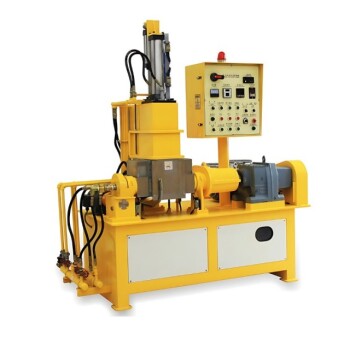
- Lab Internal Rubber Mixer Rubber Kneader Machine for Mixing and Kneading
- Heated Hydraulic Press Machine with Heated Plates for Vacuum Box Laboratory Hot Press
- Heated Hydraulic Press Machine with Integrated Manual Heated Plates for Lab Use
- Automatic Heated Hydraulic Press Machine with Heated Plates for Laboratory Hot Press 25T 30T 50T
- Heated Hydraulic Press Machine with Heated Plates for Vacuum Box Laboratory Hot Press
People Also Ask
- What does a rubber mixer do? Transform Raw Ingredients into a High-Performance Compound
- What is a laboratory mixer? A Guide to Achieving Perfect Sample Homogeneity
- What is a laboratory mixer used for? Choose the Right Tool for Liquids or Solids
- What is the process of mixing rubber compounds? A Guide to Creating Uniform, High-Performance Materials
- What are the different types of internal mixers? Choose Between Tangential & Intermeshing Rotors