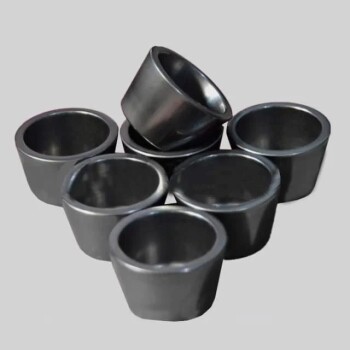
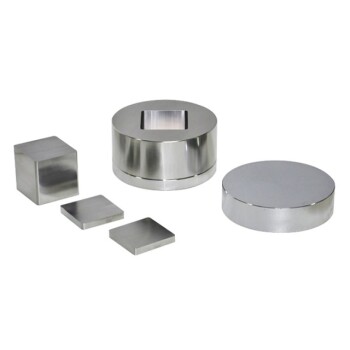
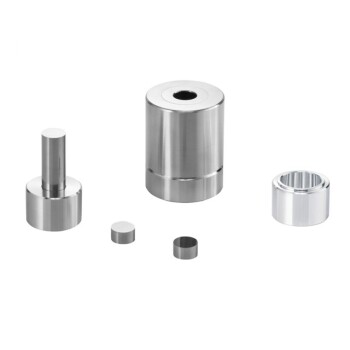
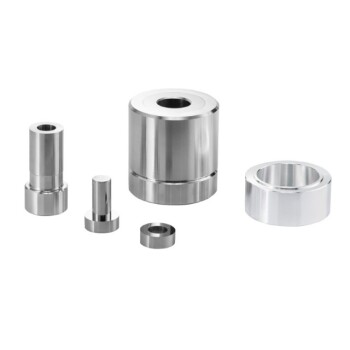
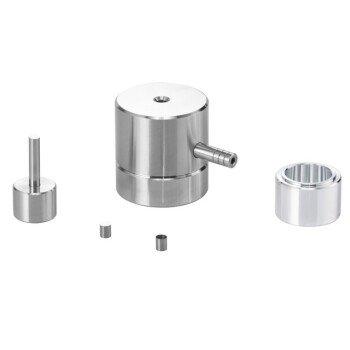
High-purity graphite molds are the critical interface between raw potential and structural reality. In the hot-pressing synthesis of MAX phase materials, these molds perform a dual function: they serve as the precise container for raw material powders and act as the primary medium for transmitting uniaxial pressure, typically up to 50 MPa. By leveraging graphite’s high-temperature mechanical strength and electrical conductivity, the molds ensure that both pressure and heat are distributed uniformly, enabling the transformation of loose powder into a fully dense solid.
Core Takeaway Graphite molds are not passive vessels; they are active participants in the material synthesis. Their ability to maintain structural integrity under high heat and pressure allows for the precise particle diffusion and rearrangement required to achieve complete densification and specific microstructural orientations in MAX phase materials.
The Mechanics of Densification
Acting as a Pressure Transmission Medium
The primary mechanical role of the graphite mold is to convert hydraulic force into direct physical compaction.
The mold applies uniaxial pressure—often reaching 50 MPa—directly to the powder. This pressure is essential for overcoming the friction between particles and forcing them into a cohesive state.
Facilitating Particle Rearrangement
The combination of confinement and pressure drives the physical evolution of the material.
Under this sustained load, the powder particles undergo diffusion and rearrangement. This movement eliminates voids between particles, which is the fundamental mechanism for achieving high density in the final product.
Thermal and Electrical Dynamics
Ensuring Uniform Heat Distribution
Temperature gradients are the enemy of consistent material properties.
Graphite’s excellent thermal conductivity ensures that heat is transferred evenly throughout the powder volume. This prevents localized hot spots or cold zones, ensuring the entire sample sinters at the same rate.
The Role of Electrical Conductivity
In many hot-pressing setups, particularly those involving direct current or induction, the mold itself is part of the heating circuit.
The high electrical conductivity of high-purity graphite allows it to facilitate efficient energy transfer. This aids in maintaining precise temperature control during the critical phases of synthesis.
Impact on Microstructure
Achieving Complete Densification
The ultimate goal of using high-purity graphite is to produce a void-free material.
By maintaining pressure and temperature stability, the mold enables the material to reach complete densification. This maximizes the mechanical and physical properties of the resulting MAX phase material.
Developing Preferred Orientations
MAX phase materials often require a specific grain alignment to maximize their performance.
The uniaxial pressure applied by the graphite mold helps induce preferred orientations within the microstructure. This texture development is critical for tailoring the anisotropic properties (directional strength or conductivity) of the material.
Understanding the Limitations
Pressure Constraints
While high-purity graphite is strong, it is not indestructible.
There is a physical limit to the pressure graphite can withstand without deforming or fracturing, typically around the 50 to 100 MPa range depending on the grade. Exceeding this limit to force higher density can result in mold failure and sample contamination.
Environmental Sensitivity
Graphite is susceptible to oxidation at high temperatures if exposed to air.
To ensure the longevity of the mold and the purity of the MAX phase material, the process generally requires a protective atmosphere or vacuum. Without this, the mold may degrade rapidly, altering dimensions and introducing impurities.
Making the Right Choice for Your Goal
To optimize your synthesis of MAX phase materials, consider how the mold interacts with your specific objectives:
- If your primary focus is Maximum Density: Ensure your graphite grade can withstand sustained pressures of 50 MPa or higher without creep deformation to eliminate all porosity.
- If your primary focus is Microstructural Texture: Prioritize molds with exceptional thermal uniformity to ensure the uniaxial pressure creates consistent grain alignment across the entire sample.
The success of your synthesis relies not just on the raw powder, but on the stability and conductivity of the mold that shapes it.
Summary Table:
| Feature | Role in MAX Phase Synthesis | Benefit |
|---|---|---|
| Pressure Transmission | Applies uniaxial pressure up to 50 MPa | Drives particle rearrangement and eliminates voids |
| Thermal Conductivity | Even heat distribution across powder volume | Prevents localized hot spots and ensures uniform sintering |
| Electrical Conductivity | Facilitates energy transfer in heating circuits | Enables precise temperature control during synthesis |
| Structural Integrity | Maintains shape under high temperature/load | Induces preferred grain orientation and microstructural texture |
| Material Purity | High-purity graphite composition | Minimizes sample contamination during high-heat processing |
Elevate Your Material Research with KINTEK
Precision in MAX phase synthesis starts with superior equipment. KINTEK specializes in providing the high-performance laboratory solutions you need to achieve complete densification and optimal microstructural alignment.
From high-purity graphite molds and crucibles to advanced high-temperature vacuum furnaces and hydraulic presses, our comprehensive range of tools is designed to withstand the rigors of 50+ MPa hot-pressing and extreme thermal environments. Whether you are developing battery materials, advanced ceramics, or aerospace components, our expertise in high-temperature, high-pressure systems ensures your research is backed by reliability.
Ready to optimize your synthesis process? Contact KINTEK today to discuss your laboratory equipment needs and discover how our tailored solutions can enhance your results.
References
- Jesús González‐Julián. Processing of MAX phases: From synthesis to applications. DOI: 10.1111/jace.17544
This article is also based on technical information from Kintek Solution Knowledge Base .
Related Products
- High Purity Pure Graphite Crucible for Evaporation
- High Purity Pure Graphite Crucible for Electron Beam Evaporation
- Ultra-High Temperature Graphite Vacuum Graphitization Furnace
- Horizontal High Temperature Graphite Vacuum Graphitization Furnace
- Vertical High Temperature Graphite Vacuum Graphitization Furnace
People Also Ask
- Why are high-purity graphite crucibles preferred for sulfide solid electrolytes? Achieve Superior Material Purity
- Why is a high-purity graphite crucible required for Chromel-TaC composites? Ensure Peak Purity at 1400°C
- What role do high-purity graphite crucibles play in molten salt corrosion research? Ensure Reactor-Grade Precision
- Why are high-purity graphite crucibles used for magnesium distillation? Ensure 3N8 Purity & Thermal Stability
- Why is a high-purity graphite crucible ideal for nitrogen-doped graphene at 1500 °C? Maximize Purity and Stability