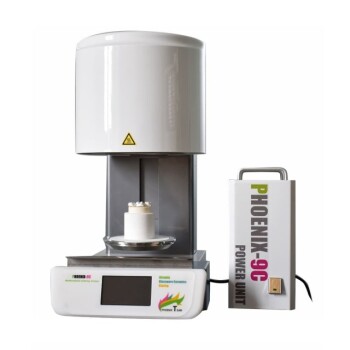
Spark Plasma Sintering (SPS) furnaces play a definitive role in the fabrication of biomedical alloys like Ti-Nb-Zr by utilizing pulsed electric currents and synchronous axial pressure to achieve rapid material consolidation.
This technology is specifically employed to overcome the diffusion barriers of refractory elements like Niobium, ensuring high-density, chemically uniform implant materials without the structural degradation associated with prolonged exposure to heat.
Core Insight: The primary value of the SPS furnace lies in its ability to decouple densification from grain growth. By achieving full density rapidly at high temperatures (1300–1500°C), it preserves the fine-grained, stable beta-phase structure required for high-strength, low-modulus orthopedic implants.
Overcoming Diffusion Barriers in Ti-Nb-Zr
Accelerating Refractory Element Diffusion
In titanium alloys, elements like Niobium (Nb) are critical for biocompatibility but possess inherently slow diffusion rates.
SPS furnaces utilize the plasma effect induced by pulsed currents to generate an intense, high-energy sintering environment.
This accelerates atomic diffusion, forcing the difficult-to-diffuse Niobium into the titanium matrix much faster than traditional thermal methods.
Achieving Chemical Homogeneity
For a biomedical implant to function reliably, its chemical composition must be uniform throughout the part.
The combination of Joule heat and axial pressure ensures that the alloying elements are evenly distributed.
This eliminates segregation, resulting in a chemically homogeneous material essential for consistent biological interaction.
Controlling Microstructure for Performance
Inhibiting Grain Growth
Traditional sintering often requires long "dwell times" at high heat, which causes metal grains to coarsen and weaken the material.
SPS furnaces achieve rapid heating rates and short holding times, which allows for densification before grains have time to grow abnormally.
This preservation of a fine-grained structure is directly linked to superior mechanical durability.
Stabilizing the Beta Phase
The specific goal for Ti-Nb-Zr alloys is to achieve a stable "beta-phase" structure.
By precisely regulating sintering temperatures and cooling rates, SPS locks this phase into place.
This is critical because the beta phase provides the low elastic modulus needed to mimic human bone, reducing the risk of stress shielding (bone loss around the implant).
Mechanical Outcomes and Densification
Rapid Densification Under Pressure
SPS utilizes uniaxial pressure simultaneously with temperatures ranging from 1300°C to 1500°C.
This synchronous application of force and heat facilitates nearly full densification of the raw powders in a very short timeframe.
Achieving Superior Strength Metrics
The result of this controlled process is an alloy that balances flexibility with extreme durability.
Ti-Nb-Zr alloys processed via SPS exhibit a low elastic modulus while maintaining tensile strength exceeding 900 MPa.
Critical Process Considerations
Precision Parameter Control
While SPS offers superior properties, the outcome is highly sensitive to process parameters.
Operators must precisely regulate cooling rates to ensure the beta phase is retained; improper cooling can alter the local phase composition.
Managing High-Energy Inputs
The process relies on high-current pulses to generate internal Joule heating.
This requires rigorous control over the electrical input to prevent overheating or localized melting, which could compromise the chemical uniformity of the alloy.
Making the Right Choice for Your Goal
When evaluating SPS for biomedical alloy production, consider your specific performance targets:
- If your primary focus is Biocompatibility (Bone Matching): Leverage the SPS capability to stabilize the beta phase, which ensures the low elastic modulus necessary to prevent bone degradation.
- If your primary focus is Structural Integrity: Rely on the rapid densification and grain growth inhibition of SPS to achieve mechanical strengths exceeding 900 MPa.
SPS converts the theoretical potential of Ti-Nb-Zr powders into practical, high-performance medical reality through precise kinetic control.
Summary Table:
| Feature | Spark Plasma Sintering (SPS) Benefit | Impact on Ti-Nb-Zr Alloy |
|---|---|---|
| Sintering Time | Rapid heating & short holding times | Inhibits grain growth; preserves fine-grained structure |
| Diffusion Rate | Plasma effect & pulsed current | Overcomes Nb diffusion barriers for chemical homogeneity |
| Microstructure | Precise phase stabilization | Locks in 'beta-phase' for low elastic modulus (bone-mimic) |
| Mechanicals | Synchronous heat & axial pressure | Achieves >900 MPa tensile strength with full densification |
Elevate Your Advanced Material Research with KINTEK
Precision is non-negotiable when fabricating next-generation biomedical implants. KINTEK provides industry-leading Spark Plasma Sintering (SPS) furnaces and specialized laboratory equipment—including high-temperature furnaces, hydraulic presses, and crushing systems—designed to meet the rigorous demands of titanium alloy development.
Whether you are stabilizing beta-phase structures or optimizing refractory element diffusion, our technical experts are ready to provide the high-performance solutions your lab requires. Contact KINTEK today to discuss your project and request a quote.
References
- Svitlana Goncharova, Alexander Pogrebnyak. Structural features and practical application of films of transition metal carbidonitrides. DOI: 10.21175/rad.abstr.book.2023.19.19
This article is also based on technical information from Kintek Solution Knowledge Base .
Related Products
- Spark Plasma Sintering Furnace SPS Furnace
- Vacuum Heat Treat and Pressure Sintering Furnace for High Temperature Applications
- Small Vacuum Heat Treat and Tungsten Wire Sintering Furnace
- Vacuum Heat Treat and Sintering Furnace with 9MPa Air Pressure
- Dental Porcelain Zirconia Sintering Ceramic Vacuum Press Furnace
People Also Ask
- What is SPS sintering method? A Guide to High-Speed, High-Performance Material Fabrication
- Why are Spark Plasma Sintering (SPS) furnaces or hot presses utilized in the preparation of Li3PS4 solid electrolytes?
- What is the difference between spark plasma sintering and flash sintering? A Guide to Advanced Sintering Methods
- What technical advantages does a Spark Plasma Sintering (SPS) furnace offer for LZP ceramics? Enhance Ionic Conductivity
- What is the theory of spark plasma sintering? A Guide to Rapid, Low-Temperature Densification