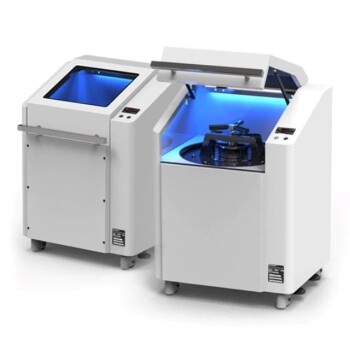
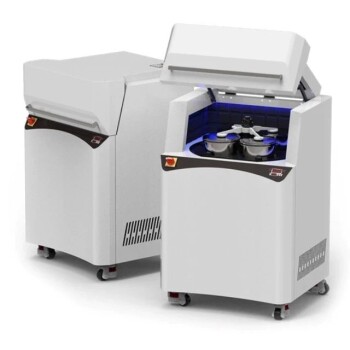
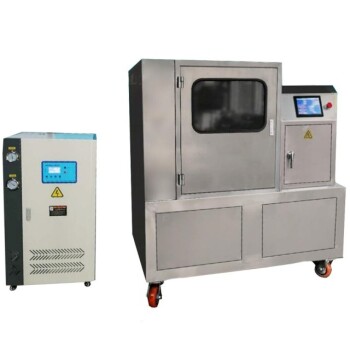
Processing waste windshield glass with a vibratory ring mill is the fundamental step required to unlock the chemical reactivity needed for silicon carbide (SiC) synthesis. This equipment utilizes high-frequency vibration to pulverize glass into an ultra-fine powder, drastically increasing its specific surface area. By breaking down the macroscopic structure of the glass, the mill reduces the kinetic barriers of the carbothermal reduction reaction, allowing the silica to react efficiently with carbon sources.
The vibratory ring mill serves as a mechanical activator that converts inert waste glass into a high-energy, ultra-fine precursor. This transformation is essential for lowering the energy requirements and improving the uniformity of the silicon carbide synthesis process.
The Mechanics of Ultra-Fine Pulverization
High-Frequency Impact and Friction
The vibratory ring mill operates by generating intense impact and friction forces through high-frequency oscillations. These forces are far more effective at shattering the rigid, macroscopic structure of windshield glass than traditional tumbling mills.
Achieving Sub-150 Micron Particle Sizes
This milling process rapidly converts large glass fragments into a fine powder, typically smaller than 150 microns. Reducing the particle size to this level is critical for ensuring the material can be processed effectively in subsequent thermal stages.
Increasing Specific Surface Area
As the glass is pulverized, its specific surface area increases exponentially. A higher surface area provides more contact points between the silica in the glass and the carbon reactants, which is a prerequisite for a successful chemical synthesis.
Enhancing Chemical Reactivity for SiC Synthesis
Reducing Kinetic Barriers
In its macroscopic state, glass is chemically stable and resistant to reaction; however, the "ultra-fine treatment" creates a highly active powder form. This active state lowers the kinetic energy threshold required to initiate the carbothermal reduction process used to create SiC.
Promoting Liquid Phase Formation
During the sintering process, the ultra-fine glass powder acts as a fluxing agent at lower temperatures. This promotes the formation of a liquid phase, which is necessary for the uniform distribution of materials and the eventual densification of the aggregate particles.
Improving Matrix Distribution
The fine nature of the powder allows it to be distributed more uniformly within a fly ash or carbon matrix. This homogeneity ensures that the synthesis reaction occurs consistently throughout the entire volume of the material, rather than in isolated pockets.
Understanding the Trade-offs
Equipment Wear and Contamination
The intense friction and impact required to pulverize glass can lead to significant wear on the grinding rings and pucks. This wear can introduce small amounts of metallic impurities into the glass powder, which may affect the purity of the final silicon carbide.
Energy Intensity vs. Particle Size
While achieving ultra-fine particles is beneficial for reactivity, the energy consumption of a vibratory ring mill increases as the target particle size decreases. There is often a point of diminishing returns where additional milling time provides negligible improvements in reaction kinetics relative to the power consumed.
Heat Generation
High-frequency milling generates substantial localized heat within the grinding chamber. If not monitored, this heat can cause the glass powder to become "sticky" or agglomerate, potentially counteracting the surface area gains achieved by the pulverization.
Making the Right Choice for Your Goal
How to Apply This to Your Project
- If your primary focus is maximizing reaction efficiency: Prioritize longer milling cycles to achieve the smallest possible particle size, thereby minimizing the kinetic barriers for carbothermal reduction.
- If your primary focus is material density and strength: Ensure the glass is milled fine enough to act as an effective fluxing agent, promoting the liquid phase formation necessary for structural densification.
- If your primary focus is high-purity SiC production: Select grinding media made of materials that are either chemically compatible with SiC or highly resistant to abrasion to minimize contamination.
The vibratory ring mill is the essential bridge between discarded waste glass and high-performance silicon carbide, providing the mechanical activation necessary for advanced chemical synthesis.
Summary Table:
| Key Feature | Impact on SiC Synthesis | Benefit for Researchers |
|---|---|---|
| Ultra-Fine Pulverization | Achieves sub-150 micron particle size. | Increases contact points for carbothermal reduction. |
| Mechanical Activation | Lowers kinetic energy barriers. | Reduces temperature/energy requirements for reaction. |
| Surface Area Increase | Exponentially expands specific surface area. | Ensures uniform reaction and faster kinetics. |
| Fluxing Action | Promotes liquid phase formation. | Enhances material densification and matrix distribution. |
Elevate Your Material Synthesis with KINTEK Precision
To transform waste glass into high-performance silicon carbide, you need more than just equipment—you need precision. KINTEK specializes in advanced laboratory solutions, offering high-frequency vibratory ring mills and crushing systems specifically engineered to achieve the ultra-fine particle sizes required for chemical activation.
Whether you are focusing on maximizing reaction efficiency or structural densification, our comprehensive portfolio supports your entire workflow:
- Milling & Sieving: Achieve perfect sub-150 micron powders with our high-durability pucks and rings.
- Thermal Processing: High-temperature furnaces (muffle, vacuum, and atmosphere) for precise carbothermal reduction.
- Material Shaping: Hydraulic pellet presses for consistent aggregate formation.
- Quality Consumables: High-purity ceramics and crucibles to minimize metallic contamination.
Ready to optimize your SiC synthesis process? Contact our technical team today for a tailored equipment consultation and discover how KINTEK can bring reliability to your research.
References
- Sepideh Hemati, Veena Sahajwalla. Degradation Kinetics of Automotive Shredder Residue and Waste Automotive Glass for SiC Synthesis: An Energy-Efficient Approach. DOI: 10.3390/cryst13081183
This article is also based on technical information from Kintek Solution Knowledge Base .
Related Products
- Vibrating Disc Mill Small Laboratory Grinding Machine
- Laboratory Disc Cup Vibratory Mill for Sample Grinding
- Disc Cup Vibrating Mill Multi-Platform for Lab
- Lab Vibration Mill
- Low-Temperature Water-Cooled Touchscreen Vibratory Ultrafine Pulverizer
People Also Ask
- What role do disc mills play in the wet or dry pretreatment of lignocellulosic waste? Scalable Biomass Solutions
- What is the function of a laboratory grinding mill? Achieve Precise Sample Preparation for Accurate Results
- What is the function of an industrial vibratory mill? Optimize Fe-Cr-Al Alloy Powder Production
- What laboratory apparatus is used for grinding? Match the Right Mill to Your Sample Material
- Why use stainless steel jars and balls for solid-state battery slurries? Maximize Dispersion and Conductivity