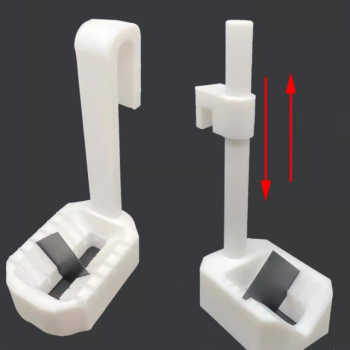
Quartz glass sample holders function as precision instruments designed to maintain specific geometric alignment and chemical neutrality within high-temperature environments. Their primary role is to secure alloy specimens, such as N10276, ensuring their surfaces remain strictly parallel to the direction of gas flow. This configuration is essential for replicating the aerodynamic and kinetic stresses found in real-world industrial applications.
Core Insight By forcing a parallel alignment between the specimen and the gas stream, quartz holders allow researchers to simulate the specific kinetic phenomenon of "gas scrubbing" found in industrial reactors. This ensures that corrosion rate data reflects actual operational wear rather than random turbulence or static exposure.
Simulating Industrial Kinetic Conditions
Precision Specimen Alignment
The most critical function of the quartz holder is geometric control. In a tube furnace, the positioning of the sample dictates how the corrosive environment interacts with the metal.
The holder ensures the specimen does not tilt or rotate. It maintains the material surfaces parallel to the gas flow direction.
Replicating Gas Scrubbing
Industrial reactors subjects metals to high-velocity gases that "scrub" surfaces. Static tests cannot replicate this physical wear.
By maintaining parallel alignment, the holder allows the gas to flow across the surface with realistic kinetic energy. This is vital for analyzing chemical composition distribution and understanding how flow dynamics influence corrosion rates.
Preserving Data Integrity
Chemical Inertness
Corrosion studies rely on measuring minute changes in mass and composition. The sample holder must effectively be invisible to the experiment.
Quartz glass is utilized because of its high resistance to corrosion. It does not react with the alloy sample or the corrosive gases, ensuring that the holder does not introduce foreign elements into the reaction.
Eliminating Cross-Contamination
In high-temperature environments, materials often migrate or diffuse. A reactive holder could skew mass loss data by absorbing material or releasing impurities.
Quartz provides a stable barrier. This isolation guarantees that any measured corrosion products are the result of the interaction between the gas and the alloy, ensuring the accuracy of kinetic data.
Understanding the Limitations
Material Compatibility
While quartz is highly inert, it is not universally indestructible. It is essential to verify that the test temperature does not exceed the glass's softening point or devitrification threshold.
Mechanical Fragility
Quartz provides excellent thermal stability but lacks mechanical toughness. The holders are brittle and require careful handling during the loading of heavy alloy specimens to avoid micro-fractures that could fail under thermal stress.
Making the Right Choice for Your Experiment
To ensure your corrosion study yields valid, industrial-grade data, align your equipment choice with your specific analytical goals:
- If your primary focus is kinetic simulation: Ensure the holder design rigidly locks the specimen parallel to the gas vector to accurately mimic industrial gas scrubbing.
- If your primary focus is chemical purity: Verify the quartz grade is of sufficient purity to prevent trace element diffusion into the alloy at your target temperature.
The integrity of your corrosion data depends as much on the inert stability of the holder as it does on the precision of the furnace.
Summary Table:
| Function | Key Benefit | Technical Importance |
|---|---|---|
| Geometric Alignment | Parallel to gas flow | Simulates industrial "gas scrubbing" kinetics |
| Chemical Inertness | Non-reactive material | Prevents cross-contamination and data skewing |
| Thermal Stability | High heat resistance | Maintains integrity in tube furnace environments |
| Data Integrity | Accurate mass loss | Ensures corrosion products are sample-specific |
Elevate Your Research Precision with KINTEK
To achieve industrial-grade accuracy in your corrosion studies, you need more than just a furnace; you need the right technical peripherals. KINTEK specializes in high-performance laboratory equipment and consumables designed for the most demanding thermal environments.
Whether you are conducting advanced material synthesis with our CVD and PECVD systems, performing precise sample preparation with our crushing and milling systems, or requiring high-purity quartz and ceramic consumables, we provide the tools that guarantee data integrity.
Unlock superior kinetic simulations today. Contact our specialists at KINTEK to find the perfect high-temperature solution for your laboratory.
References
- Manuela Nimmervoll, Roland Haubner. Corrosion of N10276 in a H2S, HCl, and CO2 Containing Atmosphere at 480 °C and 680 °C. DOI: 10.3390/met11111817
This article is also based on technical information from Kintek Solution Knowledge Base .
Related Products
- High Temperature Resistant Optical Quartz Glass Sheet
- 1200℃ Split Tube Furnace with Quartz Tube Laboratory Tubular Furnace
- 1700℃ Laboratory High Temperature Tube Furnace with Alumina Tube
- 1400℃ Laboratory High Temperature Tube Furnace with Alumina Tube
- Carbon Graphite Boat -Laboratory Tube Furnace with Cover
People Also Ask
- What is the high temperature of quartz? Key Thresholds for Crystalline vs. Fused Silica
- What is high temperature quartz? A Guide to Unmatched Thermal Stability & Purity
- What is the high temperature variety of quartz? Unlock the Secrets of Beta-Quartz & Fused Quartz
- Which materials are used as high temperature resistance materials? A Guide to Superalloys, Ceramics & Composites
- What is optical quartz? The Ultimate Material for UV and High-Temp Optics