Knowledge Resources What is the temperature and time for ashing? Achieve Accurate Results with the Right Parameters
Author avatar

Tech Team · Kintek Solution

Updated 3 months ago

What is the temperature and time for ashing? Achieve Accurate Results with the Right Parameters


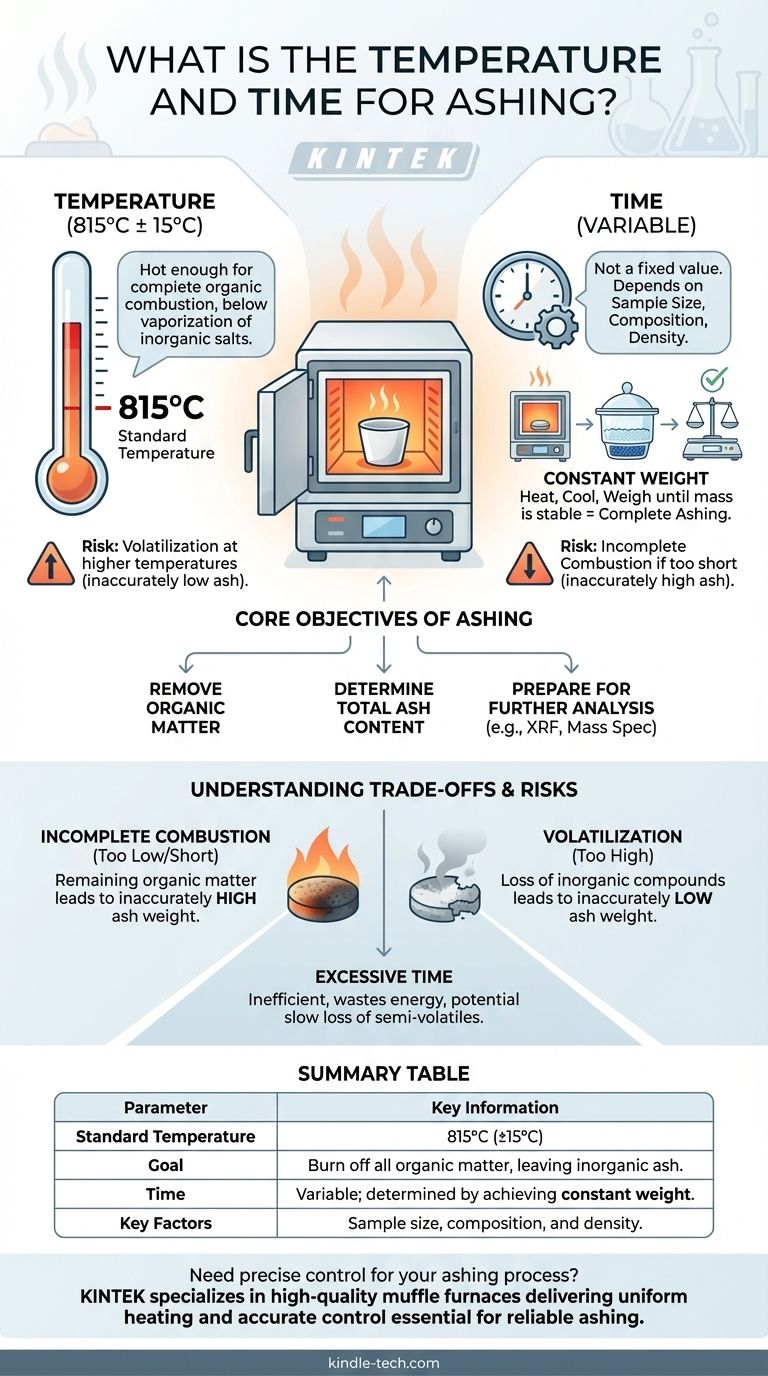
The standard temperature for ashing is typically specified at 815°C with a tolerance of ±15°C. The required time, however, is not a fixed value. It is the duration needed to ensure the sample is completely ashed, meaning all organic material has been burned away.

The objective of ashing is to achieve complete combustion of organic matter, leaving only inorganic residue. Therefore, the correct time and temperature are not universal constants but are the specific conditions required to achieve this goal without altering the inorganic components you intend to measure.
What is the temperature and time for ashing? Achieve Accurate Results with the Right Parameters

The Core Objective of Ashing

To correctly determine the time and temperature, you must first understand the purpose of your procedure. The process is designed to isolate the inorganic, non-combustible part of a sample.

Removing All Organic Matter

The fundamental goal is to use high heat in the presence of oxygen to burn off all carbon-based organic material, such as proteins, fats, and carbohydrates. What remains is the ash.

Determining Total Ash Content

One of the most common applications is gravimetric analysis, where you measure the total mass of the residual ash. This value represents the total mineral content of the original sample.

Preparing for Further Analysis

Often, the ash itself is the material of interest. It is collected and prepared for subsequent tests like X-ray fluorescence (XRF) or mass spectroscopy to characterize its specific inorganic components.

Key Factors Influencing Time and Temperature

The standard temperature is a reliable starting point, but achieving complete ashing requires careful consideration of several variables.

The Role of Temperature (815°C)

The specified temperature of 815±15°C is a critical balance. It is hot enough to ensure the thorough and efficient combustion of organic compounds.

However, it is generally kept below temperatures where certain inorganic salts might begin to vaporize or decompose, which would result in an inaccurate, artificially low measurement.

Why Time is Variable

There is no universal time for ashing because the duration depends entirely on the sample. Key factors include the sample's size, its composition, and its density.

A large, dense sample with a high organic content will naturally require a longer time in the furnace than a small, porous sample.

The Concept of "Constant Weight"

The only reliable way to know if ashing is complete is to heat the sample until it reaches a constant weight.

The procedure involves heating for a set period, cooling the sample in a desiccator to prevent moisture absorption, and weighing it. This process is repeated until two consecutive weighings show no change, indicating all combustible material is gone.

Understanding the Trade-offs and Risks

Applying the wrong parameters can compromise your results. Understanding the potential pitfalls is essential for accuracy.

Risk of Incomplete Combustion

If the temperature is too low or the time is too short, traces of organic material may remain. This will lead to an inaccurately high ash weight.

Risk of Volatilization

If the temperature is too high, you risk the loss of volatile inorganic compounds, such as chlorides and sulfates. This leads to an inaccurately low ash weight and compromises any further elemental analysis.

The Problem with Excessive Time

While ensuring completeness is vital, arbitrarily prolonging the ashing time is inefficient. It consumes unnecessary energy and, for certain materials, may still lead to the slow loss of semi-volatile components, even at the correct temperature.

How to Determine the Right Parameters for Your Sample

Your specific analytical goal should guide your methodology.

  • If your primary focus is determining total ash content: Your objective is to heat the sample until it reaches a constant weight, confirming all organic matter has been eliminated.
  • If your primary focus is preparing samples for elemental analysis: You must strictly adhere to the validated method's temperature (e.g., 815°C) to prevent the loss of the specific inorganic elements you intend to measure.

Ultimately, successful ashing depends on understanding your specific sample and analytical goal, not just on following a fixed number.

Summary Table:

Parameter Key Information
Standard Temperature 815°C (±15°C)
Goal Burn off all organic matter, leaving inorganic ash.
Time Variable; determined by achieving constant weight.
Key Factors Sample size, composition, and density.

Need precise control for your ashing process? KINTEK specializes in high-quality laboratory muffle furnaces that deliver the uniform heating and accurate temperature control (like 815°C) essential for reliable ashing and sample preparation. Our equipment helps your lab avoid incomplete combustion or volatilization, ensuring the integrity of your results for gravimetric analysis or subsequent elemental testing. Contact us today to find the perfect furnace for your laboratory's needs!

Contact our experts for a consultation

Visual Guide
What is the temperature and time for ashing? Achieve Accurate Results with the Right Parameters Visual Guide

Related Products

People Also Ask

Related Products

High Temperature Muffle Oven Furnace for Laboratory Debinding and Pre Sintering

High Temperature Muffle Oven Furnace for Laboratory Debinding and Pre Sintering

KT-MD High temperature debinding and pre-sintering furnace for ceramic materials with various molding processes. Ideal for electronic components such as MLCC and NFC.

Graphite Vacuum Furnace High Thermal Conductivity Film Graphitization Furnace

Graphite Vacuum Furnace High Thermal Conductivity Film Graphitization Furnace

The high thermal conductivity film graphitization furnace has uniform temperature, low energy consumption and can operate continuously.

Ultra-High Temperature Graphite Vacuum Graphitization Furnace

Ultra-High Temperature Graphite Vacuum Graphitization Furnace

The ultra-high temperature graphitization furnace utilizes medium frequency induction heating in a vacuum or inert gas environment. The induction coil generates an alternating magnetic field, inducing eddy currents in the graphite crucible, which heats up and radiates heat to the workpiece, bringing it to the desired temperature. This furnace is primarily used for graphitization and sintering of carbon materials, carbon fiber materials, and other composite materials.

Vertical High Temperature Graphite Vacuum Graphitization Furnace

Vertical High Temperature Graphite Vacuum Graphitization Furnace

Vertical high temperature graphitization furnace for carbonization and graphitization of carbon materials up to 3100℃.Suitable for shaped graphitization of carbon fiber filaments and other materials sintered in a carbon environment.Applications in metallurgy, electronics, and aerospace for producing high-quality graphite products like electrodes and crucibles.

Large Vertical Graphite Vacuum Graphitization Furnace

Large Vertical Graphite Vacuum Graphitization Furnace

A large vertical high-temperature graphitization furnace is a type of industrial furnace used for the graphitization of carbon materials, such as carbon fiber and carbon black. It is a high-temperature furnace that can reach temperatures of up to 3100°C.

Laboratory Muffle Oven Furnace Bottom Lifting Muffle Furnace

Laboratory Muffle Oven Furnace Bottom Lifting Muffle Furnace

Efficiently produce batches with excellent temperature uniformity using our Bottom Lifting Furnace. Features two electric lifting stages and advanced temperature control up to 1600℃.

2200 ℃ Graphite Vacuum Heat Treat Furnace

2200 ℃ Graphite Vacuum Heat Treat Furnace

Discover the power of the KT-VG Graphite Vacuum Furnace - with a maximum working temperature of 2200℃, it's perfect for vacuum sintering of various materials. Learn more now.

Non Consumable Vacuum Arc Induction Melting Furnace

Non Consumable Vacuum Arc Induction Melting Furnace

Explore the benefits of Non-Consumable Vacuum Arc Furnace with high melting point electrodes. Small, easy to operate & eco-friendly. Ideal for laboratory research on refractory metals & carbides.

Horizontal High Temperature Graphite Vacuum Graphitization Furnace

Horizontal High Temperature Graphite Vacuum Graphitization Furnace

Horizontal Graphitization Furnace: This type of furnace is designed with the heating elements placed horizontally, allowing for uniform heating of the sample. It's well-suited for graphitizing large or bulky samples that require precise temperature control and uniformity.

Graphite Vacuum Continuous Graphitization Furnace

Graphite Vacuum Continuous Graphitization Furnace

High-temperature graphitization furnace is a professional equipment for graphitization treatment of carbon materials. It is a key equipment for the production of high-quality graphite products. It has high temperature, high efficiency and uniform heating. It is suitable for various high-temperature treatments and graphitization treatments. It is widely used in metallurgy, electronics, aerospace, etc. industry.

Dental Porcelain Zirconia Sintering Ceramic Furnace Chairside with Transformer

Dental Porcelain Zirconia Sintering Ceramic Furnace Chairside with Transformer

Experience top-notch sintering with Chairside Sintering Furnace with Transformer. Easy to operate, noise-free pallet, and automatic temperature calibration. Order now!

Vacuum Heat Treat and Pressure Sintering Furnace for High Temperature Applications

Vacuum Heat Treat and Pressure Sintering Furnace for High Temperature Applications

Vacuum pressure sintering furnaces are designed for high temperature hot pressing applications in metal and ceramic sintering. Its advanced features ensure precise temperature control, reliable pressure maintenance, and a robust design for seamless operation.

1700℃ Controlled Atmosphere Furnace Nitrogen Inert Atmosphere Furnace

1700℃ Controlled Atmosphere Furnace Nitrogen Inert Atmosphere Furnace

KT-17A Controlled atmosphere furnace: 1700℃ heating, vacuum sealing technology, PID temperature control, and versatile TFT smart touch screen controller for laboratory and industrial use.

Rotary Tube Furnace Split Multi Heating Zone Rotating Tube Furnace

Rotary Tube Furnace Split Multi Heating Zone Rotating Tube Furnace

Multi zone rotary furnace for high-precision temperature control with 2-8 independent heating zones. Ideal for lithium ion battery electrode materials and high-temperature reactions. Can work under vacuum and controlled atmosphere.

1200℃ Controlled Atmosphere Furnace Nitrogen Inert Atmosphere Furnace

1200℃ Controlled Atmosphere Furnace Nitrogen Inert Atmosphere Furnace

Discover our KT-12A Pro Controlled atmosphere furnace - high precision, heavy duty vacuum chamber, versatile smart touch screen controller, and excellent temperature uniformity up to 1200C. Ideal for both laboratory and industrial application.

Spark Plasma Sintering Furnace SPS Furnace

Spark Plasma Sintering Furnace SPS Furnace

Discover the benefits of Spark Plasma Sintering Furnaces for rapid, low-temperature material preparation. Uniform heating, low cost & eco-friendly.

Vacuum Heat Treat Furnace with Ceramic Fiber Liner

Vacuum Heat Treat Furnace with Ceramic Fiber Liner

Vacuum furnace with polycrystalline ceramic fiber insulation liner for excellent heat insulation and uniform temperature field. Choose from 1200℃ or 1700℃ max. working temperature with high vacuum performance and precise temperature control.

Graphite Vacuum Furnace Bottom Discharge Graphitization Furnace for Carbon Materials

Graphite Vacuum Furnace Bottom Discharge Graphitization Furnace for Carbon Materials

Bottom-out graphitization furnace for carbon materials, ultra-high temperature furnace up to 3100°C, suitable for graphitization and sintering of carbon rods and carbon blocks. Vertical design, bottom discharging, convenient feeding and discharging, high temperature uniformity, low energy consumption, good stability, hydraulic lifting system, convenient loading and unloading.

1800℃ Muffle Oven Furnace for Laboratory

1800℃ Muffle Oven Furnace for Laboratory

KT-18 muffle furnace with Japan Al2O3 polycrystalline fibe and Silicon Molybdenum heating element, up to 1900℃, PID temperature control and 7" smart touch screen. Compact design, low heat loss, and high energy efficiency. Safety interlock system and versatile functions.

Mesh belt controlled atmosphere furnace

Mesh belt controlled atmosphere furnace

Discover our KT-MB mesh belt sintering furnace - perfect for high-temperature sintering of electronic components & glass insulators. Available for open air or controlled atmosphere environments.


Leave Your Message