Knowledge muffle furnace What is the temperature of a burnout furnace? A Guide to the Multi-Stage Cycle for Perfect Castings
Author avatar

Tech Team · Kintek Solution

Updated 2 months ago

What is the temperature of a burnout furnace? A Guide to the Multi-Stage Cycle for Perfect Castings


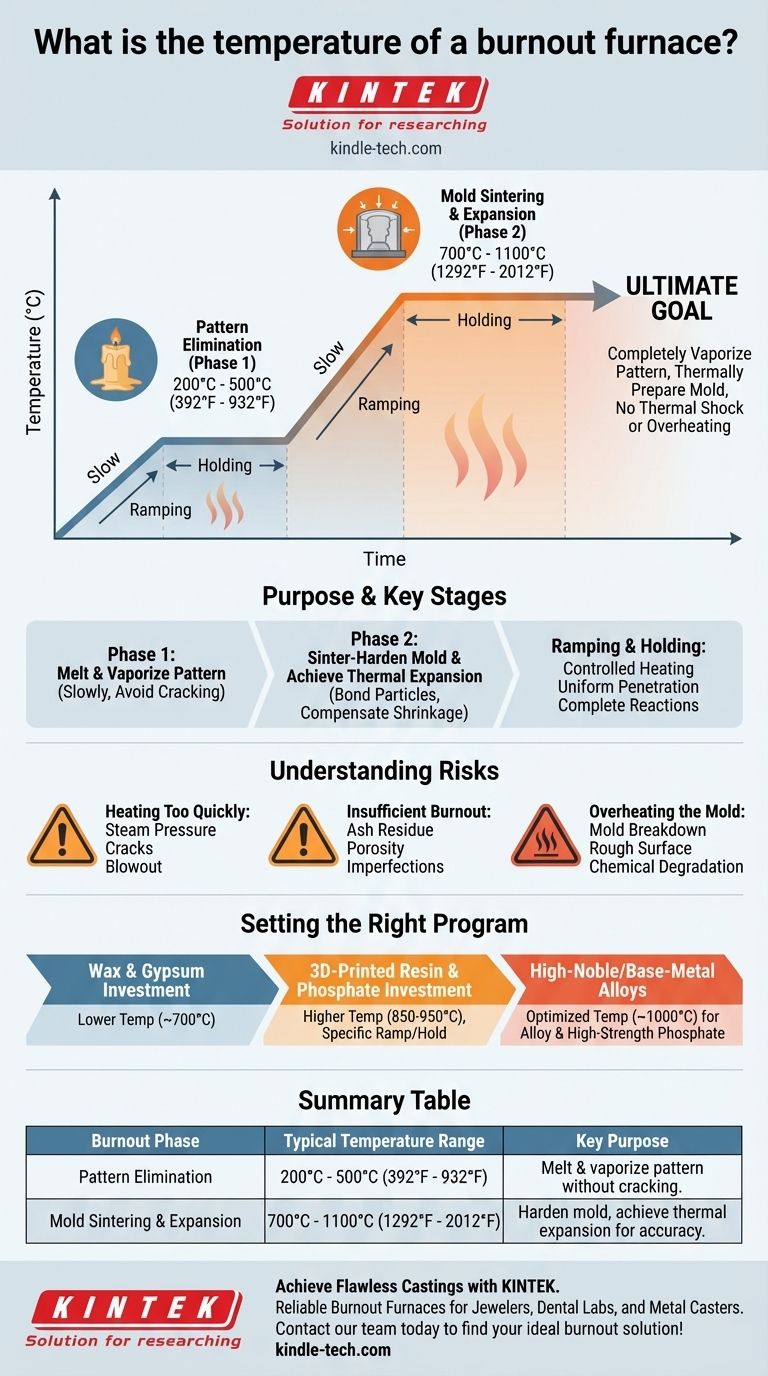
The operational temperature of a burnout furnace is not a single value but a carefully controlled cycle with multiple stages. While some high-temperature furnaces can reach 1800°C, a typical burnout process for casting ranges from a low of 200°C (392°F) to a high of 1100°C (2012°F). The precise temperatures are dictated entirely by the pattern material and the investment mold being used.

A burnout furnace's temperature profile is a means to an end. The ultimate goal is to completely vaporize a pattern (like wax or resin) and thermally prepare the investment mold for casting, all without causing damage from thermal shock or overheating.
What is the temperature of a burnout furnace? A Guide to the Multi-Stage Cycle for Perfect Castings

The Purpose of a Burnout Cycle

A burnout is not a simple heating process but a multi-stage thermal program. Each stage has a distinct purpose in preparing the mold for the introduction of molten metal.

Phase 1: Pattern Elimination

The initial, low-temperature stage is designed to melt and vaporize the pattern. For traditional wax patterns, this occurs at a relatively low temperature, often between 200°C and 500°C.

This phase must be slow enough to allow the material to liquefy and run or vaporize out of the mold without creating pressure that could crack the investment.

Phase 2: Mold Sintering and Expansion

After the pattern is gone, the temperature is increased to the final, higher setpoint, typically between 700°C and 1100°C. This phase has two critical functions.

First, it sinter-hardens the investment mold. This process heats the refractory particles in the investment, causing them to bond and significantly increasing the mold's strength to withstand the pressures of casting.

Second, it brings the mold to a specific, calculated thermal expansion. This expansion is engineered to compensate for the shrinkage of the metal alloy as it cools, ensuring the final cast piece is dimensionally accurate.

The Critical Role of Ramping and Holding

The furnace does not jump to its final temperature. The rate of temperature increase, or "ramping," is carefully controlled.

Different stages are also held at a specific temperature for a set duration, known as "holding" or "heat soaking." This ensures the heat penetrates the entire mold uniformly and that all chemical and physical reactions (like vaporizing residual carbon) are complete.

Understanding the Trade-offs and Risks

Achieving a perfect casting requires balancing temperature, time, and material properties. Deviating from the ideal burnout cycle introduces significant risks.

Heating Too Quickly

Ramping the temperature too fast is a common cause of failure. It can generate steam from residual moisture inside the investment, creating internal pressure that leads to cracks or a complete mold blowout.

Insufficient Burnout

If the peak temperature is too low or the hold time is too short, the pattern material will not be completely eliminated. This leaves behind ash or carbon residue, which will cause porosity, surface imperfections, and an incomplete casting.

Overheating the Mold

Exceeding the recommended temperature for your investment material is just as damaging. Overheating can cause the investment to break down, resulting in a rough, unusable surface on the final casting. As a core principle, you must heat the material without causing it to chemically degrade or melt.

Setting the Right Burnout Program

To determine your furnace settings, you must start with your materials. The manufacturer's instructions for your specific investment powder and pattern material are your primary guide.

  • If your primary focus is casting standard wax with a gypsum investment: Your final burnout temperature will be on the lower end, typically around 700°C (1292°F), as gypsum-based investments cannot tolerate higher heat.
  • If your primary focus is casting 3D-printed resins with a phosphate investment: You will need a cycle with a higher top temperature, often 850-950°C (1562-1742°F), and a specific ramp/hold schedule to ensure complete, ash-free burnout of the resin.
  • If your primary focus is casting high-noble or base-metal alloys: The mold temperature must be optimized for the alloy's characteristics, often requiring a high-strength phosphate investment and a final temperature approaching 1000°C (1832°F).

Always consult the manufacturer's technical data sheets for your specific materials to build the correct, successful burnout program.

Summary Table:

Burnout Phase Typical Temperature Range Key Purpose
Pattern Elimination 200°C - 500°C (392°F - 932°F) Melt and vaporize wax/resin pattern without cracking the mold.
Mold Sintering & Expansion 700°C - 1100°C (1292°F - 2012°F) Harden the mold and achieve thermal expansion for dimensional accuracy.

Achieve flawless castings with the right burnout furnace. The precise temperature cycle is critical for eliminating pattern residue and preparing your investment mold. At KINTEK, we specialize in lab equipment, including reliable burnout furnaces designed for the exacting needs of jewelers, dental labs, and metal casters. Our experts can help you select the perfect furnace for your specific materials—whether you're working with wax, 3D-printed resins, gypsum, or phosphate investments.

Let KINTEK provide the reliable equipment and support you need for perfect results every time. Contact our team today to discuss your application and find your ideal burnout solution!

Visual Guide
What is the temperature of a burnout furnace? A Guide to the Multi-Stage Cycle for Perfect Castings Visual Guide

Related Products

People Also Ask

Related Products

High Temperature Muffle Oven Furnace for Laboratory Debinding and Pre Sintering

High Temperature Muffle Oven Furnace for Laboratory Debinding and Pre Sintering

KT-MD High temperature debinding and pre-sintering furnace for ceramic materials with various molding processes. Ideal for electronic components such as MLCC and NFC.

1700℃ Controlled Atmosphere Furnace Nitrogen Inert Atmosphere Furnace

1700℃ Controlled Atmosphere Furnace Nitrogen Inert Atmosphere Furnace

KT-17A Controlled atmosphere furnace: 1700℃ heating, vacuum sealing technology, PID temperature control, and versatile TFT smart touch screen controller for laboratory and industrial use.

Molybdenum Vacuum Heat Treat Furnace

Molybdenum Vacuum Heat Treat Furnace

Discover the benefits of a high-configuration molybdenum vacuum furnace with heat shield insulation. Ideal for high-purity, vacuum environments like sapphire crystal growth and heat treatment.

1200℃ Controlled Atmosphere Furnace Nitrogen Inert Atmosphere Furnace

1200℃ Controlled Atmosphere Furnace Nitrogen Inert Atmosphere Furnace

Discover our KT-12A Pro Controlled atmosphere furnace - high precision, heavy duty vacuum chamber, versatile smart touch screen controller, and excellent temperature uniformity up to 1200C. Ideal for both laboratory and industrial application.

1400℃ Controlled Atmosphere Furnace with Nitrogen and Inert Atmosphere

1400℃ Controlled Atmosphere Furnace with Nitrogen and Inert Atmosphere

Achieve precise heat treatment with KT-14A controlled atmosphere furnace. Vacuum sealed with a smart controller, it's ideal for lab and industrial use up to 1400℃.

600T Vacuum Induction Hot Press Furnace for Heat Treat and Sintering

600T Vacuum Induction Hot Press Furnace for Heat Treat and Sintering

Discover the 600T Vacuum Induction Hot Press Furnace, designed for high-temperature sintering experiments in vacuum or protected atmospheres. Its precise temperature and pressure control, adjustable working pressure, and advanced safety features make it ideal for nonmetal materials, carbon composites, ceramics, and metal powders.

Vacuum Hot Press Furnace Machine Heated Vacuum Press

Vacuum Hot Press Furnace Machine Heated Vacuum Press

Discover the advantages of Vacuum Hot Press Furnace! Manufacture dense refractory metals & compounds, ceramics, and composites under high temp and pressure.

2200 ℃ Graphite Vacuum Heat Treat Furnace

2200 ℃ Graphite Vacuum Heat Treat Furnace

Discover the power of the KT-VG Graphite Vacuum Furnace - with a maximum working temperature of 2200℃, it's perfect for vacuum sintering of various materials. Learn more now.

Laboratory Muffle Oven Furnace Bottom Lifting Muffle Furnace

Laboratory Muffle Oven Furnace Bottom Lifting Muffle Furnace

Efficiently produce batches with excellent temperature uniformity using our Bottom Lifting Furnace. Features two electric lifting stages and advanced temperature control up to 1600℃.

Ultra-High Temperature Graphite Vacuum Graphitization Furnace

Ultra-High Temperature Graphite Vacuum Graphitization Furnace

The ultra-high temperature graphitization furnace utilizes medium frequency induction heating in a vacuum or inert gas environment. The induction coil generates an alternating magnetic field, inducing eddy currents in the graphite crucible, which heats up and radiates heat to the workpiece, bringing it to the desired temperature. This furnace is primarily used for graphitization and sintering of carbon materials, carbon fiber materials, and other composite materials.

Vacuum Heat Treat and Pressure Sintering Furnace for High Temperature Applications

Vacuum Heat Treat and Pressure Sintering Furnace for High Temperature Applications

Vacuum pressure sintering furnaces are designed for high temperature hot pressing applications in metal and ceramic sintering. Its advanced features ensure precise temperature control, reliable pressure maintenance, and a robust design for seamless operation.

Vacuum Heat Treat Furnace with Ceramic Fiber Liner

Vacuum Heat Treat Furnace with Ceramic Fiber Liner

Vacuum furnace with polycrystalline ceramic fiber insulation liner for excellent heat insulation and uniform temperature field. Choose from 1200℃ or 1700℃ max. working temperature with high vacuum performance and precise temperature control.

Vertical High Temperature Graphite Vacuum Graphitization Furnace

Vertical High Temperature Graphite Vacuum Graphitization Furnace

Vertical high temperature graphitization furnace for carbonization and graphitization of carbon materials up to 3100℃.Suitable for shaped graphitization of carbon fiber filaments and other materials sintered in a carbon environment.Applications in metallurgy, electronics, and aerospace for producing high-quality graphite products like electrodes and crucibles.

Non Consumable Vacuum Arc Induction Melting Furnace

Non Consumable Vacuum Arc Induction Melting Furnace

Explore the benefits of Non-Consumable Vacuum Arc Furnace with high melting point electrodes. Small, easy to operate & eco-friendly. Ideal for laboratory research on refractory metals & carbides.

Controlled Nitrogen Inert Hydrogen Atmosphere Furnace

Controlled Nitrogen Inert Hydrogen Atmosphere Furnace

KT-AH Hydrogen atmosphere furnace - induction gas furnace for sintering/annealing with built-in safety features, dual housing design, and energy-saving efficiency. Ideal for lab and industrial use.

Graphite Vacuum Furnace High Thermal Conductivity Film Graphitization Furnace

Graphite Vacuum Furnace High Thermal Conductivity Film Graphitization Furnace

The high thermal conductivity film graphitization furnace has uniform temperature, low energy consumption and can operate continuously.

Electric Rotary Kiln Small Rotary Furnace Biomass Pyrolysis Plant

Electric Rotary Kiln Small Rotary Furnace Biomass Pyrolysis Plant

Learn about Rotary Biomass Pyrolysis Furnaces & how they decompose organic material at high temps without oxygen. Use for biofuels, waste processing, chemicals & more.

Electric Rotary Kiln Small Rotary Furnace for Activated Carbon Regeneration

Electric Rotary Kiln Small Rotary Furnace for Activated Carbon Regeneration

Revitalize your activated carbon with KinTek's Electric Regeneration Furnace. Achieve efficient and cost-effective regeneration with our highly automated rotary kiln and intelligent thermal controller.

Horizontal High Temperature Graphite Vacuum Graphitization Furnace

Horizontal High Temperature Graphite Vacuum Graphitization Furnace

Horizontal Graphitization Furnace: This type of furnace is designed with the heating elements placed horizontally, allowing for uniform heating of the sample. It's well-suited for graphitizing large or bulky samples that require precise temperature control and uniformity.

Rotary Tube Furnace Split Multi Heating Zone Rotating Tube Furnace

Rotary Tube Furnace Split Multi Heating Zone Rotating Tube Furnace

Multi zone rotary furnace for high-precision temperature control with 2-8 independent heating zones. Ideal for lithium ion battery electrode materials and high-temperature reactions. Can work under vacuum and controlled atmosphere.


Leave Your Message