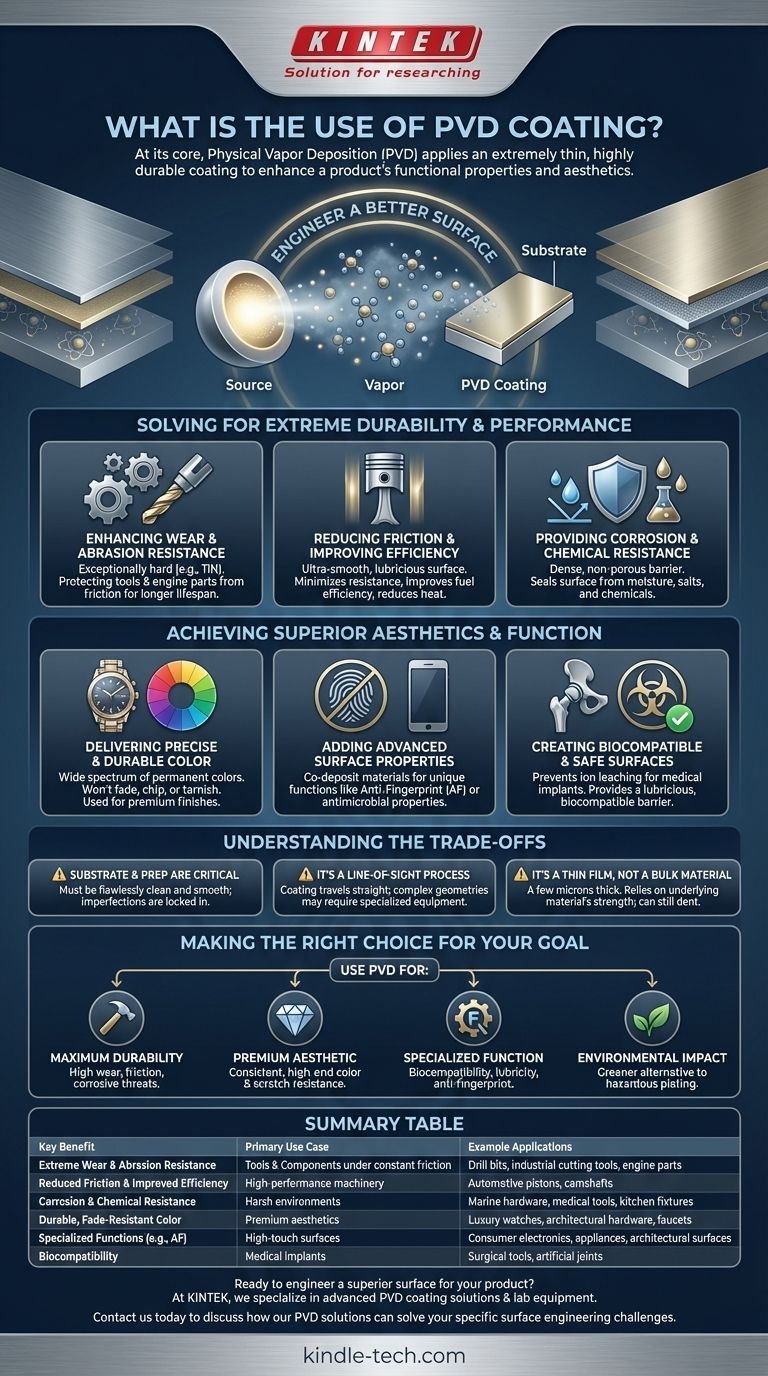
At its core, Physical Vapor Deposition (PVD) is used to apply an extremely thin but highly durable coating onto a product's surface. This process enhances a product's functional properties—like wear resistance and lubricity—and its aesthetic qualities, such as color and finish. It is a go-to solution in industries ranging from automotive and medical to consumer electronics and architecture for creating high-performance surfaces.
The true purpose of PVD is not just to coat an object, but to fundamentally upgrade its surface. It solves critical engineering and design challenges by adding durability, performance, and aesthetic value that the underlying material cannot provide on its own.
Solving for Extreme Durability and Performance
The primary driver for adopting PVD is often a need for a surface that can withstand demanding physical environments. It is a surface engineering tool used to overcome the limitations of a base material.
Enhancing Wear and Abrasion Resistance
PVD coatings, particularly those using ceramic materials like Titanium Nitride (TiN), are exceptionally hard. This makes them ideal for applications involving constant friction or contact.
This hardness directly translates to a longer lifespan for items like drill bits, industrial cutting tools, and critical engine components. The coating acts as a sacrificial shield, protecting the softer metal underneath from being worn away.
Reducing Friction and Improving Efficiency
In high-performance machinery, friction is an enemy of both efficiency and longevity. PVD coatings create an ultra-smooth, lubricious surface that minimizes resistance between moving parts.
This is why PVD is applied to automotive components like pistons and camshafts. Lower friction means less energy is wasted as heat, improving fuel efficiency and reducing wear on the engine over its lifetime.
Providing Corrosion and Chemical Resistance
The PVD film is dense and non-porous, creating an inert barrier between the substrate and its environment. This barrier effectively seals the surface from moisture, salts, and chemicals that would otherwise cause corrosion.
This makes it invaluable for marine hardware exposed to saltwater, kitchen and bath fixtures that see constant water and cleaning agents, and medical tools that undergo repeated sterilization.
Achieving Superior Aesthetics and Function
While driven by performance, PVD is also chosen for its ability to deliver a premium look and feel that is far more durable than traditional finishes like paint or plating.
Delivering Precise and Durable Color
PVD allows for the deposition of a wide spectrum of colors with remarkable consistency and permanence. Because the color is integral to the atomic structure of the coating, it will not fade, chip, or tarnish.
This is why it is used extensively on luxury goods like watches and writing instruments, architectural hardware, and high-end faucets. It provides the look of materials like gold or bronze but with superior scratch resistance.
Adding Advanced Surface Properties
The PVD process can be adapted to co-deposit materials that add unique functions. A common example is an anti-fingerprint (AF) coating applied in the chamber along with the color.
This is highly desirable for high-touch architectural surfaces, consumer electronics, and appliances. Future applications being researched include integrating antimicrobial properties, which would be transformative for healthcare and food processing equipment.
Creating Biocompatible and Safe Surfaces
In the medical field, safety and material interaction are paramount. PVD is used to coat surgical implants to create a biocompatible barrier.
This coating prevents potentially harmful metal ions, like nickel or chromium from the implant's alloy, from leaching into the body. It also provides a lubricious surface that improves the function and lifespan of artificial joints.
Understanding the Trade-offs
PVD is a powerful tool, but it is not a universal solution. Understanding its limitations is key to using it effectively.
Substrate and Preparation are Critical
The final quality of a PVD coating is entirely dependent on the surface beneath it. The substrate must be flawlessly clean and smooth, as any imperfection will be locked in and may even be magnified by the coating.
It's a Line-of-Sight Process
In a standard PVD process, the coating material travels in a straight line from the source to the substrate. This means complex internal geometries or deep, narrow holes can be difficult or impossible to coat uniformly without specialized equipment and rotation.
It's a Thin Film, Not a Bulk Material
A PVD coating is typically only a few microns thick. While incredibly hard, it relies on the strength of the underlying material. A significant impact can still dent or deform the substrate, which will cause the thin, hard coating to crack or flake.
Making the Right Choice for Your Goal
Deciding whether to use PVD requires aligning its capabilities with your primary objective.
- If your primary focus is maximum durability: Use PVD for applications facing high wear, friction, or corrosive threats where extending product life is the main goal.
- If your primary focus is a premium aesthetic: Choose PVD when you need a consistent, high-end color and finish that is vastly more resistant to scratches and fading than paint or plating.
- If your primary focus is specialized function: Specify PVD when you require unique surface properties like biocompatibility, lubricity, or an integrated anti-fingerprint finish.
- If your primary focus is environmental impact: Consider PVD as a greener alternative to traditional processes like hard chrome plating, which involves hazardous chemicals.
Ultimately, PVD coating is a strategic decision to engineer a better surface, solving problems where the base material alone falls short.
Summary Table:
| Key Benefit | Primary Use Case | Example Applications |
|---|---|---|
| Extreme Wear & Abrasion Resistance | Tools & Components under constant friction | Drill bits, industrial cutting tools, engine parts |
| Reduced Friction & Improved Efficiency | High-performance machinery | Automotive pistons, camshafts |
| Corrosion & Chemical Resistance | Harsh environments | Marine hardware, medical tools, kitchen fixtures |
| Durable, Fade-Resistant Color | Premium aesthetics | Luxury watches, architectural hardware, faucets |
| Specialized Functions (e.g., Anti-fingerprint) | High-touch surfaces | Consumer electronics, appliances, architectural surfaces |
| Biocompatibility | Medical implants | Surgical tools, artificial joints |
Ready to engineer a superior surface for your product?
At KINTEK, we specialize in providing advanced PVD coating solutions and lab equipment to meet the demanding needs of industries from automotive to medical devices. Whether you need to enhance durability, achieve a premium finish, or integrate specialized functions like anti-fingerprint coatings, our expertise and high-quality systems ensure your products perform at their best.
Contact us today to discuss how our PVD coating solutions can solve your specific surface engineering challenges and add lasting value to your products.
Get in touch with our experts now!
Visual Guide
Related Products
- RF PECVD System Radio Frequency Plasma-Enhanced Chemical Vapor Deposition RF PECVD
- Chemical Vapor Deposition CVD Equipment System Chamber Slide PECVD Tube Furnace with Liquid Gasifier PECVD Machine
- Split Chamber CVD Tube Furnace with Vacuum Station Chemical Vapor Deposition System Equipment Machine
- VHP Sterilization Equipment Hydrogen Peroxide H2O2 Space Sterilizer
- Molybdenum Tungsten Tantalum Special Shape Evaporation Boat
People Also Ask
- What are the applications of PECVD? Essential for Semiconductors, MEMS, and Solar Cells
- What are the benefits of PECVD? Achieve Superior Low-Temperature Thin Film Deposition
- How does RF power create plasma? Achieve Stable, High-Density Plasma for Your Applications
- How are PECVD and CVD different? A Guide to Choosing the Right Thin-Film Deposition Process
- What is an example of PECVD? RF-PECVD for High-Quality Thin Film Deposition