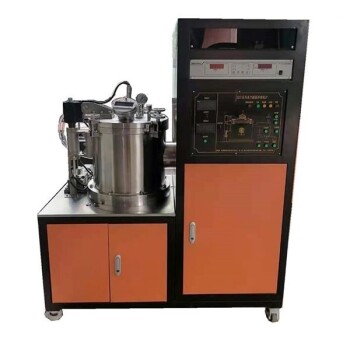
A vacuum induction furnace creates a specific dual-condition environment: extreme thermal energy exceeding 1550°C combined with a high vacuum pressure maintained below 10 Pa. This precise atmosphere is engineered to facilitate thermal reduction and sintering while actively managing gas byproducts.
By maintaining a vacuum below 10 Pa, the furnace does more than just exclude air; it actively manipulates chemical equilibrium. The continuous removal of gaseous carbon monoxide drives the reaction forward, ensuring efficient synthesis while protecting the titanium oxycarbide from oxidation.
The Role of Thermal Energy
Achieving Reaction Thresholds
To synthesize titanium oxycarbide, the system must reach temperatures exceeding 1550°C.
This high thermal input is non-negotiable. It provides the necessary energy to initiate the thermal reduction process and facilitate the sintering of the final material.
The Critical Function of High Vacuum
Managing Pressure Levels
The furnace must sustain a high vacuum level, specifically keeping the pressure below 10 Pa.
This low-pressure environment is not merely a passive container; it is an active participant in the chemical synthesis.
Shifting Chemical Equilibrium
The primary advantage of this vacuum level is the effective removal of gaseous byproducts, particularly carbon monoxide (CO).
By continuously extracting CO as it is generated, the system prevents the gas from accumulating. According to chemical principles, removing the product of a reaction pushes the equilibrium forward, thereby accelerating and stabilizing the formation of titanium oxycarbide.
Material Protection and Purity
Preventing Unwanted Oxidation
Operating at temperatures above 1550°C usually poses a severe risk of oxidation for most materials.
The high vacuum environment neutralizes this threat. By eliminating the presence of oxygen, the furnace prevents the raw materials and the developing product from reacting with air, ensuring the chemical integrity of the final output.
Understanding the Process Sensitivities
The Consequence of Pressure Fluctuation
The success of this synthesis is heavily dependent on the stability of the vacuum.
If the pressure rises above 10 Pa, the efficiency of CO removal diminishes. This can stall the reaction equilibrium, leading to incomplete synthesis or lower-quality titanium oxycarbide.
Thermal-Atmospheric Dependency
There is a strict dependency between the temperature and the vacuum.
You cannot utilize the required high temperatures (>1550°C) without the protective vacuum. Doing so would immediately lead to the degradation of the material through rapid oxidation.
Making the Right Choice for Your Goal
To ensure successful synthesis, you must view temperature and pressure as coupled variables rather than independent settings.
- If your primary focus is Reaction Efficiency: Prioritize maintaining the vacuum strictly below 10 Pa to maximize CO extraction and drive chemical equilibrium.
- If your primary focus is Material Purity: Ensure the vacuum is established before heating and maintained throughout the cooling phase to prevent surface oxidation.
Control the vacuum to control the chemistry; control the temperature to enable the physics.
Summary Table:
| Parameter | Required Condition | Primary Function |
|---|---|---|
| Temperature | > 1550°C | Initiates thermal reduction & facilitates sintering |
| Vacuum Pressure | < 10 Pa | Removes CO gas to drive chemical equilibrium |
| Atmosphere | Inert/Oxygen-free | Protects material from oxidation & ensures purity |
| Byproduct Management | Active Extraction | Prevents reaction stalls by extracting CO gas |
Elevate Your Material Synthesis with KINTEK Precision
Achieving the delicate balance of 1550°C+ temperatures and sub-10 Pa vacuum requires equipment engineered for excellence. KINTEK specializes in advanced laboratory solutions, offering a comprehensive range of high-temperature vacuum induction, tube, and atmosphere furnaces designed to maintain precise chemical equilibrium for your most sensitive projects.
Whether you are synthesizing titanium oxycarbide or developing next-generation ceramics, our portfolio—including high-pressure reactors, crushing systems, and specialized crucibles—provides the reliability your research demands. Don't let pressure fluctuations compromise your material purity.
Ready to optimize your thermal processing? Contact our technical experts today to find the perfect furnace solution for your laboratory.
References
- Tianzhu Mu, Bin Deng. Dissolution Characteristic of Titanium Oxycarbide Electrolysis. DOI: 10.2320/matertrans.mk201616
This article is also based on technical information from Kintek Solution Knowledge Base .
Related Products
- 600T Vacuum Induction Hot Press Furnace for Heat Treat and Sintering
- Vacuum Arc Induction Melting Furnace
- Lab-Scale Vacuum Induction Melting Furnace
- Vacuum Heat Treat and Molybdenum Wire Sintering Furnace for Vacuum Sintering
- Small Vacuum Heat Treat and Tungsten Wire Sintering Furnace
People Also Ask
- What role does an induction vacuum hot pressing furnace play in sintering? Achieve 98% Density in Carbide Blocks
- What advantages does a vacuum hot press furnace provide for LSLBO ceramic electrolytes? Achieve 94% Relative Density
- What role does a Vacuum Hot Press (VHP) furnace play in the densification of austenitic stainless steel 316 composites?
- What role does mechanical pressure play during the vacuum diffusion bonding of tungsten and copper? Keys to Solid Bonding
- What are the advantages of a vacuum hot press furnace for W-50%Cu? Achieve 99.6% Density at Lower Temperatures