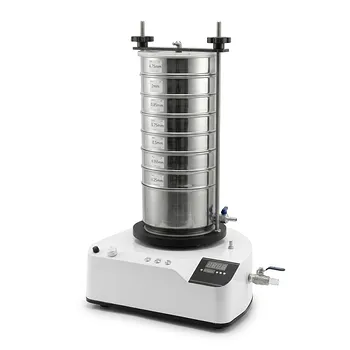
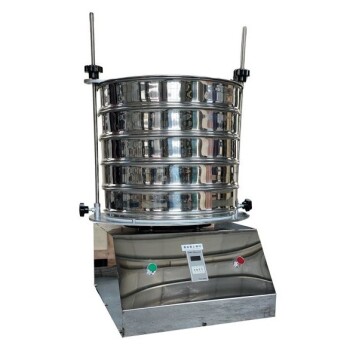
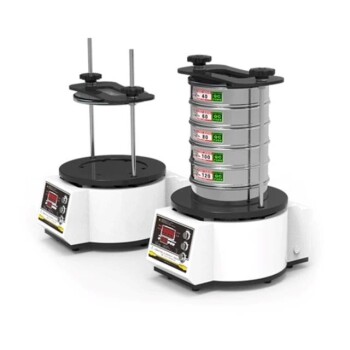
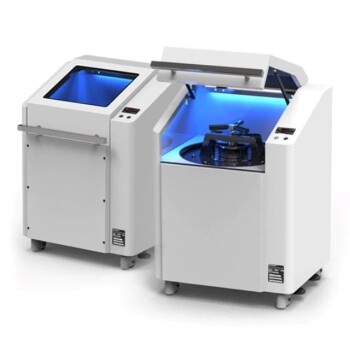
Sieving equipment acts as the essential conditioner for all-solid-state battery powders immediately following the solvent evaporation stage. Its primary function is to mechanically break down hard agglomerates and filter out oversized particles, ensuring the composite electrode material achieves a precise, uniform particle size distribution before mold filling.
The integrity of the final battery structure relies on this step; without the uniformity provided by sieving, uneven powder packing will compromise the layer flatness required for successful Spark Plasma Sintering (SPS).
Transforming Dried Powder into Usable Material
The drying process is necessary to remove solvents, but it leaves the raw material in a state unsuitable for immediate manufacturing.
Addressing Solvent Evaporation Effects
When solvents evaporate from the battery slurry, the remaining solid particles often bind together.
This results in the formation of hard agglomerates—dense clusters of material that are significantly larger than the target particle size.
Mechanical conditioning
Sieving equipment intervenes to physically break these agglomerates apart.
Simultaneously, it separates and removes any particles that remain oversized, ensuring that only material within a specific size range passes through to the next stage.
The Critical Link to Spark Plasma Sintering (SPS)
The ultimate goal of sieving is not just particle sizing, but preparing the material for the rigorous demands of the Spark Plasma Sintering (SPS) process.
Ensuring Uniform Powder Packing
Before sintering, the powder must be filled into molds.
Sieving ensures the particle distribution is uniform, which allows the powder to pack down evenly and densely inside the mold.
Achieving Flat Layer Structures
For an all-solid-state battery to function correctly, its internal layers must be distinct and flat.
The uniform packing facilitated by sieving is critical to achieving these flat battery layer structures during the high-pressure SPS process.
The Consequence of Inconsistency
It is vital to understand the risks associated with inadequate sieving.
Structural Irregularities
If hard agglomerates or oversized particles are allowed into the mold, the powder will not pack evenly.
Compromised Sintering Results
These irregularities create distinct weak points or uneven surfaces.
During the SPS process, this lack of uniformity prevents the formation of the flat, consistent layers necessary for a high-performance battery.
Making the Right Choice for Your Process
Optimizing your sieving process is about balancing material preparation with downstream requirements.
- If your primary focus is Structural Integrity: Ensure your sieving mesh is fine enough to eliminate all hard agglomerates, guaranteeing the flat layers required for SPS.
- If your primary focus is Process Consistency: Prioritize sieving to standardize particle distribution, which ensures reproducible mold filling and packing density batch after batch.
Sieving is not merely a separation step; it is the fundamental preparation that enables the creation of a structurally sound solid-state battery.
Summary Table:
| Process Stage | Function of Sieving | Impact on Battery Quality |
|---|---|---|
| Post-Drying | Breaks down hard agglomerates & filters oversized particles | Ensures precise particle size distribution (PSD) |
| Mold Filling | Facilitates uniform powder packing & density | Prevents structural irregularities & weak points |
| SPS Sintering | Enables creation of perfectly flat layer structures | Maximizes electrochemical performance & stability |
Elevate Your Battery Research with KINTEK Precision
Don't let particle agglomeration compromise the structural integrity of your all-solid-state batteries. KINTEK specializes in advanced laboratory solutions designed for the rigorous demands of battery material processing. From high-performance sieving equipment and crushing systems to state-of-the-art Spark Plasma Sintering (SPS) compatible hydraulic presses, we provide the tools necessary to achieve uniform powder packing and flawless layer structures.
Whether you are refining composite electrodes or optimizing electrolyte powders, our team is ready to equip your lab with professional-grade high-temperature furnaces, planetary ball mills, and specialized battery consumables.
Ready to achieve superior sintering results? Contact us today to find the perfect equipment for your process!
Related Products
- Three-dimensional electromagnetic sieving instrument
- Laboratory Vibratory Sieve Shaker Machine for Dry and Wet Three-Dimensional Sieving
- Laboratory Test Sieves and Sieving Machines
- Laboratory Wet Three-Dimensional Vibratory Sieve Shaker Machine
- Laboratory Test Sieves and Vibratory Sieve Shaker Machine
People Also Ask
- Why is sieving equipment essential for the classification of processed bio-activated carbon? Optimize Performance
- What are the limitations of sieving? Understanding the Constraints of Particle Size Analysis
- What are advantages and disadvantages of sieving method? A Guide to Reliable & Cost-Effective Particle Sizing
- How is sieving important? The Critical Role of Particle Size Analysis in Quality Control
- What is sieving and how does it work? A Guide to Accurate Particle Size Analysis