Knowledge cvd machine What machines make lab diamonds? Discover the HPHT and CVD Technologies Behind Lab-Grown Gems
Author avatar

Tech Team · Kintek Solution

Updated 3 months ago

What machines make lab diamonds? Discover the HPHT and CVD Technologies Behind Lab-Grown Gems


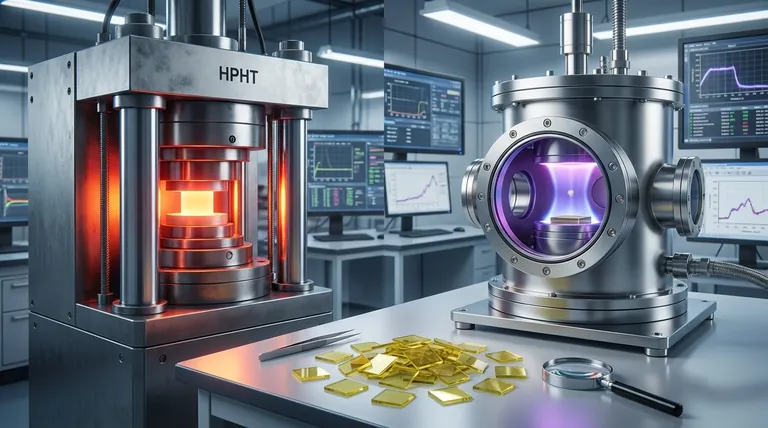
At its core, creating a lab diamond involves one of two primary technologies: High Pressure, High-Temperature (HPHT) and Chemical Vapor Deposition (CVD). These are not simply machines but sophisticated industrial processes designed to replicate the extreme conditions under which diamonds form, resulting in a product that is physically, chemically, and optically identical to a mined diamond.

The question isn't just about the machines, but the two fundamentally different philosophies they represent. One method simulates the brute force of nature, while the other builds a diamond with atomic precision, layer by layer.
What machines make lab diamonds? Discover the HPHT and CVD Technologies Behind Lab-Grown Gems

The Two Core Technologies for Gem-Quality Diamonds

For diamonds used in jewelry, the industry relies exclusively on two proven methods. Each process starts with a "seed"—a tiny, high-quality sliver of a previously grown diamond that acts as the template for new growth.

HPHT (High Pressure, High Temperature): Replicating Nature's Force

The HPHT method is the original process for growing diamonds and directly mimics the conditions deep within the Earth's mantle.

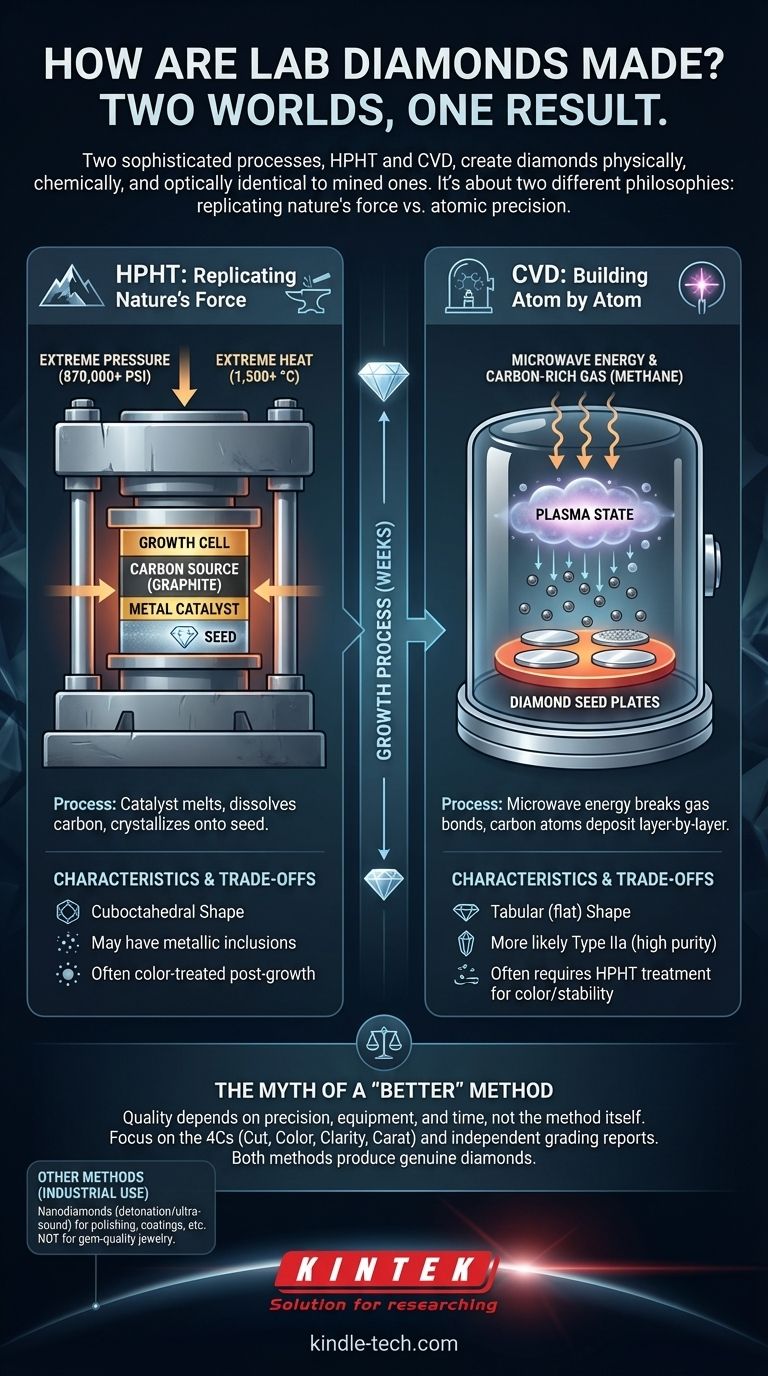
The "machine" is a massive mechanical press capable of generating immense force and heat. These presses subject a carbon source, like purified graphite, to pressures over 870,000 pounds per square inch and temperatures above 1,500°C (2,732°F).

Inside the press, the carbon source and a diamond seed are placed in a growth cell with a metal catalyst. The intense heat melts the catalyst, which dissolves the carbon source. This dissolved carbon then crystallizes onto the diamond seed, growing a new, larger rough diamond over several weeks.

CVD (Chemical Vapor Deposition): Building Atom by Atom

The CVD method is a newer technique that builds a diamond in a way more analogous to 3D printing, but on an atomic scale.

The machine for this process is a vacuum chamber. Diamond seed plates are placed inside, and the chamber is filled with carbon-rich gases, typically methane.

High-power microwave energy is used to heat the gases into a plasma state. This breaks the molecular bonds of the gas, freeing carbon atoms. These atoms then "rain down" and deposit onto the cooler diamond seed plates, growing the diamond crystal one layer at a time. This process can also take several weeks to produce a sizeable gem.

Understanding the Trade-offs and Distinctions

While both methods produce genuine diamonds, the different growth environments can leave behind subtle tell-tale signs, or "growth habits," that gemological labs can detect.

The Impact on Diamond Characteristics

HPHT diamonds grow in a cuboctahedral shape. Due to the metal catalyst used, they can sometimes have tiny metallic inclusions. Many HPHT diamonds undergo a post-growth treatment to improve their color.

CVD diamonds grow in a flatter, tabular shape. They are more likely to be Type IIa diamonds, a classification that is very rare in nature and denotes exceptional chemical purity. However, many CVD diamonds also require post-growth treatment (often using the HPHT process) to enhance their color and stability.

The Myth of a "Better" Method

Neither HPHT nor CVD is inherently superior. The final quality of any lab-grown diamond is determined by the precision of the manufacturer, the quality of their equipment, and their commitment to slow, stable growth.

A high-quality diamond from a top-tier CVD grower will be far superior to a low-quality diamond from a rushed HPHT process, and vice-versa. The growth method is a manufacturing detail, not a final indicator of quality.

What About Other Methods?

You may encounter mentions of other diamond-creation techniques, such as detonation synthesis or ultrasound cavitation.

Nanodiamonds for Industrial Use

These methods are not used for creating gem-quality diamonds. Instead, they produce vast quantities of microscopic diamond dust, or nanodiamonds.

These tiny diamonds are used for industrial purposes, such as in polishing slurries, engine oil additives, and advanced coatings. For the purpose of jewelry, these methods are irrelevant.

How This Informs Your Choice

Understanding how lab diamonds are made empowers you to focus on what truly matters: the final product's quality, not its specific manufacturing journey.

  • If your primary focus is technology: You might find the story behind either the nature-mimicking HPHT process or the atom-by-atom CVD process more compelling.
  • If your primary focus is quality and value: Ignore the growth method entirely and concentrate on the independent grading report, which details the 4Cs (Cut, Color, Clarity, and Carat).

Ultimately, the machine is just the tool; the true measure of any diamond is its certified quality and brilliance.

Summary Table:

Technology Process Description Key Characteristics
HPHT (High Pressure, High Temperature) Uses massive presses to replicate Earth's mantle conditions with extreme pressure and heat. Grows cuboctahedral crystals; may have metallic inclusions; often color-treated post-growth.
CVD (Chemical Vapor Deposition) Builds diamonds layer-by-layer in a vacuum chamber using carbon-rich gas and microwave energy. Produces tabular-shaped crystals; often Type IIa (high purity); may require HPHT treatment for color.

Ready to explore lab equipment for advanced material synthesis? KINTEK specializes in high-performance lab equipment and consumables, serving researchers and manufacturers in need of reliable, precise tools for diamond growth and other advanced processes. Whether you're scaling up HPHT presses or optimizing CVD chambers, our expertise ensures you get the right solutions for your laboratory needs. Contact us today to discuss how we can support your innovation with cutting-edge technology!

Visual Guide
What machines make lab diamonds? Discover the HPHT and CVD Technologies Behind Lab-Grown Gems Visual Guide

Related Products

People Also Ask

Related Products

High Precision Diamond Wire Cutting Machine Laboratory Saw Precision Wire EDM Cutting Machine

High Precision Diamond Wire Cutting Machine Laboratory Saw Precision Wire EDM Cutting Machine

The high precision diamond wire cutting machine is a versatile and precise cutting tool designed specifically for material researchers. It utilizes a continuous diamond wire cutting mechanism, enabling precise cutting of brittle materials such as ceramics, crystals, glass, metals, rocks, and various other materials.

12 Inch 24 Inch High Precision Automatic Diamond Wire Cutting Machine Laboratory Saw Precision Wire EDM Cutting Machine

12 Inch 24 Inch High Precision Automatic Diamond Wire Cutting Machine Laboratory Saw Precision Wire EDM Cutting Machine

The high precision automatic diamond wire cutting machine is a versatile cutting tool that uses a diamond wire to cut through a wide range of materials, including conductive and non-conductive materials, ceramics, glass, rocks, gems, jade, meteorites, monocrystalline silicon, silicon carbide, polycrystalline silicon, refractory bricks, epoxy boards, and ferrite bodies. It is especially suitable for cutting various brittle crystals with high hardness, high value, and easy to break.

Precision Wire Saw Laboratory Cutting Machine with 800mm x 800mm Workbench for Diamond Single Wire Circular Small Cutting

Precision Wire Saw Laboratory Cutting Machine with 800mm x 800mm Workbench for Diamond Single Wire Circular Small Cutting

Diamond wire cutting machines are mainly used for precision cutting of ceramics, crystals, glass, metals, rocks, thermoelectric materials, infrared optical materials, composite materials, biomedical materials and other material analysis samples. Especially suitable for precision cutting of ultra-thin plates with thickness up to 0.2mm.

Microwave Plasma Chemical Vapor Deposition MPCVD Machine System Reactor for Lab and Diamond Growth

Microwave Plasma Chemical Vapor Deposition MPCVD Machine System Reactor for Lab and Diamond Growth

Get high-quality diamond films with our Bell-jar Resonator MPCVD machine designed for lab and diamond growth. Discover how Microwave Plasma Chemical Vapor Deposition works for growing diamonds using carbon gas and plasma.

Vibrating Disc Mill Small Laboratory Grinding Machine

Vibrating Disc Mill Small Laboratory Grinding Machine

Discover the versatile Vibrating Disc Mill for efficient laboratory grinding. Ideal for geology, metallurgy, biology, and more. Explore now!

Laboratory CVD Boron Doped Diamond Materials

Laboratory CVD Boron Doped Diamond Materials

CVD boron-doped diamond: A versatile material enabling tailored electrical conductivity, optical transparency, and exceptional thermal properties for applications in electronics, optics, sensing, and quantum technologies.

CVD Diamond Dressing Tools for Precision Applications

CVD Diamond Dressing Tools for Precision Applications

Experience the Unbeatable Performance of CVD Diamond Dresser Blanks: High Thermal Conductivity, Exceptional Wear Resistance, and Orientation Independence.

Mini Planetary Ball Mill Machine for Laboratory Milling

Mini Planetary Ball Mill Machine for Laboratory Milling

Discover the KT-P400 desktop planetary ball mill, ideal for grinding and mixing small samples in the lab. Enjoy stable performance, long service life, and practicality. Functions include timing and overload protection.

Metallographic Specimen Mounting Machine for Laboratory Materials and Analysis

Metallographic Specimen Mounting Machine for Laboratory Materials and Analysis

Precision metallographic mounting machines for labs—automated, versatile, and efficient. Ideal for sample prep in research and quality control. Contact KINTEK today!

CVD Diamond Cutting Tool Blanks for Precision Machining

CVD Diamond Cutting Tool Blanks for Precision Machining

CVD Diamond Cutting Tools: Superior Wear Resistance, Low Friction, High Thermal Conductivity for Non-Ferrous Materials, Ceramics, Composites Machining

Rubber Vulcanizer Vulcanizing Machine Plate Vulcanizing Press for Lab

Rubber Vulcanizer Vulcanizing Machine Plate Vulcanizing Press for Lab

The Plate vulcanizing press is a kind of equipment used in the production of rubber products, mainly used for the vulcanization of rubber products. Vulcanization is a key step in rubber processing.

High-Energy Omnidirectional Planetary Ball Mill Milling Machine for Laboratory

High-Energy Omnidirectional Planetary Ball Mill Milling Machine for Laboratory

The KT-P4000E is a new product derived from the vertical high-energy planetary ball mill with a 360° swivel function. Experience faster, uniform, and smaller sample output results with 4 ≤1000ml ball mill jars.

Disc Cup Vibrating Mill Multi-Platform for Lab

Disc Cup Vibrating Mill Multi-Platform for Lab

The multi-platform vibrating disc mill is suitable for non-destructive crushing and fine grinding of samples with large particle sizes. It is suitable for crushing and grinding applications of medium-hard, high-hard, brittle, fibrous, and elastic materials.

Laboratory Horizontal Planetary Ball Mill Milling Machine

Laboratory Horizontal Planetary Ball Mill Milling Machine

Improve sample uniformity with our Horizontal Planetary Ball Mills. KT-P400H reduces sample deposition and KT-P400E has multi-directional capabilities. Safe, convenient and efficient with overload protection.

Laboratory Planetary Ball Mill Rotating Ball Milling Machine

Laboratory Planetary Ball Mill Rotating Ball Milling Machine

KT-P400E is a desktop multi-directional planetary ball mill with unique grinding and mixing capabilities. It offers continuous and intermittent operation, timing, and overload protection, making it ideal for various applications.

Laboratory Vibratory Sieve Shaker Machine for Dry and Wet Three-Dimensional Sieving

Laboratory Vibratory Sieve Shaker Machine for Dry and Wet Three-Dimensional Sieving

KT-VD200 can be used for sieving tasks of dry and wet samples in the laboratory. The screening quality is 20g-3kg. The product is designed with a unique mechanical structure and an electromagnetic vibrating body with a vibration frequency of 3000 times per minute.

High Energy Planetary Ball Mill Milling Machine for Laboratory

High Energy Planetary Ball Mill Milling Machine for Laboratory

Experience fast and effective sample processing with the F-P2000 high-energy planetary ball mill. This versatile equipment offers precise control and excellent grinding capabilities. Perfect for laboratories, it features multiple grinding bowls for simultaneous testing and high output. Achieve optimal results with its ergonomic design, compact structure, and advanced features. Ideal for a wide range of materials, it ensures consistent particle size reduction and low maintenance.

High Energy Planetary Ball Mill Milling Machine for Laboratory

High Energy Planetary Ball Mill Milling Machine for Laboratory

The biggest feature is that the high energy planetary ball mill can not only perform fast and effective grinding, but also has good crushing ability

Lab Plastic PVC Calender Stretch Film Casting Machine for Film Testing

Lab Plastic PVC Calender Stretch Film Casting Machine for Film Testing

The cast film machine is designed for the molding of polymer cast film products and has multiple processing functions such as casting, extrusion, stretching, and compounding.

Lab Internal Rubber Mixer Rubber Kneader Machine for Mixing and Kneading

Lab Internal Rubber Mixer Rubber Kneader Machine for Mixing and Kneading

Lab internal rubber mixer is suitable for mixing, kneading and dispersing various chemical raw materials such as plastics, rubber, synthetic rubber, hot melt adhesive and various low-viscosity materials.


Leave Your Message