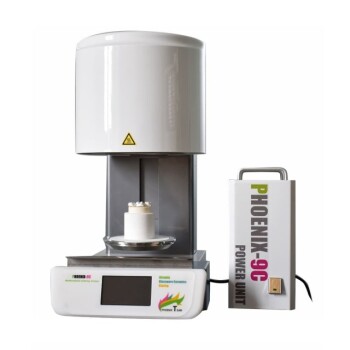
An atmosphere sintering furnace establishes a high-purity, thermally regulated inert environment. Specifically, it maintains a protective Argon (Ar) atmosphere while precisely controlling temperatures between 700°C and 1050°C. This dual-control system is the standard for preparing Li7La3Zr2O12-Li3.5Ge0.5V0.5O4 (LLZ-LGVO) multilayer composite electrolytes.
The furnace’s inert Argon environment and precise thermal regulation are the twin pillars of successful LLZ-LGVO synthesis. This specific atmosphere facilitates essential Germanium diffusion for bonding while strictly isolating the material from atmospheric contaminants like moisture and CO2.
The Critical Role of the Inert Atmosphere
Protection Against Chemical Degradation
The primary function of the furnace environment is to shield the composite materials from ambient air. The system utilizes an inert Argon (Ar) gas to create a protective barrier around the sample.
Preventing Environmental Contamination
This Argon shield is non-negotiable for LLZ-based electrolytes. It prevents the materials from reacting with moisture or carbon dioxide, which would otherwise degrade the material's performance during high-temperature processing.
Thermal Precision and Material Bonding
Controlling the Sintering Window
The furnace provides a highly specific temperature operating range, typically between 700°C and 1050°C. Maintaining this exact range is crucial for the physical evolution of the composite structure.
Facilitating Germanium Diffusion
The thermal energy within this specific range drives a critical chemical interaction. It promotes the diffusion of Germanium (Ge) from the LGVO component into the LLZ layer.
Achieving Densified Bonding
This diffusion is not a side effect; it is the mechanism required to achieve a densified bond between the layers. The controlled environment ensures the multilayer structure becomes cohesive and mechanically sound.
Understanding the Trade-offs
The Risk of Atmosphere Impurity
There is little room for error regarding the inert gas supply. Any breach in the Argon environment that allows moisture or CO2 ingress will likely result in the formation of resistive surface layers, rendering the electrolyte ineffective.
Sensitivity to Temperature Deviations
The process relies on a delicate balance within the 700°C–1050°C window. Temperatures too low will fail to trigger sufficient Germanium diffusion for bonding, while excessive heat may risk material decomposition or unwanted phase changes.
Optimizing Your Sintering Strategy
To ensure the successful preparation of LLZ-LGVO composites, align your process parameters with your specific material goals:
- If your primary focus is structural integrity: Prioritize precise thermal regulation within the 700°C–1050°C range to maximize Germanium diffusion and ensure robust densification.
- If your primary focus is chemical purity: Ensure the furnace maintains a rigorous, continuous flow of high-purity Argon to strictly eliminate any exposure to atmospheric moisture or carbon dioxide.
By synchronizing a pure inert atmosphere with precise thermal control, you transform raw layers into a unified, high-performance electrolyte.
Summary Table:
| Parameter | Specification/Requirement | Role in LLZ-LGVO Synthesis |
|---|---|---|
| Atmosphere Type | High-purity Inert Argon (Ar) | Prevents degradation from moisture and CO2 |
| Temperature Range | 700°C – 1050°C | Controls sintering window and densification |
| Key Chemical Driver | Germanium (Ge) Diffusion | Facilitates bonding between LLZ and LGVO layers |
| Critical Risk | Atmosphere Impurity | Avoids formation of resistive surface layers |
Elevate Your Solid-State Battery Research with KINTEK
Precision is paramount when synthesizing sensitive materials like LLZ-LGVO multilayer composite electrolytes. At KINTEK, we specialize in high-performance atmosphere furnaces and vacuum sintering systems designed to maintain rigorous chemical purity and thermal stability.
Whether you are focusing on structural integrity through precise temperature regulation or chemical purity via advanced gas management, our comprehensive range of laboratory equipment—including high-temperature furnaces, planetary ball mills, and hydraulic pellet presses—is engineered to meet the demands of cutting-edge material science.
Ready to optimize your sintering strategy? Contact our technical experts today to find the perfect equipment solution for your laboratory and ensure consistent, high-performance results for your research.
Related Products
- Mesh belt controlled atmosphere furnace
- Controlled Nitrogen Inert Hydrogen Atmosphere Furnace
- Vacuum Heat Treat and Sintering Furnace with 9MPa Air Pressure
- 1200℃ Controlled Atmosphere Furnace Nitrogen Inert Atmosphere Furnace
- Spark Plasma Sintering Furnace SPS Furnace
People Also Ask
- What are some of the reasons why a controlled atmosphere furnace is desirable in sintering? Achieve Superior Sintering Results
- What role does a controlled atmosphere furnace with argon gas flow play in the production of reduced graphene oxide (rGO)?
- Why is a furnace equipped with a controlled atmosphere necessary for the preparation of active metal catalysts?
- How does a mesh belt furnace work? Achieve High-Volume, Repeatable Heat Treatment
- What is the process of a mesh belt furnace? Achieve Consistent, High-Volume Heat Treatment