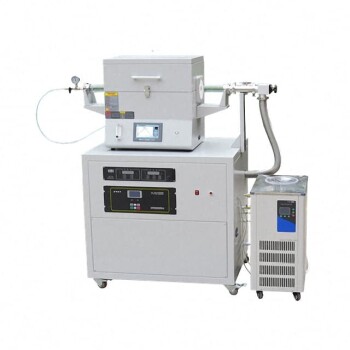
High vacuum tube furnaces protect sensitive chemical processes by creating a strictly isolated, contaminant-free environment. By extracting impurity gases prior to heating and maintaining superior sealing during the reaction, these systems prevent external air infiltration. This ensures that only the specific ratios of reaction gases, such as methane (CH4) and carbon dioxide (CO2), interact with the catalyst.
The integrity of data in methane dry reforming relies on eliminating environmental variables. High vacuum tube furnaces provide the essential isolation required to prevent catalyst oxidation, enabling researchers to attribute performance changes solely to the reaction mechanics rather than atmospheric contamination.
Establishing a Baseline of Purity
To understand the specific protections offered, one must look at how these furnaces manage the environment before the reaction even begins.
Removing Impurities Before Heating
The primary line of defense in a high vacuum tube furnace is its ability to extract impurity gases from the system entirely.
Before the temperature is raised, the vacuum system purges the tube of ambient air and residual moisture. This creates a clean "blank slate," ensuring that no unwanted background gases are present to interfere with the initial stages of the reaction.
Precise Gas Introduction
Once the vacuum is established, the furnace allows for the controlled introduction of reaction gases.
Operators can introduce specific ratios of CH4 and CO2 into the chamber. Because the system starts from a vacuum, the partial pressures of these gases can be calculated with high precision, free from the error introduced by residual atmospheric nitrogen or oxygen.
Maintaining Process Integrity
The value of a high vacuum tube furnace extends beyond the initial setup; it actively protects the reaction dynamics during high-temperature operation.
Superior Sealing Capabilities
The structural design of these furnaces prioritizes superior sealing to maintain the established atmosphere.
Standard furnaces may suffer from minor leaks that allow external air to seep in as thermal expansion occurs. High vacuum systems are engineered to prevent this infiltration entirely, maintaining the purity of the internal environment throughout the duration of the experiment.
Preventing Catalyst Oxidation
The most critical protection offered is the prevention of catalyst oxidation and deactivation.
In methane dry reforming, many catalysts are highly sensitive to oxygen. Even trace amounts of external air infiltration can oxidize the active metal sites, rendering the catalyst useless and ruining the experiment.
Enabling Mechanism Studies
By guaranteeing a pure environment, these furnaces protect the validity of scientific observation.
They allow researchers to study carbon deposition mechanisms and the evolution of catalyst activity without interference. When carbon forms on the catalyst, you can be certain it resulted from the CH4/CO2 reaction, not from contaminants burning off or reacting with leaks.
Understanding the Trade-offs
While high vacuum tube furnaces offer unmatched atmosphere control, they introduce specific operational demands that must be managed.
Stringent Maintenance Requirements
The "superior sealing" mentioned is not permanent; it requires distinct attention.
O-rings, flanges, and vacuum grease must be meticulously maintained. A single compromised seal negates the benefits of the entire system, turning a high-precision instrument into a standard furnace with a leak.
Complexity of Operation
Achieving and breaking a high vacuum adds time and complexity to the experimental workflow.
Unlike simple flow-through systems, these furnaces require pump-down cycles and leak checks before every run. This reduces sample throughput but is the necessary cost for data reliability in sensitive reactions.
Making the Right Choice for Your Goal
The decision to use a high vacuum tube furnace should be driven by the sensitivity of your specific catalytic material and the depth of data required.
- If your primary focus is studying reaction mechanisms: This equipment is essential to isolate variables, allowing you to observe carbon deposition and catalyst evolution in a pure environment.
- If your primary focus is working with oxygen-sensitive catalysts: The vacuum capability is non-negotiable to prevent immediate deactivation caused by external air infiltration.
Control the atmosphere, and you control the reliability of your results.
Summary Table:
| Feature | Protection Mechanism | Impact on DMR Process |
|---|---|---|
| Impurity Extraction | Pre-heating vacuum purge | Removes ambient air/moisture for a clean baseline |
| Superior Sealing | High-vacuum flanges/O-rings | Prevents oxygen infiltration during thermal expansion |
| Precise Gas Control | Controlled partial pressures | Ensures exact CH4/CO2 ratios for accurate data |
| Atmospheric Isolation | Total environmental control | Prevents catalyst deactivation and oxidation |
Elevate Your Research Precision with KINTEK
Don't let atmospheric contamination compromise your catalyst performance or reaction data. KINTEK specializes in advanced laboratory solutions designed for the most demanding thermal processes. Our high-performance high vacuum tube furnaces, CVD systems, and atmosphere-controlled reactors provide the rigorous isolation needed for methane dry reforming (DMR) and sensitive material synthesis.
From high-temperature reactors to specialized PTFE consumables and ceramics, we empower researchers with tools that guarantee reliability.
Ready to secure your process integrity? Contact our technical experts today to find the perfect furnace configuration for your laboratory needs.
References
- Jhonatan Luiz Fiorio, Giovanna Machado. Nanoengineering of Catalysts for Enhanced Hydrogen Production. DOI: 10.3390/hydrogen3020014
This article is also based on technical information from Kintek Solution Knowledge Base .
Related Products
- Laboratory High Pressure Vacuum Tube Furnace
- 1700℃ Controlled Atmosphere Furnace Nitrogen Inert Atmosphere Furnace
- Vacuum Sealed Continuous Working Rotary Tube Furnace Rotating Tube Furnace
- 1200℃ Split Tube Furnace with Quartz Tube Laboratory Tubular Furnace
- Ultra-High Temperature Graphite Vacuum Graphitization Furnace
People Also Ask
- What is the role of a high-vacuum tube furnace in preparing Co3S4@NiS2/C composite materials? Expert Synthesis Insights
- What role does a high-vacuum tube furnace play in synthesizing manganese nitride? Achieve Precise Phase & Stoichiometry.
- What is the primary function of a high-vacuum tube furnace in CVD synthesis of Sb-doped Bi2Se3? Precision Growth Control
- Role of High-Pressure Tube Furnace in Ru/OMC Synthesis: Achieve Precise Reduction & Nanostructure Control
- What are the primary functions of a high-pressure tube furnace? Expert Guide to MWCNT/Metal Oxide Synthesis