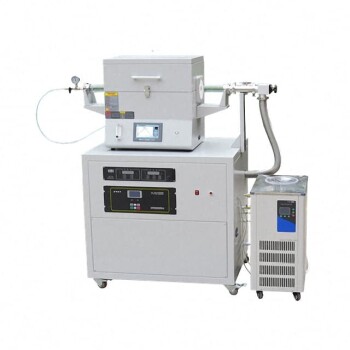
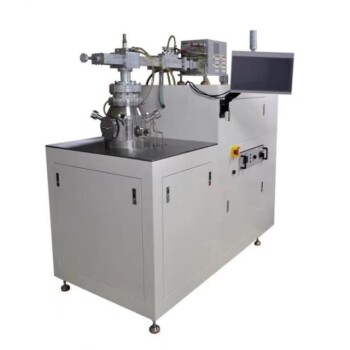
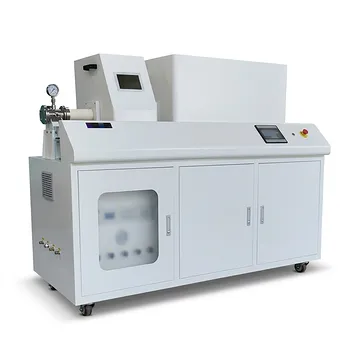
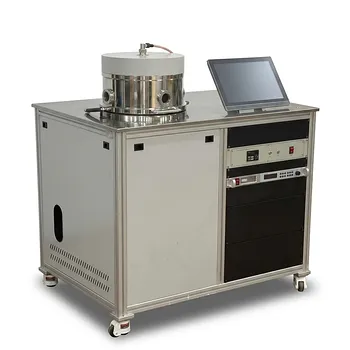
Chemical Vapor Deposition (CVD) systems serve as the primary engine for scaling environmental remediation technologies from the lab to the field. They facilitate the creation of large-area photocatalytic coatings by utilizing chemical reactions of gas-phase precursors to grow solid films on specific substrates. This process is uniquely capable of producing the uniform, continuous, and highly adherent layers required for effective environmental cleanup.
CVD systems are the key to unlocking the industrial viability of photocatalytic films. By combining rapid processing speeds with the ability to engineer complex material structures, these systems allow for the creation of high-performance coatings that are both durable and optimized for specific environmental tasks.
The Mechanics of High-Quality Coatings
Achieving Uniformity at Scale
For environmental remediation to be effective, coatings must cover large surface areas without gaps or weak points.
CVD systems excel here by growing films that are uniform and continuous across the entire substrate.
This ensures that the catalytic activity is consistent across the entire treated area, preventing "dead zones" where pollutants might escape untreated.
Ensuring Durability
A major challenge in environmental applications is ensuring the active coating stays attached to the base material.
CVD produces highly adherent catalytic layers.
Because the film is grown through a chemical reaction directly on the surface, the bond is significantly stronger than coatings applied through simple physical deposition.
Rapid Processing Capabilities
Time is a critical factor when manufacturing materials for large-scale infrastructure.
CVD systems offer rapid processing capabilities, making them essential for mass production.
This speed allows manufacturers to produce large quantities of treated materials efficiently, meeting the volume demands of environmental projects.
Advanced Engineering for Optimization
Bandgap Engineering
To degrade pollutants effectively, photocatalytic films must react to specific wavelengths of light.
CVD systems are particularly suitable for bandgap engineering.
This allows engineers to precisely tune the electronic properties of the material, maximizing its ability to absorb light and trigger the necessary chemical reactions.
Constructing Heterojunctions
Advanced environmental coatings often require combining different materials to enhance performance.
CVD enables the construction of heterojunctions within the film.
This capability is vital for complex material systems, allowing for the creation of multi-layered structures that move charges more efficiently to break down contaminants.
Understanding the Operational Considerations
Managing Process Complexity
While versatile, CVD is inherently complex because it relies on gas-phase precursors.
Operators must manage chemical reactions rather than simple physical applications.
This requires precise control over system parameters to ensure the reactions occur exactly as intended on the substrate surface.
Pressure Condition Requirements
CVD systems do not operate in a standard open-air environment.
They require specific pressure conditions to function correctly.
Whether operating at low or atmospheric pressures, maintaining the correct environment is critical for the stability and quality of the film growth.
How to Apply This to Your Project
If you are evaluating coating technologies for environmental remediation, consider your specific performance targets.
- If your primary focus is Mass Production: Leverage CVD for its rapid processing capabilities to generate large-area coatings quickly without sacrificing uniformity.
- If your primary focus is High Efficiency: Utilize CVD to implement bandgap engineering and heterojunctions to maximize the photocatalytic activity of your films.
CVD is not just a coating method; it is a precision engineering tool that transforms raw chemical precursors into durable, active solutions for environmental cleanup.
Summary Table:
| Key Feature | Benefit for Environmental Remediation |
|---|---|
| Uniform Film Growth | Ensures consistent catalytic activity and prevents untreated "dead zones." |
| High Adherence | Stronger chemical bonding ensures coating durability in harsh environments. |
| Rapid Processing | High-throughput capabilities essential for mass-producing treated materials. |
| Bandgap Engineering | Precision tuning of materials to maximize light absorption and pollutant degradation. |
| Heterojunction Construction | Enables multi-layered structures for more efficient contaminant breakdown. |
Elevate Your Environmental Engineering with KINTEK Precision
Transitioning from lab-scale prototypes to industrial environmental solutions requires high-performance equipment that guarantees uniformity and durability. KINTEK specializes in advanced laboratory equipment, offering state-of-the-art CVD and PECVD systems designed for the precise engineering of large-area coatings.
Our extensive portfolio also includes high-temperature furnaces, crushing and milling systems, and high-pressure reactors to support every stage of your material research and production. Whether you are focused on bandgap engineering for photocatalysis or developing complex heterojunctions, KINTEK provides the tools needed to maximize efficiency and industrial viability.
Ready to scale your environmental remediation technology? Contact our experts today to find the perfect CVD system for your project's unique requirements.
References
- Suzan Biran Ay, Nihan Kosku Perkgöz. Nanotechnological Advances in Catalytic Thin Films for Green Large‐Area Surfaces. DOI: 10.1155/2015/257547
This article is also based on technical information from Kintek Solution Knowledge Base .
Related Products
- Chemical Vapor Deposition CVD Equipment System Chamber Slide PECVD Tube Furnace with Liquid Gasifier PECVD Machine
- Microwave Plasma Chemical Vapor Deposition MPCVD Machine System Reactor for Lab and Diamond Growth
- 915MHz MPCVD Diamond Machine Microwave Plasma Chemical Vapor Deposition System Reactor
- Customer Made Versatile CVD Tube Furnace Chemical Vapor Deposition Chamber System Equipment
- Split Chamber CVD Tube Furnace with Vacuum Station Chemical Vapor Deposition System Equipment Machine
People Also Ask
- What are the advantages of chemical vapor deposition? Achieve Superior Thin Films for Your Lab
- What types of substrates are used in CVD to facilitate graphene films? Optimize Graphene Growth with the Right Catalyst
- What is the chemical vapor deposition growth process? Build Superior Thin Films from the Atom Up
- How expensive is chemical vapor deposition? Understanding the True Cost of High-Performance Coating
- Why is Chemical Vapor Deposition (CVD) equipment uniquely suited for constructing hierarchical superhydrophobic structures?