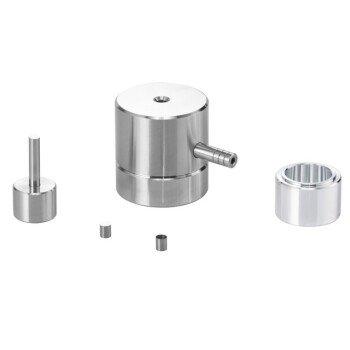
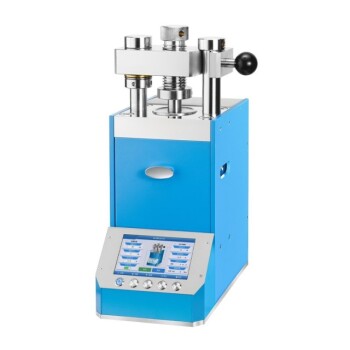
Specialized pressure dies act as the critical structural interface between mechanical force and chemical bonding. Their primary role is to secure the multi-layer battery stack—comprising the cathode, electrolyte, anode, and current collector—while transferring precise uniaxial pressure. By maintaining exceptional dimensional stability, these dies ensure uniform force distribution during transient chemical reactions to eliminate voids and achieve solid integration.
The die is not merely a clamp; it is a precision instrument that dictates the quality of the device's internal structure. It facilitates the tight physical and chemical integration of components by maintaining absolute uniformity while transient reactions fuse the layers together.
The Mechanics of Multi-Layer Lamination
Securing the Device Architecture
The first function of the specialized die is to act as a containment vessel for the battery's complex architecture.
It must securely hold multiple distinct components—the cathode, electrolyte, anode, and current collector—in place.
This prevents lateral movement or misalignment of the layers before the bonding process is complete.
Transferring Uniaxial Pressure
The die is the mechanism through which force is applied to the stack.
It is responsible for transferring uniaxial pressure (force applied in a single vertical direction) deep into the multi-layer structure.
This pressure is the driving force that brings separate materials into the intimate contact required for lamination.
Achieving Interface Integrity
Uniform Pressure Distribution
For a solid-state battery to function correctly, every micron of the interface surface area must be treated equally.
The pressure die must distribute force uniformly across all interface layers.
Even slight variations in pressure distribution can lead to incomplete bonding or structural weak points.
Managing Transient Chemical Reactions
Cold Sintering is not a static mechanical process; it involves active chemistry.
The lamination occurs while transient chemical reactions are taking place within the stack.
The die stabilizes the physical structure during this dynamic phase, ensuring the chemical bonds form correctly across the interfaces.
The Necessity of Precision
Dimensional Stability
To function effectively, the pressure die requires excellent dimensional stability.
It must not warp, compress, or deform under the high loads required for lamination.
Any lack of rigidity in the die would transfer imperfections to the battery layers, compromising performance.
Eliminating Gaps
The ultimate measure of the die's success is the absence of voids.
By maintaining precision under pressure, the die facilitates the elimination of gaps between the solid layers.
This results in tight physical and chemical integration, creating a cohesive monolithic device rather than a stack of loose parts.
Understanding the Engineering Constraints
The Risk of deformation
If a die lacks the requisite stiffness or precision, it cannot maintain uniform pressure.
This failure leads to heterogeneous interfaces where the transient chemical reactions do not complete uniformly.
The result is a battery with internal voids and poor connectivity between the anode, electrolyte, and cathode.
Complexity of Multi-Layer Stacks
As the number of layers increases, the demand on the pressure die increases.
Securing the current collector alongside active materials requires a die geometry that accommodates different material behaviors.
A die that cannot secure all layers simultaneously will result in delamination or electrical disconnects.
Ensuring Fabrication Success
To achieve a high-performance solid-state device, the tooling must be matched to the sensitivity of the lamination process.
- If your primary focus is Electrochemical Performance: Prioritize dies with maximum dimensional stability to ensure the uniform pressure required for consistent chemical integration.
- If your primary focus is Structural Longevity: Ensure the die mechanism is capable of eliminating all gaps to prevent delamination between the electrolyte and the electrodes.
Precision tooling is the only way to transform separate battery components into a unified, high-integrity solid-state device.
Summary Table:
| Feature | Role in Cold Sintering Lamination | Impact on Battery Quality |
|---|---|---|
| Structural Containment | Secures cathode, electrolyte, and anode layers | Prevents misalignment and lateral shifting |
| Uniaxial Pressure | Transfers vertical force deep into the stack | Drives intimate contact for material bonding |
| Pressure Uniformity | Distributes force equally across interfaces | Eliminates gaps and prevents internal voids |
| Dimensional Stability | Maintains rigidity under high mechanical loads | Ensures consistent transient chemical reactions |
| Interface Integration | Facilitates tight physical and chemical bonding | Creates a cohesive, high-performance device |
Precision tooling is critical for the next generation of solid-state energy storage. KINTEK specializes in advanced laboratory solutions, including high-precision hydraulic pellet presses and custom specialized pressure dies designed for battery research. From high-temperature reactors to crushing and milling systems, we provide the tools needed to eliminate voids and achieve superior interface integrity. Contact KINTEK today to enhance your research and transform separate components into high-performance, monolithic battery devices.
Related Products
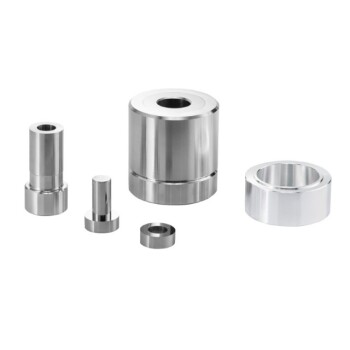
- Ring Press Mold for Lab Applications
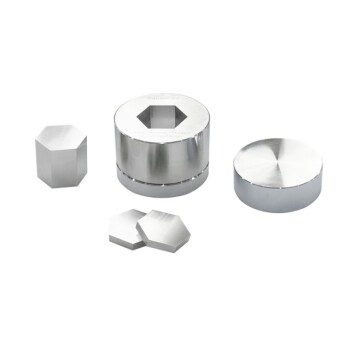
- Polygon Press Mold for Lab
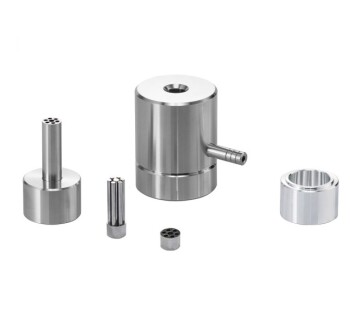
- Special Heat Press Mold for Lab Use
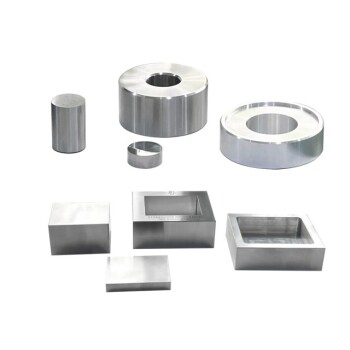
- Special Shape Press Mold for Lab
- Cylindrical Press Mold for Lab Applications
People Also Ask
- How to use a press mold? Master the Art of Creating Consistent Ceramic Forms
- Why are pressure molds with non-conductive resin inner walls required for battery testing? Ensure Data Accuracy
- What is the press mould method? A Guide to Consistent, Detailed Ceramic Forms
- What is the function of press molds during the preparation of SiCf/Ti-43Al-9V composites? Achieve Structural Precision
- What is a press mold used for? Achieve Repeatable Precision and Efficiency