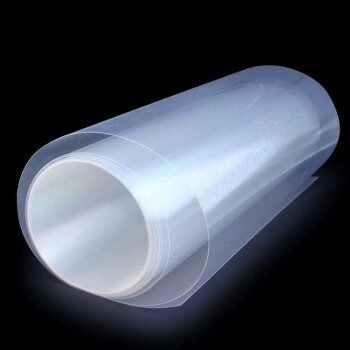
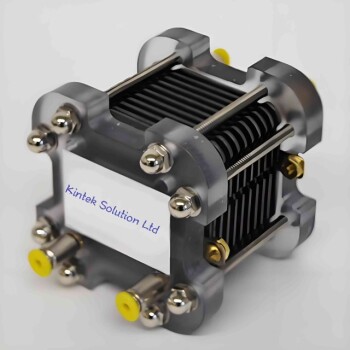
The cation exchange membrane serves as the critical regulator of mass transport within an H-type electrolytic cell during glycerol oxidation. Its primary function is to physically separate the anode and cathode chambers while facilitating the selective migration of protons to maintain the system's electrical balance.
Core Takeaway While the membrane completes the electrical circuit by allowing proton flow, its most vital role is isolation. By strictly preventing organic substrates and oxidation products from crossing between chambers, it ensures a stable chemical environment and preserves the purity of the reaction products.
The Mechanics of Selective Permeability
Completing the Electrical Circuit
For electrochemical oxidation to proceed, the circuit must remain closed. The cation exchange membrane enables this by allowing the transport of protons ($H^+$) between the chambers.
This ionic movement compensates for the charge transfer occurring at the electrodes. Without this flow of protons, the circuit acts as an open loop, and the reaction halts immediately.
Isolating the Reaction Chambers
The membrane creates a physical boundary between the anolyte (the solution at the anode) and the catholyte (the solution at the cathode).
This separation is not merely structural; it defines the chemical identity of each chamber. It ensures that the reactants specific to the anode do not physically interact with the processes occurring at the cathode.
Ensuring Chemical Purity and Stability
Preventing Cross-Contamination
A major challenge in electrolytic cells is the unintended mixing of chemicals. The membrane strictly prevents the crossover of organic substrates (like glycerol) and their oxidation products.
If these organic molecules were allowed to migrate to the opposing chamber, they could contaminate the catholyte. This would complicate product recovery and potentially trigger unwanted side reactions.
Maintaining a Controlled Environment
By restricting movement to only specific ions (cations), the membrane stabilizes the local chemistry of the cell.
This selective permeability ensures that the oxidation reaction occurs in a consistent environment. It allows researchers and engineers to precisely control the reaction conditions without interference from fluctuating chemical concentrations caused by mixing.
Understanding the Trade-offs
The Balance Between Conductivity and Selectivity
Ideally, a membrane would offer zero resistance to protons and 100% resistance to organic molecules. In practice, the membrane is a control point where these two factors interact.
If the membrane is highly permeable to ensure maximum proton flow, there is a theoretical risk of reducing its structural isolation properties. Conversely, a membrane that is too dense might impede proton flow, increasing the resistance of the cell and lowering energy efficiency. The goal is to utilize a membrane that strictly enforces separation without becoming a bottleneck for the electrical current.
Optimizing Your Electrolytic Setup
When designing or operating an H-type cell for glycerol oxidation, the membrane determines the limits of your system's purity and efficiency.
- If your primary focus is Product Purity: Prioritize a membrane with high selectivity to strictly block organic crossover, ensuring the anolyte and catholyte remain distinct.
- If your primary focus is Reaction Stability: Ensure the membrane is properly seated to maintain a controlled chemical environment, preventing fluctuations that disrupt the oxidation rate.
The cation exchange membrane is not just a separator; it is the active filter that dictates the quality and success of the electrochemical process.
Summary Table:
| Feature | Function in H-Type Electrolytic Cell |
|---|---|
| Selective Permeability | Facilitates proton ($H^+$) transport while blocking organic molecules. |
| Circuit Completion | Allows ionic movement to maintain electrical balance and continuous reaction. |
| Physical Isolation | Prevents cross-contamination between anolyte and catholyte chambers. |
| Product Purity | Ensures oxidation products remain in the anode chamber for easier recovery. |
| Process Stability | Maintains a controlled chemical environment by restricting reactant migration. |
Optimize Your Electrochemical Research with KINTEK
Precision in glycerol oxidation requires more than just high-quality reagents—it demands the right hardware. KINTEK specializes in advanced laboratory equipment designed for rigorous electrochemical applications. From high-performance electrolytic cells and electrodes to specialized battery research tools, we provide the infrastructure needed to ensure maximum product purity and reaction stability.
Our extensive portfolio includes:
- Electrolytic cells optimized for selective mass transport.
- High-temperature high-pressure reactors for challenging oxidation environments.
- Precision homogenizers and cooling solutions to stabilize your reaction conditions.
- Essential consumables including PTFE products, ceramics, and crucibles.
Don't let cross-contamination or electrical resistance hinder your results. Partner with KINTEK for reliable, high-quality laboratory solutions.
Contact us today to find the perfect cell for your lab!
References
- Michael Guschakowski, Uwe Schröder. Direct and Indirect Electrooxidation of Glycerol to Value‐Added Products. DOI: 10.1002/cssc.202100556
This article is also based on technical information from Kintek Solution Knowledge Base .
Related Products
- Anion Exchange Membrane for Laboratory Use
- Proton Exchange Membrane for Batteries Lab Applications
- Customizable PEM Electrolysis Cells for Diverse Research Applications
- FS Electrochemical Hydrogen Fuel Cells for Diverse Applications
People Also Ask
- What is the role of an Anion Exchange Membrane (AEM)? Boost Safety and Efficiency in Photoelectrochemical Systems
- What role does an anion exchange membrane play in a PEC battery? Ensure Safe, High-Purity Hydrogen Production
- What role do ion exchange membranes play in zero-gap CO2 reduction? Master the Engine of Selective Transport
- What is the role of an ion exchange membrane in MCCA Kolbe electrolysis? Enhance Purity & Safety in Your Lab
- What should be considered when selecting an ion exchange membrane? Key Factors for Optimal Performance