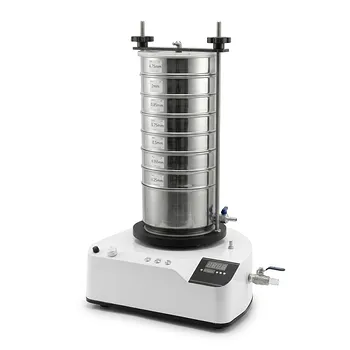
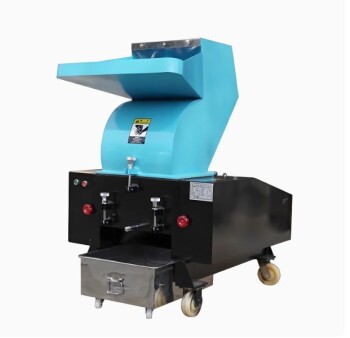
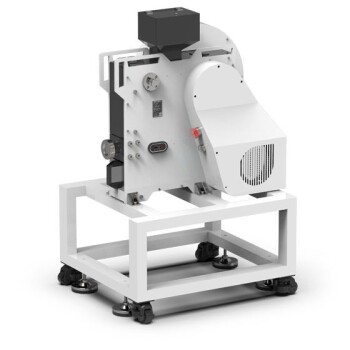
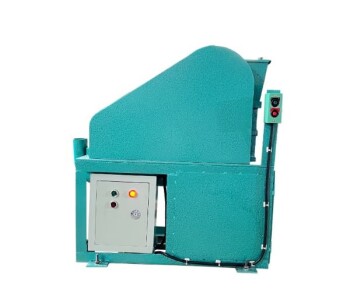
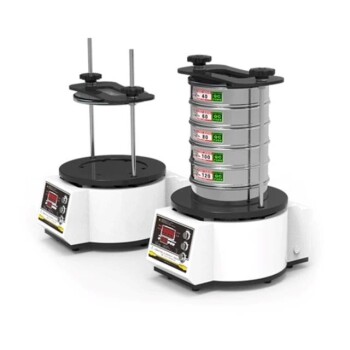
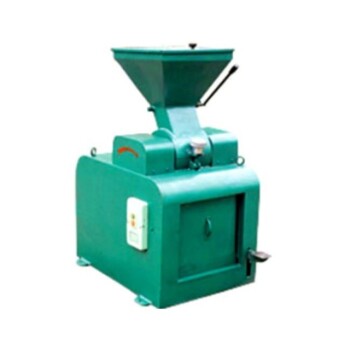
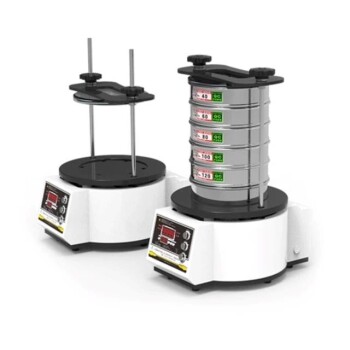
The crushing and sieving system functions as the fundamental geometric regulator in the production of immobilized beads. It transforms raw components, specifically natural minerals and organic carriers, into strictly controlled particle sizes. This mechanical refinement is not merely about physical reduction; it is the primary method for unlocking the chemical potential required to treat Acid Mine Drainage (AMD).
By processing materials into specific micro-ranges, this system maximizes specific surface area and optimizes adsorption capacity. It ensures that functional components are uniformly distributed within the bead matrix, directly determining the overall efficiency of the wastewater treatment process.
The Mechanics of Material Optimization
Achieving Precise Particle Dimensions
The primary function of the system is to process raw materials into exact size specifications suitable for immobilization.
For natural minerals like maifan stone, the system targets a precise range of 0.046–0.074 mm.
For organic carriers such as bagasse, the target size is processed to approximately 0.149 mm.
Increasing Specific Surface Area
The reduction of particle size has a direct, non-linear impact on the material's reactive capabilities.
By crushing materials to these fine dimensions, the system significantly increases the specific surface area available for contact with wastewater.
This increased surface area is the physical mechanism that optimizes adsorption capacity, allowing the beads to trap contaminants more effectively.
Enhancing Matrix Structural Integrity
Ensuring Uniform Distribution
Beyond individual particle performance, the system plays a vital role in the collective structure of the immobilized bead.
Sieving ensures that only particles within the target range are introduced to the immobilization matrix.
This strict size control guarantees a uniform distribution of maifan stone and bagasse throughout the bead, preventing clumping and ensuring consistent treatment results.
The Critical Importance of Precision
The Risks of Improper Sizing
Omitting or poorly executing this stage compromises the entire treatment process.
Larger, unregulated particles possess a lower surface area-to-volume ratio, which directly diminishes adsorption efficiency.
Furthermore, inconsistent particle sizes lead to a heterogeneous matrix, resulting in unpredictable performance during the subsequent wastewater treatment phase.
Optimizing Your Preparation Protocol
To maximize the efficacy of your immobilized beads, you must view crushing and sieving as a variable of chemical performance, not just physical preparation.
- If your primary focus is Adsorption Capacity: Prioritize the finer end of the spectrum (e.g., maifan stone near 0.046 mm) to maximize specific surface area.
- If your primary focus is Matrix Homogeneity: Ensure your sieving tolerances are tight to guarantee uniform distribution of organic carriers like bagasse.
Mechanical precision in the crushing phase is the primary driver of chemical success in the treatment phase.
Summary Table:
| Material Component | Target Particle Size (mm) | Core Function in Bead Preparation |
|---|---|---|
| Natural Minerals (Maifan Stone) | 0.046 – 0.074 mm | Maximizes specific surface area and adsorption capacity. |
| Organic Carriers (Bagasse) | ~0.149 mm | Ensures structural integrity and matrix homogeneity. |
| Combined System | Precision Sieving | Guarantees uniform distribution and prevents clumping. |
Elevate Your AMD Treatment Efficiency with KINTEK Precision
High-performance immobilized beads require uncompromising mechanical precision. KINTEK specializes in advanced crushing and milling systems and high-accuracy sieving equipment designed to help laboratory researchers achieve the exact particle dimensions needed for optimal adsorption and matrix homogeneity.
From processing raw minerals to refining organic carriers, our equipment ensures your wastewater treatment materials meet the strictest specifications. Beyond material preparation, KINTEK offers a comprehensive range of laboratory solutions, including high-temperature furnaces, hydraulic presses, and PTFE consumables to support your entire research workflow.
Ready to optimize your bead preparation protocol? Contact KINTEK today to discover how our expert laboratory solutions can drive your chemical success!
References
- Yanrong Dong, Mingwei Li. Dynamic Experimental Study on Treatment of Acid Mine Drainage by Bacteria Supported in Natural Minerals. DOI: 10.3390/en13020439
This article is also based on technical information from Kintek Solution Knowledge Base .
Related Products
- Laboratory Test Sieves and Sieving Machines
- Three-dimensional electromagnetic sieving instrument
- Laboratory Vibratory Sieve Shaker Machine for Dry and Wet Three-Dimensional Sieving
- Powerful Plastic Crusher Machine
- Laboratory Jaw Crusher
People Also Ask
- What are laboratory test sieves used for? A Guide to Particle Size Analysis
- How do you calculate the sieve test? Master Particle Size Distribution for Quality Control
- How does a lab test sieve contribute to biomass charcoal powder preparation? Achieve Uniform Particle Size
- What are the specifications for test sieves? A Guide to ASTM & ISO Standards for Accurate Particle Analysis
- What materials are required for sieving? Achieve Accurate Particle Size Analysis