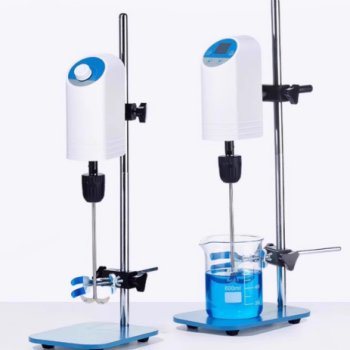
A dual-blade stirring mechanism is the primary driver of homogeneity during the processing of Chromel-TaC melt. Its function is to generate high mechanical shear forces and fluid vortices that physically break apart clustered Tantalum Carbide (TaC) particles, ensuring they are fully wetted by the molten matrix and maintained in a uniform suspension to prevent segregation.
The mechanism acts as a critical kinetic stabilizer, transforming a mixture of raw components into a cohesive composite. By sustaining shear forces over time, it overcomes the natural tendency of reinforcement particles to agglomerate, ensuring the microstructural consistency required for high-quality materials.
The Mechanics of Particle Dispersion
Generating Mechanical Shear
The rotation of the dual blades creates intense mechanical shear within the melt. This physical force is essential for overcoming the cohesive forces that naturally draw particles together. Without this shear, the melt would remain a heterogeneous mixture rather than a unified composite.
Breaking Down Agglomerations
Tantalum Carbide (TaC) particles have a natural tendency to cluster, or agglomerate. The stirring mechanism utilizes fluid vortices to impact these clusters directly. This action fractures the agglomerations, dispersing individual particles throughout the liquid matrix.
Ensuring Microstructural Integrity
Achieving Complete Wetting
Dispersion alone is not enough; the particles must adhere to the matrix. The stirring process forces the molten metal into intimate contact with the surface of the TaC particles. This ensures the reinforcement phase is thoroughly wetted, a prerequisite for strong bonding in the final solid state.
Preventing Segregation
In a static melt, particles may settle or float due to density differences. The continuous motion provided by the dual-blade mechanism maintains a dynamic suspension. This prevents the particles from segregating, ensuring that the final material has a uniform distribution of reinforcement.
Critical Process Parameters and Trade-offs
The Necessity of Duration
Achieving a uniform suspension is not instantaneous. The process requires a sustained duration, such as 30 minutes, to be effective. Cutting this time short can result in incomplete wetting or remaining particle clusters.
Balancing Speed and Stability
The mechanism relies on specific rotation speeds to generate the necessary vortices. If the speed is too low, the shear force will be insufficient to break agglomerations. Conversely, the process must be controlled to maintain a stable melt environment while generating the required turbulence.
Optimizing the Stirring Process
To ensure the highest quality Chromel-TaC composite, you must align the stirring parameters with your structural goals.
- If your primary focus is microstructural uniformity: Prioritize maintaining a specific rotation speed that is sufficient to generate consistent fluid vortices throughout the melt volume.
- If your primary focus is particle-matrix bonding: Strictly adhere to the required processing time (e.g., 30 minutes) to guarantee that all particles are thoroughly wetted.
The dual-blade stirring mechanism is not just a mixer; it is the fundamental tool for engineering the internal architecture of the composite.
Summary Table:
| Function | Mechanism | Impact on Chromel-TaC Material |
|---|---|---|
| Dispersion | High Mechanical Shear | Breaks down TaC particle agglomerations |
| Wetting | Sustained Fluid Vortices | Ensures intimate contact between matrix and particles |
| Uniformity | Dynamic Suspension | Prevents segregation and settling of reinforcements |
| Consistency | Process Timing (30 min) | Guarantees complete microstructural integrity |
Elevate Your Advanced Material Processing with KINTEK
Precise control over melt homogeneity is vital for high-performance composites. KINTEK specializes in precision laboratory equipment, providing the advanced stirring systems and high-temperature furnaces needed to master complex alloys and composites like Chromel-TaC.
Whether you require high-temperature vacuum furnaces, induction melting systems, or specialized crushing and milling equipment, our solutions are engineered for researchers and manufacturers who demand microstructural perfection. Enhance your lab’s capabilities and ensure superior bonding in your materials—Contact KINTEK experts today for a tailored solution!
References
- B. Mohmed Fazil, P.M. Suresh. Tribological Behaviors Analysis of Synthesized Chromel Composite. DOI: 10.1590/1980-5373-mr-2022-0008
This article is also based on technical information from Kintek Solution Knowledge Base .
Related Products
- High Performance Laboratory Stirrers for Diverse Applications
- Laboratory Small Constant Temperature Heated Magnetic Stirrer Heater and Stirrer
- Custom PTFE Teflon Parts Manufacturer for Magnetic Stirring Bar
People Also Ask
- How does a laboratory stirrer influence MOF product quality? Master Precision in Non-Solvothermal Synthesis
- What critical role does a Laboratory Stirrer play during leaching? Enhance Titanium-Magnesium Waste Recovery
- What is the primary function of laboratory stirring equipment in the preparation of compost leachate? Optimize Extraction
- What is a laboratory mixer? A Guide to Achieving Perfect Sample Homogeneity
- What is a laboratory mixer used for? Choose the Right Tool for Liquids or Solids