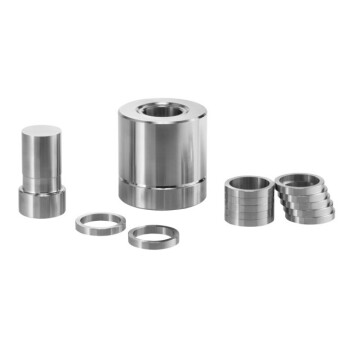
The graphite mold is the critical interface between mechanical force and thermal energy during the densification process. Specifically for $Bi_2Se_3$, the mold serves as a high-purity containment vessel that facilitates the application of 80 MPa of pressure at temperatures of 485 °C. It ensures that both heat and mechanical loads are distributed uniformly across the powder, preventing sample contamination and promoting full material densification.
Core Takeaway: The graphite mold acts as a high-strength, thermally conductive medium that transforms loose $Bi_2Se_3$ powder into a dense solid by precisely transmitting uniaxial pressure and uniform heat within a vacuum or inert environment.
Mechanical Integrity and Pressure Transmission
Efficient Force Distribution
The graphite mold acts as the primary medium for transferring uniaxial mechanical pressure from the press punches to the powder sample. In the case of $Bi_2Se_3$, it must withstand 80 MPa without significant deformation, ensuring that the pressure is distributed uniformly to achieve a homogenous density.
High-Temperature Structural Stability
Unlike many materials that weaken as they heat, graphite maintains exceptional mechanical strength at the processing temperature of 485 °C. This stability ensures that the mold remains rigid, allowing the $Bi_2Se_3$ material to be compressed into its intended shape with high dimensional precision.
Shaping and Containment
The mold serves as a high-strength container that defines the final geometric shape of the sintered product. By resisting the outward expansion forces of the powder under pressure, it ensures the resulting material meets strict structural requirements.
Thermal Management and Chemical Purity
Uniform Heat Distribution
Graphite’s excellent thermal conductivity ensures that heat is applied evenly across the entire sample body. This uniformity is vital for $Bi_2Se_3$ to prevent localized thermal gradients, which could otherwise lead to internal stresses or inconsistent material properties.
Prevention of Sample Contamination
Using high-purity graphite is essential to protect the $Bi_2Se_3$ powder from impurities during the hot-pressing cycle. The material is chemically stable in vacuum or inert environments, ensuring that the mold does not react with the sample during the high-temperature densification process.
Protective Atmosphere
In some contexts, the graphite mold helps maintain a reducing atmosphere, which can protect sensitive materials from oxidation by residual oxygen. This provides an additional layer of safety for the powder, ensuring the final product maintains its intended chemical composition.
Understanding the Trade-offs
Mechanical Limits and Fracture Risks
While graphite is strong, it is also brittle; exceeding its maximum tensile or compressive limits can lead to catastrophic mold failure. Operators must carefully balance the 80 MPa pressure requirement against the specific grade and wall thickness of the graphite used.
Oxidative Degradation
Graphite is highly susceptible to oxidative loss if exposed to oxygen at elevated temperatures. To maintain the service life of the mold and the purity of the $Bi_2Se_3$, the process must be strictly maintained within a high-quality vacuum or a high-purity inert gas environment.
Wear and Consumable Costs
Despite its durability, graphite molds are consumable components that experience wear over multiple cycles. Friction between the powder and the mold walls can lead to surface degradation, eventually necessitating replacement to maintain dimensional accuracy.
How to Apply This to Your Project
Optimizing the Hot-Pressing Workflow
Effective material synthesis requires aligning your mold selection with your specific performance targets for $Bi_2Se_3$.
- If your primary focus is material purity: Utilize high-purity, electronic-grade graphite and ensure a high-vacuum environment to prevent any chemical interaction or oxidative contamination.
- If your primary focus is structural homogeneity: Prioritize a mold design with thick walls and high-density graphite to ensure perfectly uniform pressure distribution at the 80 MPa threshold.
- If your primary focus is cost-efficiency: Implement protective inert atmospheres and graphite foils to minimize mold wear and extend the service life of each unit.
By treating the graphite mold as a precision instrument rather than a simple container, you ensure the consistent production of high-performance $Bi_2Se_3$ materials.
Summary Table:
| Key Role | Function in Process | Benefit for Bi2Se3 Materials |
|---|---|---|
| Pressure Transmission | Distributes 80 MPa uniaxial force | Achieves homogenous material density |
| Thermal Management | Conducts heat evenly at 485 °C | Prevents thermal gradients and internal stress |
| Containment | Defines final geometric shape | Ensures high dimensional precision |
| Chemical Purity | High-purity graphite interface | Protects against contamination and oxidation |
| Stability | Maintains strength at high temp | Resists deformation under heavy loads |
Elevate Your Material Synthesis with KINTEK
Precision is the difference between a successful sample and a failed experiment. KINTEK specializes in advanced laboratory solutions, providing high-performance hot-pressing systems, vacuum furnaces, and high-purity graphite consumables designed to withstand the rigorous demands of $Bi_2Se_3$ research.
From achieving perfect densification with our hydraulic presses to maintaining purity with our specialized crucibles and molds, we offer the tools you need for superior results.
Ready to optimize your lab's efficiency? Contact us today to discuss your specific project requirements and discover how our expertise can accelerate your material breakthroughs!
References
- Zicheng Yuan, Yu Liu. Exploring Material Properties and Device Output Performance of a Miniaturized Flexible Thermoelectric Generator Using Scalable Synthesis of Bi2Se3 Nanoflakes. DOI: 10.3390/nano13131937
This article is also based on technical information from Kintek Solution Knowledge Base .
Related Products
- Double Plate Heating Press Mold for Lab
- Special Heat Press Mold for Lab Use
- Ball Press Mold for Lab
- Round Bidirectional Press Mold for Lab
- Anti-Cracking Press Mold for Lab Use
People Also Ask
- How to use a press mold? Master the Art of Creating Consistent Ceramic Forms
- What is the process of mold press? A Step-by-Step Guide to Compression Molding
- What is the primary function of mold pressing for LAGP powders? Achieve High-Performance Solid Electrolytes
- Why are pressure molds with non-conductive resin inner walls required for battery testing? Ensure Data Accuracy
- What is the press mould method? A Guide to Consistent, Detailed Ceramic Forms