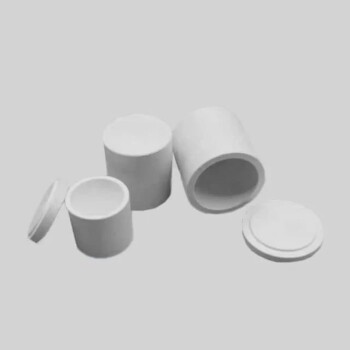
In high-temperature chemical activation, the choice of vessel is as critical as the activation agent itself. A high-purity quartz crucible serves as the primary reaction vessel, providing a chemically inert and thermally stable environment that prevents cross-contamination between the container and the reactants. This ensures that the final ultramicroporous carbon derived from peat reaches maximum chemical purity and structural integrity at temperatures reaching 973 K.
The central takeaway: The high-purity quartz crucible acts as a non-reactive barrier that preserves the chemical signature of the peat-derived carbon while protecting surrounding furnace hardware from corrosive zinc chloride vapors.
The Role of Chemical Inertness in Corrosive Environments
Resisting Zinc Chloride (ZnCl2) Attack
Zinc chloride is a highly corrosive activation agent when heated to the temperatures required for peat pyrolysis. High-purity quartz is uniquely suited for this environment because it does not react with ZnCl2, ensuring the chemical process remains focused entirely on the development of the peat’s pore structure.
Preventing Cross-Contamination
At temperatures up to 973 K, trace elements from lower-quality containers can migrate into the sample. The high-purity nature of the quartz prevents impurity ions from leaching into the carbon lattice, which is vital for maintaining the performance of ultramicroporous materials.
Ensuring Product Purity
By serving as a chemically stable container, the crucible ensures that the resulting biochar or activated carbon is free from metallic or mineral by-products. This purity is essential for applications where the pore volume and surface chemistry of the peat-derived carbon must be precisely controlled.
Thermal Stability and Structural Integrity
Maintaining Performance at 973 K
The pyrolysis of peat requires sustained high temperatures to drive off volatiles and facilitate activation. High-purity quartz maintains its structural stability at these levels, resisting deformation or melting that would otherwise compromise the experiment or the furnace.
Superior Thermal Shock Resistance
Laboratory processes often involve rapid heating cycles to simulate industrial environments. Quartz possesses excellent thermal shock resistance, allowing the crucible to withstand sudden temperature shifts without cracking, which protects the sample and the heating elements.
Accurate Mass Balance Calculations
Because the quartz crucible does not react with the biomass or the activation agent, it does not gain or lose mass during the reaction. This stability is critical for researchers who need to perform accurate mass balance calculations to determine the yield and efficiency of the peat activation process.
Protecting the Processing Environment
Safeguarding Furnace Components
During activation, peat releases volatile components that can be highly corrosive to the inner walls of a tube furnace. The crucible acts as the first line of defense, containing the primary reaction and reducing the direct exposure of the furnace's ceramic or metal components to these harsh vapors.
Intensifying the Oxygen-Limited Environment
When used within a sealed system, the crucible helps maintain the necessary oxygen-limited environment for pyrolysis. This prevents the over-oxidation of the peat's surface, ensuring the thermochemical decomposition results in a consistent and high-quality carbon structure.
Understanding the Trade-offs
Fragility and Handling
While quartz is chemically and thermally robust, it is physically brittle. High-purity quartz crucibles require careful handling to avoid mechanical chips or fractures, which can be a disadvantage compared to more durable but less inert metallic alternatives.
Temperature Limitations and Devitrification
Although quartz is stable at 973 K, prolonged exposure to even higher temperatures (typically above 1100°C–1200°C) can lead to devitrification, where the glass begins to crystallize and lose its structural integrity. Users must monitor the cumulative "heat clock" of the crucible to ensure it remains safe for use.
Potential for Trace Surface Adsorption
Even with high-purity materials, the surface of a used crucible can accumulate trace residues from previous experiments if not cleaned aggressively. In highly sensitive ultramicroporous carbon production, any residue could act as a catalyst or contaminant in subsequent runs.
Applying This to Your Project
Recommendations for Material Selection
- If your primary focus is maximum chemical purity: Always opt for high-purity quartz (99.9%+) to eliminate the risk of ion migration into the carbon pores.
- If your primary focus is experimental repeatability: Use quartz crucibles to ensure that no container-side reactions interfere with your mass balance or yield data.
- If your primary focus is equipment longevity: Utilize deep-walled quartz crucibles to better contain volatile splatter and protect your furnace's heating elements and tube walls.
Ultimately, the high-purity quartz crucible is the silent enabler of high-performance carbon synthesis, providing the sterile, stable stage necessary for complex thermochemical transformations.
Summary Table:
| Feature | Role in Pyrolysis & Activation | Benefit to Research |
|---|---|---|
| Chemical Inertness | Resists corrosive ZnCl2 attack | Prevents sample contamination & ensures carbon purity |
| Thermal Stability | Maintains integrity at 973 K | Prevents vessel deformation or melting during heating |
| Thermal Shock Resistance | Withstands rapid temperature cycles | Reduces risk of cracking and sample loss |
| Mass Stability | Remains non-reactive with biomass | Enables accurate mass balance & yield calculations |
| Vapor Containment | Acts as a barrier for corrosive vapors | Safeguards furnace heating elements and tube walls |
Achieve Precision in Your Carbon Research
Elevate your material synthesis with KINTEK’s high-purity quartz crucibles and advanced thermal processing systems. Designed for demanding applications like peat pyrolysis and zinc chloride activation, our portfolio ensures maximum chemical purity and structural integrity for your ultramicroporous materials.
Why Partner with KINTEK?
- Comprehensive Furnace Solutions: From tube and atmosphere furnaces to vacuum and CVD systems, we provide the precise environment your research demands.
- High-Performance Consumables: Our high-purity quartz, ceramics, and crucibles are engineered to withstand corrosive agents and high temperatures.
- Reliable Lab Tools: We offer everything from hydraulic presses and milling systems to cooling solutions and battery research tools.
Don't let contamination or equipment failure compromise your data. Contact our technical experts today to find the perfect laboratory equipment and consumables tailored to your specific project needs!
References
- Egert Möller, Enn Lust. Peat-Derived ZnCl2-Activated Ultramicroporous Carbon Materials for Hydrogen Adsorption. DOI: 10.3390/nano13212883
This article is also based on technical information from Kintek Solution Knowledge Base .
Related Products
- High Purity Pure Graphite Crucible for Evaporation
- High Purity Pure Graphite Crucible for Electron Beam Evaporation
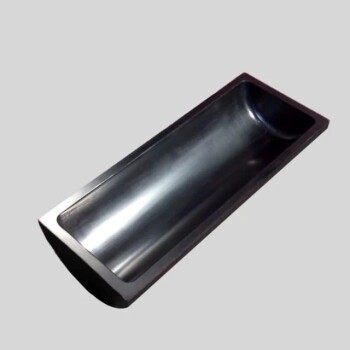
- Arc-Shaped Alumina Ceramic Crucible High Temperature Resistant for Engineering Advanced Fine Ceramics
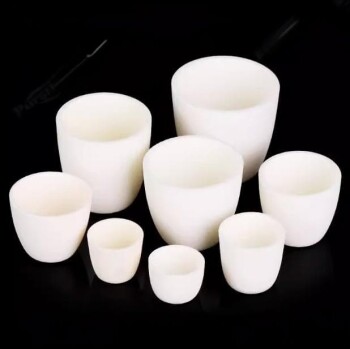
- Engineering Advanced Fine Alumina Al2O3 Ceramic Crucible for Laboratory Muffle Furnace
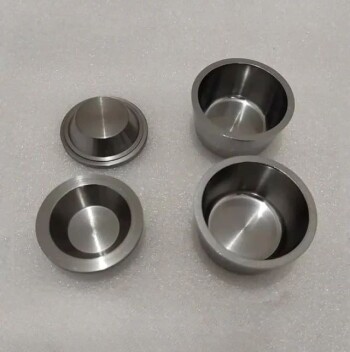
- Electron Beam Evaporation Coating Tungsten Crucible and Molybdenum Crucible for High Temperature Applications
People Also Ask
- Why are high-purity graphite crucibles preferred for sulfide solid electrolytes? Achieve Superior Material Purity
- Why is a high-purity graphite crucible required for Chromel-TaC composites? Ensure Peak Purity at 1400°C
- What role do high-purity graphite crucibles play in molten salt corrosion research? Ensure Reactor-Grade Precision
- Why are high-purity graphite crucibles used for magnesium distillation? Ensure 3N8 Purity & Thermal Stability
- Why is a high-purity graphite crucible ideal for nitrogen-doped graphene at 1500 °C? Maximize Purity and Stability