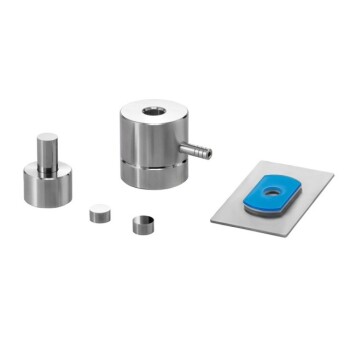
A high-strength graphite mold serves as the critical structural interface between the processing equipment and the Zinc Sulfide (ZnS) powder during vacuum hot pressing. Its primary role is to act as a robust carrier that defines the physical dimensions of the ceramic while simultaneously transmitting the mechanical force required for densification.
The graphite mold acts as a high-performance vessel that converts external hydraulic force into uniform internal pressure. By withstanding temperatures of 1000°C and pressures of 50 MPa without deformation, it facilitates the particle rearrangement and plastic flow necessary to eliminate pores and achieve infrared transparency.
The Functional Mechanics of the Mold
Geometric Definition and Containment
The most immediate function of the graphite mold is to serve as the carrier for the loose ZnS powder.
It confines the powder within a specific geometry, determining the final shape and size of the ceramic sample.
Without this containment, the application of pressure would simply scatter the powder rather than compacting it.
Transmission of Uniaxial Pressure
The mold is the active medium responsible for transferring force from the hydraulic ram to the ceramic material.
In ZnS processing, the mold transmits uniaxial pressures up to 50 MPa directly to the powder.
This pressure is the driving force that promotes plastic flow, squeezing out internal voids to achieve a density near the theoretical limit (99.8%).
Thermal Regulation and Uniformity
Graphite is selected for this role due to its exceptional thermal conductivity.
During the heating phase, the mold ensures that heat is distributed evenly throughout the ZnS powder.
This prevents thermal gradients that could lead to uneven sintering, internal stresses, or cracking in the final optical component.
Operational Conditions and Requirements
Withstanding Extreme Sintering Temperatures
The mold must maintain absolute structural rigidity at elevated temperatures.
For ZnS ceramics, the mold operates in a vacuum environment at temperatures up to 1000°C.
It must resist thermal shock and maintain its dimensions to ensure the final ceramic meets precise tolerances.
Resisting High Mechanical Load
The combination of heat and pressure creates a harsh environment for any material.
The mold serves as a high-strength container capable of enduring 50 MPa of pressure without buckling or deforming.
Any deformation in the mold would result in geometric inaccuracies or density variations in the final infrared window.
Understanding the Trade-offs
The Consumable Nature of Graphite
Despite its high strength, the graphite mold is a critical consumable, not a permanent fixture.
Repeated exposure to high pressure and temperature cycles eventually degrades the graphite's structural integrity.
Users must monitor mold wear closely; a compromised mold can introduce impurities or fail under pressure, ruining expensive ZnS batches.
Chemical Interaction Risks
While graphite provides a generally protective reducing atmosphere, it is chemically active at high temperatures.
Care must be taken to ensure the mold material does not diffuse into the ZnS ceramic, which could impair optical transmission.
Making the Right Choice for Your Goal
When selecting or designing graphite molds for ZnS vacuum hot pressing, prioritize the specific demands of your processing cycle.
- If your primary focus is Optical Quality: Prioritize high-density, high-purity graphite grades to ensure maximum thermal uniformity and minimize the risk of carbon contamination.
- If your primary focus is Dimensional Precision: Select high-strength graphite with superior creep resistance to ensure the mold maintains exact tolerances under the full 50 MPa load.
The success of ZnS infrared ceramics relies not just on the powder, but on the structural integrity of the mold that shapes it.
Summary Table:
| Function | Description | Impact on ZnS Quality |
|---|---|---|
| Containment | Defines physical dimensions and confines powder | Ensures precise geometric shape and size |
| Pressure Transmission | Transmits uniaxial forces up to 50 MPa | Promotes plastic flow and eliminates internal pores |
| Thermal Regulation | Evenly distributes heat across the material | Prevents internal stresses and uneven sintering |
| Structural Rigidity | Resists deformation at 1000°C in vacuum | Maintains dimensional tolerances and density |
| Atmosphere Support | Provides a stable reducing environment | Protects the purity of the infrared ceramic |
Elevate Your Advanced Material Synthesis with KINTEK
Precision in infrared ceramics requires more than just high-quality powder—it demands the right environment. KINTEK specializes in high-performance laboratory equipment, providing the robust hot pressing systems, vacuum furnaces, and hydraulic presses needed to master the production of ZnS ceramics.
Our extensive portfolio also includes high-temperature high-pressure reactors, crushing and milling systems, and essential consumables such as graphite, ceramics, and crucibles. Whether you are focused on optical quality or dimensional precision, our technical experts are ready to provide the tools and support to optimize your laboratory workflow.
Ready to enhance your lab's efficiency and output? Contact us today to discuss your specific requirements!
Related Products
- Dental Porcelain Zirconia Sintering Ceramic Vacuum Press Furnace
- Lab Infrared Press Mold
- Vacuum Hot Press Furnace Machine for Lamination and Heating
- Touchscreen Automatic Vacuum Heat Press
- Electric Heated Hydraulic Vacuum Heat Press for Lab
People Also Ask
- What does sintering do to zirconia? Unlock Its Full Strength and Aesthetic Potential
- What is the shrinkage of zirconia during sintering? Mastering the 20-25% Dimensional Change
- What is the sintering temperature of zirconia ceramic? Mastering the 1400°C-1600°C Thermal Profile
- What is the price of zirconia sintering furnace? Invest in Precision, Not Just a Price Tag
- What factors are important to consider when choosing a dental sintering furnace? Match Your Workflow for Optimal Results