Knowledge What role does a high-temperature rotary kiln play in the production of cement clinker? Mastering Sintering Efficiency
Author avatar

Tech Team · Kintek Solution

Updated 1 day ago

What role does a high-temperature rotary kiln play in the production of cement clinker? Mastering Sintering Efficiency


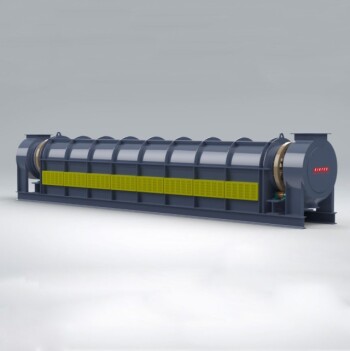
The high-temperature rotary kiln functions as the central chemical reactor in the production of cement clinker. It subjects a precise mixture of clay and limestone to a controlled thermal environment ranging from 1100°C to 1500°C, facilitating the sintering process required to transform raw feedstock into green clinker.

The rotary kiln is not merely a drying device; it is the engine of chemical transformation. It facilitates the high-temperature sintering essential for developing the hydraulic activity of the cement, which dictates the physical and chemical integrity of the final product.

The Critical Thermal Transformation

The primary purpose of the kiln is to drive specific chemical reactions that cannot occur at lower temperatures.

Achieving the Sintering Zone

The core function of the kiln is to reach and maintain a temperature range of 1100°C to 1500°C.

At these temperatures, the raw materials undergo sintering. This causes the distinct particles of clay and limestone to fuse together, creating the mineralogical structures necessary for cement.

Developing Hydraulic Activity

The primary reference highlights that the thermal processing within the kiln determines the hydraulic activity of the cement.

This property is what allows cement to harden when mixed with water. Without the specific residence time in the kiln’s high-temperature zone, the material would remain an inert mixture of minerals rather than a reactive binding agent.

Chemical Dissociation

Before sintering occurs, the kiln must drive the calcination of limestone.

This dissociation reaction, where limestone converts to lime, generally requires temperatures exceeding 900°C. The kiln ensures the material surpasses this threshold efficiently before moving into the hotter sintering zones.

Mechanics of the Process

The kiln is designed as a massive heat exchanger to ensure these reactions happen continuously and uniformly.

Controlled Material Movement

The kiln consists of a rotating cylinder set at a slight incline.

Feedstock enters at the upper end and gradually moves toward the lower discharge end. The rotation ensures the material is constantly stirred and mixed, exposing all particles to the heat source for uniform processing.

Counter-Current Heat Exchange

In most modern cement applications, the process utilizes a counter-current flow.

Hot gases generated by burning fuel (often coal) at the lower end move up the kiln, while the raw material moves down. This maximizes thermal efficiency by ensuring the hottest gases interact with the material just before it discharges as clinker.

Understanding the Trade-offs

While rotary kilns are the industry standard for clinker production, they present specific operational challenges that must be managed.

High Energy Intensity

The production of clinker is extremely energy-intensive. Energy consumption can account for up to 50% of total production costs.

Achieving temperatures of 1500°C requires massive fuel input. This makes thermal efficiency a primary engineering constraint.

Efficiency vs. Complexity

To mitigate high energy costs, modern systems have moved away from long, simple kilns to more complex "heat-exchanger" kilns.

These systems utilize upstream suspension-type pre-heaters to warm the raw feed before it enters the rotary kiln. While this lowers energy consumption, it significantly increases the mechanical complexity and maintenance requirements of the plant.

Optimizing Clinker Production

When evaluating rotary kiln operations, your focus will shift depending on your specific production metrics.

  • If your primary focus is Product Quality: Prioritize the precise control of the 1100°C–1500°C sintering zone, as this directly dictates the hydraulic activity and strength of the final cement.
  • If your primary focus is Operational Efficiency: Focus on the integration of upstream pre-heaters and the optimization of counter-current gas flows to reduce the fuel load required to reach reaction temperatures.

Ultimately, the rotary kiln is the defining component of the cement plant, acting as the bridge between raw earth and chemically active construction material.

Summary Table:

Process Phase Temperature Range Key Transformation
Calcination 900°C - 1000°C Limestone dissociation into lime
Sintering Zone 1100°C - 1500°C Formation of mineralogical structures
Hydraulic Development Maintained peak temp Development of water-reactive binding properties
Material Movement Mechanical Rotation Ensures uniform heating and continuous processing

Optimize Your Clinker Production with KINTEK Precision

High-performance cement production requires uncompromising thermal control and durable equipment. KINTEK specializes in advanced laboratory and industrial heating solutions, providing the high-temperature rotary kilns, crushing systems, and cooling solutions necessary to master the sintering process.

Whether you are focusing on maximizing hydraulic activity or reducing energy intensity through optimized heat exchange, our experts are ready to provide the high-quality furnaces and consumables your facility demands.

Enhance your material processing today—Contact KINTEK for a specialized consultation!

References

  1. Noorullah Zahid, Fada Mohammad Mohammadi. Effect of nano-materials on mechanical properties of cement and concrete. DOI: 10.33545/27068919.2022.v4.i1c.706

This article is also based on technical information from Kintek Solution Knowledge Base .

Related Products

People Also Ask

Related Products

Rotary Tube Furnace Split Multi Heating Zone Rotating Tube Furnace

Rotary Tube Furnace Split Multi Heating Zone Rotating Tube Furnace

Multi zone rotary furnace for high-precision temperature control with 2-8 independent heating zones. Ideal for lithium ion battery electrode materials and high-temperature reactions. Can work under vacuum and controlled atmosphere.

Electric Rotary Kiln Continuous Working Small Rotary Furnace Heating Pyrolysis Plant

Electric Rotary Kiln Continuous Working Small Rotary Furnace Heating Pyrolysis Plant

Efficiently calcine and dry bulk powder and lump fluid materials with an electric heating rotary furnace. Ideal for processing lithium ion battery materials and more.

Vacuum Sealed Continuous Working Rotary Tube Furnace Rotating Tube Furnace

Vacuum Sealed Continuous Working Rotary Tube Furnace Rotating Tube Furnace

Experience efficient material processing with our vacuum-sealed rotary tube furnace. Perfect for experiments or industrial production, equipped with optional features for controlled feeding and optimized results. Order now.

Electric Rotary Kiln Small Rotary Furnace for Activated Carbon Regeneration

Electric Rotary Kiln Small Rotary Furnace for Activated Carbon Regeneration

Revitalize your activated carbon with KinTek's Electric Regeneration Furnace. Achieve efficient and cost-effective regeneration with our highly automated rotary kiln and intelligent thermal controller.

Laboratory Rapid Thermal Processing (RTP) Quartz Tube Furnace

Laboratory Rapid Thermal Processing (RTP) Quartz Tube Furnace

Get lightning-fast heating with our RTP Rapid Heating Tube Furnace. Designed for precise, high-speed heating and cooling with convenient sliding rail and TFT touch screen controller. Order now for ideal thermal processing!

Horizontal High Temperature Graphite Vacuum Graphitization Furnace

Horizontal High Temperature Graphite Vacuum Graphitization Furnace

Horizontal Graphitization Furnace: This type of furnace is designed with the heating elements placed horizontally, allowing for uniform heating of the sample. It's well-suited for graphitizing large or bulky samples that require precise temperature control and uniformity.

Ultra-High Temperature Graphite Vacuum Graphitization Furnace

Ultra-High Temperature Graphite Vacuum Graphitization Furnace

The ultra-high temperature graphitization furnace utilizes medium frequency induction heating in a vacuum or inert gas environment. The induction coil generates an alternating magnetic field, inducing eddy currents in the graphite crucible, which heats up and radiates heat to the workpiece, bringing it to the desired temperature. This furnace is primarily used for graphitization and sintering of carbon materials, carbon fiber materials, and other composite materials.

Mesh belt controlled atmosphere furnace

Mesh belt controlled atmosphere furnace

Discover our KT-MB mesh belt sintering furnace - perfect for high-temperature sintering of electronic components & glass insulators. Available for open air or controlled atmosphere environments.

1700℃ Laboratory High Temperature Tube Furnace with Alumina Tube

1700℃ Laboratory High Temperature Tube Furnace with Alumina Tube

Looking for a high-temperature tube furnace? Check out our 1700℃ Tube Furnace with Alumina Tube. Perfect for research and industrial applications up to 1700C.

1200℃ Split Tube Furnace with Quartz Tube Laboratory Tubular Furnace

1200℃ Split Tube Furnace with Quartz Tube Laboratory Tubular Furnace

KT-TF12 split tube furnace: high-purity insulation, embedded heating wire coils, and max. 1200C. Widely used for new materials and chemical vapour deposition.

1700℃ Muffle Oven Furnace for Laboratory

1700℃ Muffle Oven Furnace for Laboratory

Get superior heat control with our 1700℃ Muffle Furnace. Equipped with intelligent temperature microprocessor, TFT touch screen controller & advanced insulation materials for precise heating up to 1700C. Order now!

1800℃ Muffle Oven Furnace for Laboratory

1800℃ Muffle Oven Furnace for Laboratory

KT-18 muffle furnace with Japan Al2O3 polycrystalline fibe and Silicon Molybdenum heating element, up to 1900℃, PID temperature control and 7" smart touch screen. Compact design, low heat loss, and high energy efficiency. Safety interlock system and versatile functions.

Vacuum Heat Treat Sintering Brazing Furnace

Vacuum Heat Treat Sintering Brazing Furnace

A vacuum brazing furnace is a type of industrial furnace used for brazing, a metalworking process that joins two pieces of metal using a filler metal that melts at a lower temperature than the base metals. Vacuum brazing furnaces are typically used for high-quality applications where a strong, clean joint is required.

Vacuum Hot Press Furnace Machine Heated Vacuum Press

Vacuum Hot Press Furnace Machine Heated Vacuum Press

Discover the advantages of Vacuum Hot Press Furnace! Manufacture dense refractory metals & compounds, ceramics, and composites under high temp and pressure.

Small Vacuum Heat Treat and Tungsten Wire Sintering Furnace

Small Vacuum Heat Treat and Tungsten Wire Sintering Furnace

The small vacuum tungsten wire sintering furnace is a compact experimental vacuum furnace specially designed for universities and scientific research institutes. The furnace features a CNC welded shell and vacuum piping to ensure leak-free operation. Quick-connect electrical connections facilitate relocation and debugging, and the standard electrical control cabinet is safe and convenient to operate.

Vertical High Temperature Graphite Vacuum Graphitization Furnace

Vertical High Temperature Graphite Vacuum Graphitization Furnace

Vertical high temperature graphitization furnace for carbonization and graphitization of carbon materials up to 3100℃.Suitable for shaped graphitization of carbon fiber filaments and other materials sintered in a carbon environment.Applications in metallurgy, electronics, and aerospace for producing high-quality graphite products like electrodes and crucibles.

Vacuum Heat Treat and Sintering Furnace with 9MPa Air Pressure

Vacuum Heat Treat and Sintering Furnace with 9MPa Air Pressure

The air pressure sintering furnace is a high-tech equipment commonly used for the sintering of advanced ceramic materials. It combines vacuum sintering and pressure sintering techniques to achieve high-density and high-strength ceramics.

Vacuum Dental Porcelain Sintering Furnace

Vacuum Dental Porcelain Sintering Furnace

Get precise and reliable results with KinTek's Vacuum Porcelain Furnace. Suitable for all porcelain powders, it features hyperbolic ceramic furnace function, voice prompt, and automatic temperature calibration.

Dental Porcelain Zirconia Sintering Ceramic Vacuum Press Furnace

Dental Porcelain Zirconia Sintering Ceramic Vacuum Press Furnace

Get precise dental results with Dental Vacuum Press Furnace. Automatic temperature calibration, low noise tray, and touch screen operation. Order now!

1400℃ Muffle Oven Furnace for Laboratory

1400℃ Muffle Oven Furnace for Laboratory

Get precise high-temperature control up to 1500℃ with KT-14M Muffle furnace. Equipped with a smart touch screen controller and advanced insulation materials.


Leave Your Message