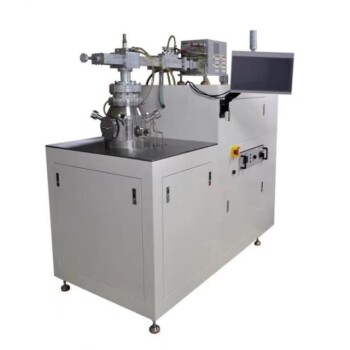
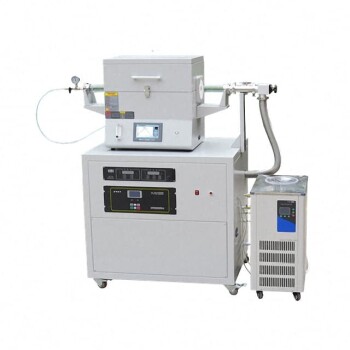
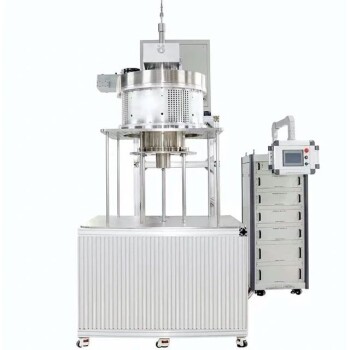
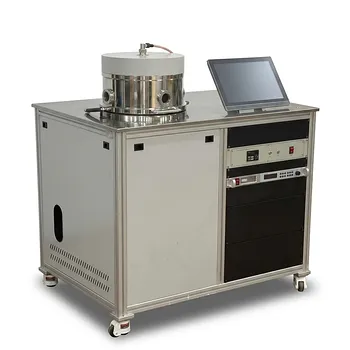
The horizontal cold-wall chemical vapor deposition (CVD) reactor serves as the critical reaction vessel for synthesizing iron germanide thin films by isolating thermal energy at the substrate. It creates a controlled environment where precursor gases are decomposed specifically on the target surface rather than on the reactor walls. This localized reaction minimizes material waste and prevents the inclusion of impurities in the growing film.
The primary role of the horizontal cold-wall reactor is to decouple the temperature of the substrate from the temperature of the chamber environment. This configuration ensures that chemical energy is focused exclusively on the film-growth surface, optimizing both precursor utilization and material purity.
Precision Thermal Management in Iron Germanide Growth
Targeted Substrate Heating
In a cold-wall system, only the substrate and its support (often a graphite susceptor) are directly heated, typically via RF induction or radiant heating. This creates a localized "hot zone" where the kinetic energy required for iron germanide formation is concentrated. Because the surrounding gas and reactor walls remain cool, the system prevents the precursor from reacting prematurely before it reaches the target.
Mitigation of Parasitic Side Reactions
By maintaining the outer quartz or metal walls at a low temperature, the reactor suppresses gas-phase side reactions. In traditional hot-wall systems, precursors may decompose in the air or on the chamber walls, leading to unwanted particulates or "snow" that can contaminate the film. The cold-wall design ensures that the thermal decomposition kinetics are restricted to the interface where the film is intended to grow.
Enhancing Material Purity and Precursor Efficiency
Maximizing Precursor Utilization
Because the iron and germanium precursors do not deposit on the reactor walls, a significantly higher percentage of the source material is converted into the final thin film. This is particularly important when working with specialized or expensive precursors required for high-performance iron germanide applications. The directional decomposition on the heated surface leads to a more efficient and predictable growth rate.
Maintenance of High Film Purity
The cold-wall configuration prevents the reactor walls from outgassing or contributing unwanted impurities into the reaction zone. Since the walls do not reach the high temperatures required for decomposition, they remain chemically inert throughout the process. This ensures that the resulting iron germanide film maintains the precise stoichiometry and crystalline structure required for electronic or magnetic applications.
Understanding the Trade-offs
Temperature Gradient Challenges
The significant temperature difference between the hot substrate and the cold walls can create steep thermal gradients. These gradients can induce natural convection currents, potentially leading to gas flow instabilities or turbulence. If not carefully managed through precise flow rate regulation, these instabilities can result in non-uniform film thickness across the substrate.
Thermal Stress and Uniformity
While localized heating protects the reactor, it can introduce thermal stress across the substrate if the heating element is not perfectly uniform. Achieving a consistent thermal field across a large surface area is more complex in a cold-wall setup than in a hot-wall system. Engineers must balance the benefit of purity against the technical challenge of maintaining isothermal conditions across the entire growth surface.
Applying Reactor Selection to Your Project
Making the Right Choice for Your Goal
The decision to utilize a horizontal cold-wall CVD reactor depends on your specific requirements for film quality and process efficiency.
- If your primary focus is maximum film purity: The cold-wall design is the superior choice as it eliminates wall-induced contamination and parasitic gas-phase reactions.
- If your primary focus is precursor cost-efficiency: This reactor type is highly recommended because it ensures the majority of the precursor is deposited only on the substrate.
- If your primary focus is large-scale thickness uniformity: You must invest in advanced gas-flow dynamics and high-precision heating assemblies to counteract the inherent thermal gradients of the cold-wall design.
Selecting a horizontal cold-wall reactor provides the specialized thermal environment necessary to master the delicate synthesis of high-purity iron germanide thin films.
Summary Table:
| Key Feature | Impact on Iron Germanide Film Preparation |
|---|---|
| Targeted Heating | Concentrates thermal energy on the substrate to prevent premature gas decomposition. |
| Cold-Wall Design | Suppresses gas-phase side reactions and eliminates impurities from reactor walls. |
| Material Efficiency | Maximizes precursor utilization by focusing deposition exclusively on the target surface. |
| Purity Maintenance | Ensures precise stoichiometry and crystalline structure for electronic applications. |
| Thermal Management | Requires precise flow control to manage steep gradients and ensure film uniformity. |
Elevate Your Material Synthesis with KINTEK
Precision is the cornerstone of high-performance thin-film development. At KINTEK, we specialize in advanced laboratory equipment designed to meet the rigorous demands of material science. Whether you are optimizing iron germanide growth or exploring new semiconductor frontiers, our comprehensive range of CVD, PECVD, and MPCVD systems provides the thermal stability and atmospheric control necessary for success.
Our portfolio features:
- Advanced CVD Reactors: Horizontal, vertical, and vacuum solutions for high-purity thin films.
- High-Temperature Furnaces: Muffle, tube, and atmosphere furnaces for diverse heat treatments.
- Precision Tools: Hydraulic pellet presses, crushing systems, and specialized high-pressure reactors.
- Essential Consumables: High-quality ceramics, crucibles, and PTFE products to ensure contamination-free results.
Don't let equipment limitations hinder your research. Contact KINTEK today to discuss your specific project needs and discover how our integrated laboratory solutions can enhance your efficiency and material quality.
References
- Thomas Büttner, David Scheschkewitz. Single‐Source Precursors for the Chemical Vapor Deposition of Iron Germanides. DOI: 10.1002/ejic.202300433
This article is also based on technical information from Kintek Solution Knowledge Base .
Related Products
- Customer Made Versatile CVD Tube Furnace Chemical Vapor Deposition Chamber System Equipment
- Cylindrical Resonator MPCVD Machine System Reactor for Microwave Plasma Chemical Vapor Deposition and Lab Diamond Growth
- Microwave Plasma Chemical Vapor Deposition MPCVD Machine System Reactor for Lab and Diamond Growth
- Split Chamber CVD Tube Furnace with Vacuum Station Chemical Vapor Deposition System Equipment Machine
- 915MHz MPCVD Diamond Machine Microwave Plasma Chemical Vapor Deposition System Reactor
People Also Ask
- What is a CVD tube furnace? A Complete Guide to Thin-Film Deposition
- What is the function of a high-temperature CVD tube furnace in 3D graphene foam prep? Master 3D Nanomaterial Growth
- What are the technical advantages of using a CVD tube furnace? Optimize Silicon-Carbon Battery Anodes
- How does a CVD tube furnace inhibit the sintering of silver supports? Boost Membrane Durability and Performance
- What is the function of a tube furnace in CVD SiC synthesis? Achieving Ultra-Pure Silicon Carbide Powders