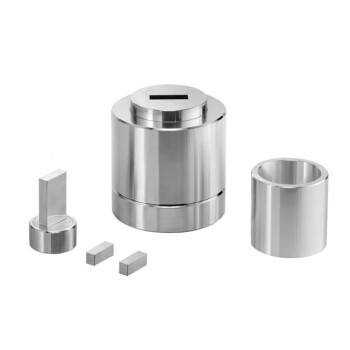
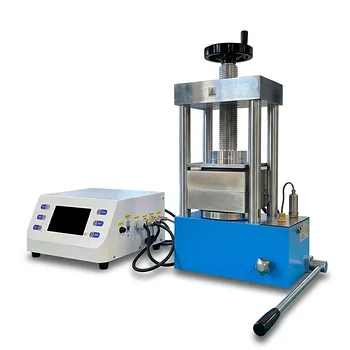
A laboratory hydraulic press serves as the fundamental tool for the "cold-pressing densification" of Li10GeP2S12 (LGPS) electrolytes. It applies immense axial pressure—typically ranging from 200 MPa to over 600 MPa—to compress loose sulfide powders into dense, pore-free pellets, effectively creating a solid material without the need for high-temperature sintering.
Core Takeaway: The hydraulic press is not just about shaping the material; it is the primary engine for reducing grain boundary impedance. By mechanically eliminating voids, the press forces particles into intimate contact, establishing the continuous lithium-ion transport pathways required for high-performance solid-state batteries.
The Mechanism of Densification
Transforming Powder into Solid
LGPS starts as a loose sulfide powder with high internal porosity. The hydraulic press applies force ranging from several tons to dozens of tons to consolidate this powder.
This process eliminates the air gaps (voids) that naturally exist between loose particles.
Leveraging Material Properties
Unlike oxide electrolytes that often require heat to densify, sulfide electrolytes like LGPS possess a low elastic modulus.
This means the materials are somewhat softer and more deformable. The hydraulic press exploits this property, mechanically deforming the particles so they press tightly against one another to form a cohesive unit solely through cold pressure.
Impact on Electrochemical Performance
Reducing Grain Boundary Resistance
The primary barrier to ion movement in a solid electrolyte is the "grain boundary"—the interface where one particle ends and another begins.
If these boundaries have gaps, resistance increases, and battery performance plummets. The high pressure from the press minimizes these gaps, significantly lowering the impedance at these boundaries.
Establishing Transport Channels
For a battery to function, lithium ions must move freely from the anode to the cathode.
The densification process creates continuous ion-conducting channels. By compacting the material to relative densities often exceeding 80%, the press ensures there are no physical interruptions in the ion's path.
Structural Integrity and Fabrication
Mechanical Strength for Handling
Loose powder cannot be integrated into a battery cell. The press converts this powder into a pellet with sufficient mechanical strength to be handled, moved, and stacked.
This structural integrity is vital for ensuring the electrolyte layer does not crumble during the subsequent assembly of the cathode and anode layers.
Optimizing Layer Interfaces
Beyond making the pellet, the press is often used in the final assembly to compress the cathode, electrolyte, and anode together.
This ensures tight physical contact between the distinct layers of the battery. Without this pressure-driven contact, the interface resistance would be too high for the battery to cycle effectively.
Understanding the Trade-offs
Pressure Magnitude vs. Material Integrity
While high pressure is critical for conductivity, there is a balance to be struck.
Applying pressure that is too low (e.g., merely molding pressure) will leave voids, resulting in poor conductivity data. Conversely, extreme pressures must be applied uniformly to prevent the pellet from developing stress fractures or density gradients, which can skew testing results.
Cold Pressing vs. Sintering
It is important to recognize that for LGPS, the hydraulic press replaces the sintering furnace used for harder ceramics.
Reliance on the press is an advantage as it avoids thermal degradation of the sulfide material. However, this means the final quality of the electrolyte is entirely dependent on the precision and capability of the press to apply force, rather than on chemical bonding via heat.
Making the Right Choice for Your Goal
To ensure valid LGPS testing results, tailor your pressing strategy to your specific objective:
- If your primary focus is measuring intrinsic ionic conductivity: Apply the higher end of the pressure range (e.g., 360–600 MPa) to maximize pellet density and eliminate as much porosity as possible.
- If your primary focus is full-cell prototyping: Focus on the consistency of the pressure to ensure uniform contact between the electrolyte and the electrode layers without crushing active materials.
The hydraulic press is the critical enabler that transforms LGPS from a theoretical material into a functional ion conductor.
Summary Table:
| Feature | Role in LGPS Fabrication | Benefit for Battery Testing |
|---|---|---|
| Pressure Range | 200 MPa to >600 MPa | Maximizes pellet density and eliminates voids |
| Mechanism | Cold-Pressing Densification | Avoids thermal degradation of sulfide materials |
| Grain Boundaries | Interfacial Compression | Lowers impedance and increases ionic conductivity |
| Structural Output | Cohesive Pellet Formation | Ensures mechanical integrity for cell assembly |
| Interface Quality | Layer-to-Layer Contact | Establishes continuous ion transport pathways |
Elevate Your Solid-State Battery Research with KINTEK Precision
Don't let high grain boundary resistance hinder your LGPS research. KINTEK specializes in advanced laboratory equipment designed to meet the rigorous demands of battery material fabrication. Our high-performance manual, electric, and isostatic hydraulic presses provide the precise axial pressure needed to achieve theoretical densities and superior ionic conductivity in sulfide electrolytes.
Whether you are developing next-generation SSBs or optimizing electrode interfaces, KINTEK offers a comprehensive range of solutions:
- Pressing Systems: Pellet, hot, and isostatic presses for pore-free electrolytes.
- Material Processing: Crushing, milling, and sieving equipment for uniform powder preparation.
- Specialized Tools: High-temperature furnaces, vacuum solutions, and inert atmosphere containers.
Ready to achieve high-performance densification? Contact KINTEK today to find the perfect hydraulic press for your laboratory!
Related Products
- Automatic Laboratory Hydraulic Pellet Press Machine for Lab Use
- Laboratory Hydraulic Press Split Electric Lab Pellet Press
- Laboratory Manual Hydraulic Pellet Press for Lab Use
- Laboratory Manual Hydraulic Pellet Press for Lab Use
- Automatic Laboratory Hydraulic Press for XRF & KBR Pellet Press
People Also Ask
- What is the role of a laboratory hydraulic pellet press and stainless steel molds in the fabrication of RuO2/NbC anodes?
- What role does a laboratory pellet press play in the enhancement of biomass energy products? Optimize Fuel Efficiency
- What is the purpose of using a laboratory pellet press when evaluating the electronic conductivity of carbon powders? Guide
- How does a laboratory hydraulic pellet press contribute to SiCw/2024 aluminum composite preforms? Optimize Densification
- What is the significance of applying 200 MPa of pressure with a laboratory hydraulic pellet press for composite ceramics?