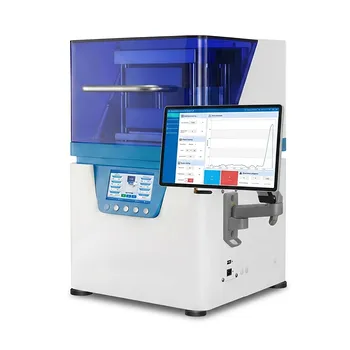
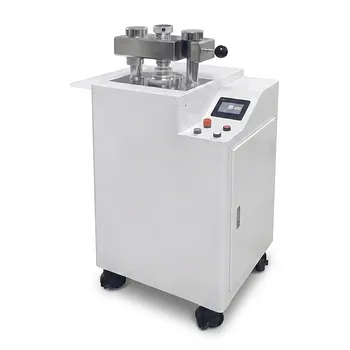
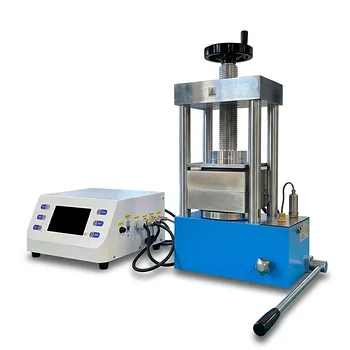
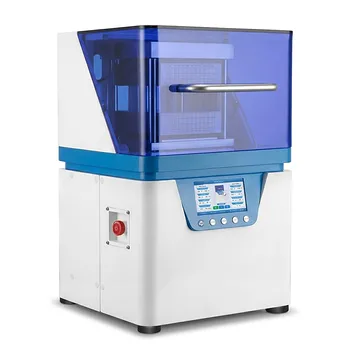
The laboratory hydraulic press is the primary tool used to transform loose calcium oxide (CaO) powder into structured, high-density lime specimens. By applying precise and stable vertical pressure—often around 30 MPa—the press rearranges high-purity particles into uniform hollow cylinders. This mechanical compaction provides the necessary structural integrity for the sample to survive high-temperature sintering and ensures a stable interface during subsequent slag dissolution experiments.
The core role of the hydraulic press is to create a standardized "green body" with consistent internal density and geometric stability. This allows researchers to isolate chemical dissolution kinetics by eliminating variables like sample porosity and irregular surface areas.
Engineering the Lime "Green Body"
Achieving Critical Initial Density
The hydraulic press applies uniform force to eliminate large voids between powder particles. This initial compaction is vital because it dictates the success of the subsequent high-temperature sintering process, where particles fuse into a solid mass. Without this standardized density, the lime sample may lack the structural strength required for experimental handling.
Ensuring Geometric Interface Stability
In dissolution studies, the rate at which lime melts into slag depends heavily on the surface area exposed to the liquid. The press creates uniform hollow cylinders with precise dimensions, ensuring the dissolution interface remains stable throughout the test. This prevents the sample from crumbling prematurely, which would otherwise lead to inaccurate kinetic data.
Accelerating Reaction Kinetics
By minimizing internal gaps, the hydraulic press increases the effective contact area between the lime particles. This compaction facilitates faster solid-liquid phase reactions once the sample is introduced to the molten slag. Consequently, the time required for the system to reach phase equilibrium is shortened, making the experiment more efficient and reproducible.
Maximizing Analytical Precision
Eliminating Surface Irregularities
Similar to preparing pellets for X-ray fluorescence (XRF) or FTIR analysis, pressing creates a flat, uniform surface. This eliminates "particle size effects" and surface roughness that could cause turbulence or uneven reaction zones. A smooth surface ensures that the slag interacts with the lime in a predictable, measurable manner.
Standardizing Specimen Dimensions
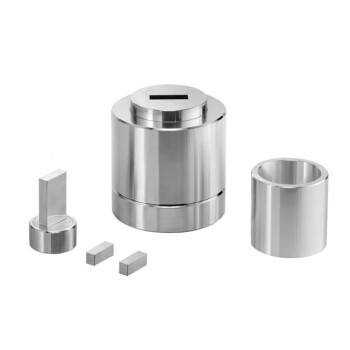
Using specialized precision molds with the hydraulic press allows for the creation of specimens with consistent thickness and diameter. This uniformity is critical when using analytical equipment, such as a Vector Network Analyzer or rotating cylinder apparatus, as it prevents data errors caused by physical defects or inconsistent sample volumes.
Understanding the Trade-offs and Pitfalls
Pressure-Induced Delamination
Applying too much pressure can lead to internal stresses that cause the lime pellet to crack or "cap" when removed from the mold. If the compaction pressure is not optimized for the specific powder grain size, the resulting specimen may look solid but fail catastrophically when exposed to the thermal shock of the furnace.
Contamination Risks
High-purity calcium oxide is highly sensitive to impurities. If the press molds are not meticulously cleaned, trace elements from previous slag or metal samples can contaminate the lime green body. Even minor impurities can alter the local melting point at the interface, skewing the results of the dissolution study.
Atmospheric Sensitivity
Lime is hygroscopic and reacts quickly with moisture and $CO_2$ in the air. The pressing process must be performed rapidly or in a controlled environment to prevent the formation of calcium hydroxide or carbonates. Failure to control this environment can result in a sample that outgasses or cracks during high-temperature testing.
How to Apply This to Your Project
Recommendations for Sample Preparation
- If your primary focus is kinetic consistency: Ensure the hydraulic press is calibrated to maintain the exact same pressure (e.g., 30 MPa) across all samples to keep porosity constant.
- If your primary focus is high-temperature durability: Focus on the "dwell time" of the pressure application to allow air to escape the powder, which reduces the risk of cracks during sintering.
- If your primary focus is analytical purity: Use hardened steel or tungsten carbide molds and clean them with high-purity solvents between setiap pressing cycle to avoid cross-contamination.
The laboratory hydraulic press is the foundation of slag dissolution studies, providing the structural and geometric consistency necessary for accurate metallurgical analysis.
Summary Table:
| Key Function | Benefit to Study | Impact on Results |
|---|---|---|
| High-Pressure Compaction | Achieves critical "green body" density | Ensures specimen survives high-temp sintering |
| Geometric Standardization | Creates uniform hollow cylinders | Stabilizes the dissolution interface area |
| Porosity Reduction | Minimizes internal air gaps | Accelerates reaction kinetics and phase equilibrium |
| Surface Smoothing | Eliminates particle size effects | Enhances analytical precision (XRF/FTIR) |
Elevate Your Metallurgical Research with KINTEK Precision
Achieving consistent density and geometric stability in lime specimens is critical for reliable slag dissolution data. KINTEK specializes in high-performance laboratory hydraulic presses, including manual and automatic pellet presses, hot presses, and isostatic systems designed to meet the rigorous demands of material science.
Beyond compaction, we provide a comprehensive ecosystem for your research, including:
- High-Temperature Furnaces: Muffle, vacuum, and atmosphere furnaces for perfect sintering.
- Precision Consumables: High-purity ceramic crucibles and specialized molds to prevent contamination.
- Sample Prep Tools: Crushing, milling, and sieving systems for uniform powder feedstock.
Ready to optimize your sample preparation workflow? Contact our technical experts today to find the ideal equipment solution tailored to your research goals.
References
- Kan Yu, Ming Gao. Effects of Al2O3/TiO2/Na2O on Lime Dissolution in Steelmaking Slag. DOI: 10.3390/met13020209
This article is also based on technical information from Kintek Solution Knowledge Base .
Related Products
- Fully Automatic Heated Hydraulic Lab Press for Materials Sintering and Sample Preparation
- Automatic Laboratory Hydraulic Pellet Press Machine for Lab Use
- Laboratory Hydraulic Press Split Electric Lab Pellet Press
- Laboratory Manual Hydraulic Pellet Press for Lab Use
- Laboratory Hydraulic Press Lab Pellet Press for Button Battery
People Also Ask
- How is a laboratory hydraulic press used in the preparation of modified biochar samples for FTIR analysis? Expert Guide
- How does a laboratory heating hydraulic press contribute to the preparation of recycled graphite green bodies? - Optimize Density.
- How does the laboratory hydraulic press contribute to the preparation of solid targets for laser ablation?
- What role does a laboratory hydraulic press play in perovskite-MOF glass fabrication? Master Material Densification
- Why use a laboratory hydraulic press for Fe2O3-CoP conductivity? Achieve Precise Material Characterization