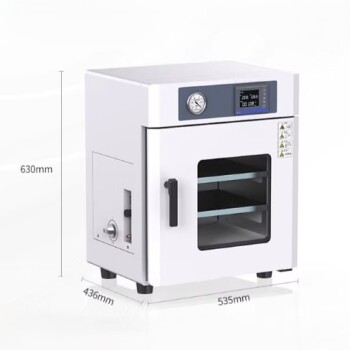
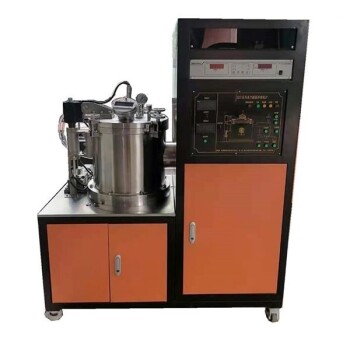
A laboratory vacuum furnace acts as a critical purification stage in the preparation of high-temperature molten salt experimental samples. Its primary function is the pre-heating and degassing of sample containers, typically at temperatures around 400 °C within a vacuum environment. This process effectively drives off moisture and residual gases adsorbed on metal surfaces, ensuring the system is contaminant-free before the introduction of molten salt.
The vacuum furnace eliminates surface contaminants that would otherwise trigger severe oxidative corrosion. By securing a high-vacuum baseline, it ensures the chemical integrity of both the molten salt and the test materials during high-temperature operations.
Establishing a Pure Testing Environment
Removing Adsorbed Contaminants
Metal surfaces naturally accumulate moisture and gases from the atmosphere. If these are not removed, they will release into the molten salt during the experiment.
By heating the containers to 400 °C in a vacuum, you force these adsorbed impurities off the surface. This deep baking treatment is non-negotiable for high-fidelity results.
Enabling High-Vacuum Sealing
The ultimate goal of sample preparation is often to seal the container under high-vacuum conditions, such as 10⁻⁶ Torr.
You cannot achieve this level of vacuum stability if the container walls are still outgassing. The vacuum furnace provides the necessary foundation to ensure that the seal holds and the internal environment remains static.
Preventing Chemical Degradation
Reducing Initial Oxygen Content
Oxygen is the enemy of molten salt experiments. Even trace amounts can lead to severe oxidative corrosion at high temperatures.
The vacuum furnace significantly reduces the initial oxygen content within the system. This prevents the immediate degradation of the salt and the corrosion of the container walls.
Preserving Alloy Composition
When your experiment involves complex alloys, maintaining precise chemical ratios is essential.
A vacuum environment prevents the high-temperature oxidation loss of reactive alloying elements like Chromium (Cr), Tungsten (W), and Vanadium (V). By minimizing gaseous impurities like oxygen and nitrogen, the furnace ensures the material's composition matches your design models strictly.
Understanding the Trade-offs
The Risk of Insufficient Degassing
It is a common error to rush the pre-heating phase. If the bake-out is not long enough or hot enough, residual moisture will remain.
This leads to "phantom" corrosion data, where the material failure is caused by the sample preparation flaws rather than the molten salt chemistry itself.
Equipment Complexity vs. Data Fidelity
Using a vacuum furnace adds time and complexity to the workflow compared to simple inert gas purging.
However, relying solely on purging often fails to remove chemically adsorbed water. The trade-off is a longer preparation time for vastly superior data reliability.
Making the Right Choice for Your Goal
To maximize the reliability of your molten salt experiments, align your preparation steps with your specific objectives:
- If your primary focus is Corrosion Resistance: Ensure you perform the deep baking treatment at 400 °C to eliminate moisture-induced oxidation.
- If your primary focus is Alloy Modeling: Prioritize the high-vacuum capability to prevent the loss of volatile elements like Chromium and Vanadium.
Precise sample preparation in a vacuum furnace is not just a cleaning step; it is the baseline requirement for accurate high-temperature material science.
Summary Table:
| Process Phase | Key Function | Benefit for Molten Salt Testing |
|---|---|---|
| Pre-heating | 400 °C Baking | Drives off adsorbed moisture and residual surface gases |
| Degassing | Vacuum Environment | Prevents oxidative corrosion and chemical degradation |
| High-Vacuum Sealing | 10⁻⁶ Torr Baseline | Ensures long-term stability and reliable experimental data |
| Material Preservation | Controlled Atmosphere | Prevents loss of reactive elements like Cr, W, and V |
Elevate Your Material Science with KINTEK Precision
Don't let sample impurities compromise your high-temperature research. KINTEK specializes in advanced laboratory solutions, including high-performance vacuum and atmosphere furnaces, high-pressure reactors, and specialized crucibles designed for the most demanding molten salt environments. Whether you need precise thermal processing or robust sample preparation tools like our crushing, milling, and pellet presses, our experts are ready to equip your lab for success.
Ensure the integrity of your results—contact KINTEK today for a customized equipment consultation!
References
- Songgang Qiu, Ming Fang. Study of Material Compatibility for a Thermal Energy Storage System with Phase Change Material. DOI: 10.3390/en11030572
This article is also based on technical information from Kintek Solution Knowledge Base .
Related Products
- Laboratory Vacuum Tilt Rotary Tube Furnace Rotating Tube Furnace
- Lab-Scale Vacuum Induction Melting Furnace
- Graphite Vacuum Furnace IGBT Experimental Graphitization Furnace
- Small Vacuum Heat Treat and Tungsten Wire Sintering Furnace
- Vertical Laboratory Tube Furnace
People Also Ask
- What are the process advantages of using a rotary tube furnace for WS2 powder? Achieve Superior Material Crystallinity
- What are the advantages of using a rotary tube furnace for MoVOx catalysts? Elevate Uniformity and Crystallinity
- What is a rotary furnace used for? Achieve Unmatched Process Uniformity and Control
- What is the role of a tube furnace in CCVD for HCNTs? Master Precise Control for Uniform Nanostructure Growth
- How do tube furnaces or atmosphere furnaces facilitate the final crystallization sintering of Li10GeP2S12 (LGPS)?