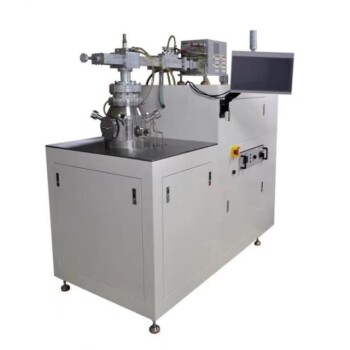
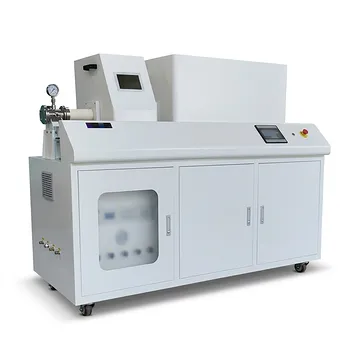
The Low-Pressure Chemical Vapor Deposition (LPCVD) system acts as the foundational processing environment for creating Low-Stress Silicon Nitride (LS SiN) films. It functions by introducing gaseous precursors into a reaction chamber held at low pressures and high temperatures—typically above 800°C. This specific environment drives chemical reactions directly on the silicon wafer surface, enabling the growth of films with controlled internal stress and structural integrity.
The LPCVD system is essential for LS SiN growth because it combines high thermal energy with low pressure to ensure surface-dominated reactions. This results in highly uniform, conformal films across large production batches, with physical properties that can be precisely tuned.
The Mechanics of Deposition
High-Temperature Reaction Environment
To successfully grow Low-Stress Silicon Nitride, the LPCVD system must maintain a high-temperature environment.
The process typically requires temperatures exceeding 800°C. This intense thermal energy is necessary to break down the gaseous precursors and drive the chemical kinetics required for high-quality film formation.
Surface-Controlled Kinetics
The defining feature of this system is the combination of high heat and precisely controlled low pressure.
By lowering the pressure, the system minimizes the chance of gases reacting with each other in the empty space of the chamber. Instead, the chemical reaction occurs almost exclusively on the surface of the silicon wafers, leading to denser and purer films.
Achieving Quality and Uniformity
Batch Processing Consistency
One of the primary roles of the LPCVD system is ensuring uniform deposition across large volumes of work.
The system is designed to process large batches of samples simultaneously. Despite the high volume, the precise regulation of pressure and temperature fields ensures that every wafer receives an identical coating thickness.
Superior Step Coverage
For applications involving complex surface geometries, the LPCVD system plays a critical role in achieving excellent step coverage.
Because the reaction is surface-controlled, the gas molecules can penetrate deep into trenches or complex features before reacting. This results in a film that coats vertical and horizontal surfaces with nearly equal thickness, a feat difficult to achieve with other deposition methods.
Understanding the Trade-offs
High Thermal Budget
While LPCVD offers superior film quality, the system's reliance on high temperatures is a significant constraint.
The requirement to operate above 800°C means this process cannot be used on substrates or devices that have low melting points or are sensitive to thermal cycling. It is strictly a high-temperature process, which limits its integration into certain stages of device fabrication.
Making the Right Choice for Your Goal
When evaluating the use of an LPCVD system for Silicon Nitride growth, consider your specific fabrication requirements.
- If your primary focus is Process Scalability: Leverage the LPCVD system's inherent ability to handle large batches while maintaining strict uniformity across all samples.
- If your primary focus is Structural Integrity: Rely on the high-temperature control to minimize defects and achieve the precise internal stress levels required for mechanical stability.
The LPCVD system remains the gold standard for depositing Silicon Nitride when film quality and conformality are paramount.
Summary Table:
| Feature | Role in LS SiN Growth | Benefit |
|---|---|---|
| High Temperature | Exceeds 800°C to drive chemical kinetics | Ensures high-quality film formation and purity |
| Low Pressure | Minimizes gas-phase reactions | Enables surface-controlled deposition for denser films |
| Batch Processing | Handles multiple wafers simultaneously | High throughput with identical coating thickness |
| Conformality | Allows molecules to penetrate deep features | Superior step coverage for complex geometries |
Elevate Your Semiconductor Fabrication with KINTEK Precision
Are you looking to achieve flawless Low-Stress Silicon Nitride films with uncompromising uniformity? KINTEK specializes in advanced laboratory equipment, providing high-performance LPCVD, CVD, and PECVD systems tailored for rigorous research and production environments.
Our extensive portfolio—ranging from high-temperature furnaces and vacuum systems to crushing equipment and hydraulic presses—is designed to support your entire material synthesis workflow. Whether you are developing next-generation battery technologies or complex micro-mechanical structures, KINTEK provides the technical expertise and reliable tools you need to succeed.
Ready to optimize your deposition process? Contact KINTEK today to discuss our range of CVD solutions and laboratory consumables!
References
- Beirong Zheng, Wei Xue. Deposition of Low Stress Silicon Nitride Thin Film and Its Application in Surface Micromachining Device Structures. DOI: 10.1155/2013/835942
This article is also based on technical information from Kintek Solution Knowledge Base .
Related Products
- Chemical Vapor Deposition CVD Equipment System Chamber Slide PECVD Tube Furnace with Liquid Gasifier PECVD Machine
- Customer Made Versatile CVD Tube Furnace Chemical Vapor Deposition Chamber System Equipment
- Custom CVD Diamond Coating for Lab Applications
- Microwave Plasma Chemical Vapor Deposition MPCVD Machine System Reactor for Lab and Diamond Growth
- RF PECVD System Radio Frequency Plasma-Enhanced Chemical Vapor Deposition RF PECVD
People Also Ask
- What are the advantages of chemical vapor deposition? Achieve Superior Thin Films for Your Lab
- What types of substrates are used in CVD to facilitate graphene films? Optimize Graphene Growth with the Right Catalyst
- What is the chemical vapor deposition growth process? Build Superior Thin Films from the Atom Up
- How expensive is chemical vapor deposition? Understanding the True Cost of High-Performance Coating
- Why is Chemical Vapor Deposition (CVD) equipment uniquely suited for constructing hierarchical superhydrophobic structures?