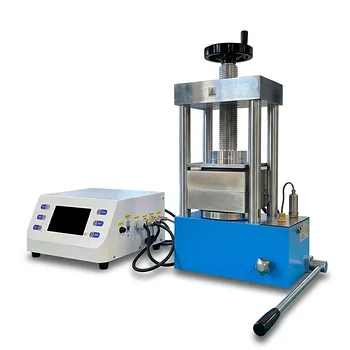
A uniaxial hydraulic press serves as the critical pre-forming tool in the fabrication of NaSICON ceramic cylinders. It acts as the initial shaping mechanism, compacting loose powder within a metal mold using significant pressure—typically around 69 MPa—to create a solid, cohesive object known as a "green body."
The primary function of the uniaxial press is to convert loose raw material into a geometric form with sufficient mechanical strength to be handled, serving as a necessary precursor to secondary densification processes.
Establishing the Foundation
Compacting Loose Powder
The fabrication process begins with loose NaSICON powder, which lacks structure. The hydraulic press applies a specific unidirectional force to this powder inside a metal mold.
Creating the "Green Body"
This application of pressure transforms the powder into a "green body." This term refers to a ceramic object that is weakly bound and unfired, yet holds its shape.
Ensuring Mechanical Integrity
The press ensures the cylinder has sufficient mechanical strength to withstand movement. Without this step, the powder compact would likely crumble during transfer to the next stage of manufacturing.
The Role in the Broader Workflow
Pre-forming for Secondary Processing
The uniaxial press is rarely the final step in densification for high-performance ceramics. Instead, it serves as a pre-forming stage.
Preparing for Isostatic Pressing
By establishing the initial shape and cohesiveness of the cylinder, the press prepares the material for isostatic pressing. This secondary process further densifies the material to achieve the final required properties.
Understanding the Limitations
It Is Not the Final Step
The uniaxial press provides the initial geometric form, but it generally does not achieve the final density required for high-performance NaSICON applications.
Dependency on Secondary Densification
Reliance solely on uniaxial pressing would result in a component lacking optimal structural properties. The process is designed to enable, not replace, subsequent densification methods like isostatic pressing.
Making the Right Choice for Your Goal
To maximize the effectiveness of your fabrication process, consider how this step aligns with your production requirements.
- If your primary focus is geometry definition: Use the uniaxial press and metal mold to strictly define the initial shape and dimensions of the cylinder.
- If your primary focus is process efficiency: Ensure the pressure remains consistent (around 69 MPa) to produce green bodies that are robust enough to handle without breakage during transfer.
The uniaxial hydraulic press is the essential "bridge" that transforms raw powder into a manageable component ready for high-pressure densification.
Summary Table:
| Feature | Specification/Role |
|---|---|
| Primary Function | Pre-forming loose powder into a cohesive "green body" |
| Typical Pressure | Approximately 69 MPa |
| Tooling Used | Precision metal molds for geometric definition |
| Output State | Unfired ceramic cylinder with mechanical handling strength |
| Process Position | Essential precursor to secondary isostatic pressing |
Elevate Your Ceramic Fabrication with KINTEK Precision
Transform your raw powders into high-performance NaSICON components with KINTEK’s industry-leading laboratory solutions. Whether you are defining initial geometries or preparing for final densification, our comprehensive range of uniaxial hydraulic presses, pellet presses, and isostatic pressing systems ensures your green bodies meet the highest standards of mechanical integrity.
From high-temperature furnaces and crushing systems to specialized isostatic presses and ceramic crucibles, KINTEK provides the end-to-end tools needed for advanced battery research and material science.
Ready to optimize your lab's efficiency and material density? Contact KINTEK today for a customized equipment consultation!
Related Products
- Heated Hydraulic Press Machine with Integrated Manual Heated Plates for Lab Use
- Automatic Laboratory Hydraulic Press for XRF & KBR Pellet Press
- Laboratory Hydraulic Pellet Press for XRF KBR FTIR Lab Applications
- Laboratory Hydraulic Press Split Electric Lab Pellet Press
- 24T 30T 60T Heated Hydraulic Press Machine with Heated Plates for Laboratory Hot Press
People Also Ask
- Why is a heated laboratory hydraulic press necessary for composite laminates? Achieve Void-Free Structural Integrity
- What role does a heated hydraulic press play in Cold Sintering (CSP)? Enhancing LATP-Halide Densification
- What technical conditions does a heated hydraulic press provide for PEO batteries? Optimize Solid-State Interfaces
- Why is the heating function of a laboratory hydraulic press essential for MEA assembly in DEFC? Optimize Cell Bonding
- What are heated hydraulic presses used for? Molding Composites, Vulcanizing Rubber, and More