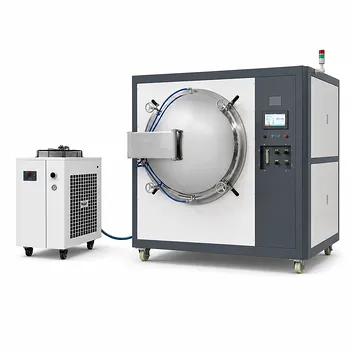
The Vacuum Hot-pressing Sintering Furnace functions as a consolidated processing unit that transforms Titanium-Aluminum (TiAl) pre-alloyed powder into dense, structural components. By simultaneously applying specific high temperatures (1200°C to 1325°C) and uniaxial mechanical pressure (typically 25 MPa) in a vacuum environment, it facilitates particle rearrangement and plastic deformation that thermal energy alone cannot achieve.
Core Takeaway This equipment solves the two primary challenges of TiAl fabrication: eliminating internal porosity to achieve high density and protecting the reactive titanium matrix from embrittlement. It allows for the direct formation of near-net-shape blanks with mechanical integrity superior to conventional pressureless sintering and comparable to forged materials.
Mechanisms of Densification
Simultaneous Heat and Pressure
The defining feature of this furnace is the concurrent application of thermal and mechanical energy. While the temperature is elevated to 1200°C–1325°C, the system applies a uniaxial pressure of 25 MPa.
Plastic Deformation and Flow
Unlike standard sintering, which relies primarily on diffusion, the added mechanical pressure forces plastic flow in the powder particles. This physical compression bridges the gaps between particles, significantly reducing the activation energy required for densification.
Elimination of Internal Pores
The combination of pressure and heat creates diffusion creep, which effectively closes internal voids. This results in the direct formation of high-density alloy blanks, overcoming the residual porosity issues often found in pressureless sintering methods.
Environmental Control and Material Purity
Prevention of Oxidation
Titanium has a high chemical affinity for interstitial elements like oxygen and nitrogen, especially at elevated temperatures. The furnace’s high-vacuum environment is critical to prevent the oxidation of alloy elements during the heating phase.
Preventing Embrittlement
By excluding atmospheric contaminants, the vacuum preserves the microstructural purity of the TiAl alloy. This control is essential for preventing the formation of brittle phases that would compromise the material's ductility and fracture toughness.
Microstructural Advantages
Inhibiting Grain Growth
Because the furnace utilizes mechanical pressure to aid densification, the process can occur at temperatures lower than those required for melting. This lower thermal profile effectively inhibits excessive grain growth.
Achieving Fine-Grained Uniformity
The result of this solid-state process is a fine-grained, uniform microstructure. This refinement enhances the mechanical properties of the final component, specifically improving hardness and tensile strength compared to traditional arc melting methods.
Understanding the Trade-offs
vs. Pressureless Sintering
The primary trade-off regarding pressureless sintering is complexity vs. density. While pressureless methods are simpler, they fail to remove all internal pores. The Vacuum Hot-pressing Furnace introduces equipment complexity to achieve the near-theoretical density (up to 98% or higher) required for high-performance applications.
vs. Melting Processes
Compared to melting methods, vacuum hot-pressing avoids liquid-phase issues such as segregation or coarse grain structure. However, it requires precise control over pressure and temperature synchronization to ensure diffusion bonding occurs without melting the matrix.
Making the Right Choice for Your Goal
When integrating a Vacuum Hot-pressing Sintering Furnace into your TiAl production line, align your process parameters with your specific material requirements:
- If your primary focus is Maximum Density: Prioritize the precise application of uniaxial mechanical pressure (25 MPa) to force plastic deformation and eliminate residual porosity.
- If your primary focus is Material Ductility: Ensure the integrity of the high-vacuum environment to prevent interstitial contamination (oxygen/nitrogen) that leads to brittleness.
- If your primary focus is Mechanical Strength: optimize the thermal profile to sinter at the lowest possible temperature that still permits densification, thereby maintaining a fine-grained microstructure.
The Vacuum Hot-pressing Sintering Furnace effectively bridges the gap between powder metallurgy and high-performance structural integrity.
Summary Table:
| Feature | Vacuum Hot-Pressing Value | Impact on TiAl Alloy |
|---|---|---|
| Temperature Range | 1200°C to 1325°C | Enables solid-state diffusion and inhibits grain growth |
| Mechanical Pressure | 25 MPa (Uniaxial) | Forces plastic deformation and eliminates internal pores |
| Atmosphere Control | High-Vacuum | Prevents oxidation and interstitial embrittlement |
| Final Density | Up to 98%+ Theoretical | Ensures structural integrity for high-performance use |
| Microstructure | Fine-grained & Uniform | Enhances hardness, tensile strength, and toughness |
Elevate Your Material Research with KINTEK
Are you looking to produce high-performance TiAl alloys with superior density and microstructural purity? KINTEK specializes in advanced laboratory equipment, including state-of-the-art Vacuum Hot-Pressing Sintering Furnaces and High-Temperature High-Pressure Reactors designed to meet the rigorous demands of aerospace and automotive material science.
Our comprehensive portfolio supports your entire workflow—from Crushing and Milling Systems for powder preparation to Isostatic Presses and Hydraulic Pellet Presses for pre-forming. By choosing KINTEK, you gain access to precision-engineered tools that ensure uniform heating, exact pressure control, and reliable vacuum environments.
Ready to achieve near-theoretical density in your structural components?
Contact KINTEK Experts Today to discuss your specific TiAl fabrication needs and discover how our specialized furnace solutions can optimize your lab's output.
Related Products
- 600T Vacuum Induction Hot Press Furnace for Heat Treat and Sintering
- Vacuum Heat Treat and Pressure Sintering Furnace for High Temperature Applications
- Vacuum Heat Treat and Sintering Furnace with 9MPa Air Pressure
- 2200 ℃ Tungsten Vacuum Heat Treat and Sintering Furnace
- Vacuum Heat Treat and Molybdenum Wire Sintering Furnace for Vacuum Sintering
People Also Ask
- What role does an induction vacuum hot pressing furnace play in sintering? Achieve 98% Density in Carbide Blocks
- What advantages does a vacuum hot press furnace provide for LSLBO ceramic electrolytes? Achieve 94% Relative Density
- What role does a Vacuum Hot Press (VHP) furnace play in the densification of austenitic stainless steel 316 composites?
- What are the advantages of a vacuum hot press furnace for W-50%Cu? Achieve 99.6% Density at Lower Temperatures
- What role does mechanical pressure play during the vacuum diffusion bonding of tungsten and copper? Keys to Solid Bonding