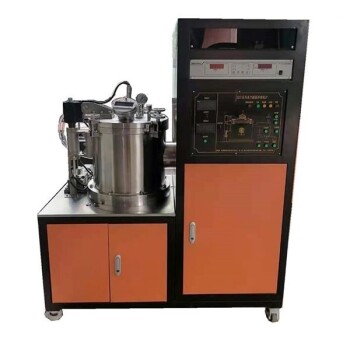
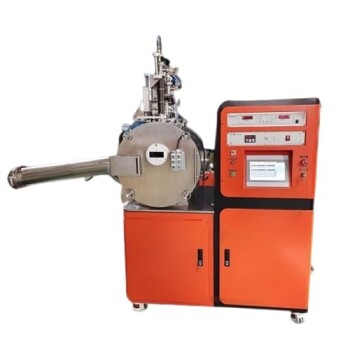
A vacuum induction furnace (VIM) serves as the primary defense against contamination during the melting of 12% Chromium heat-resistant steel. It acts as an isolation chamber, melting raw materials in a highly controlled vacuum to inhibit oxidation reactions and block the introduction of harmful gaseous impurities like oxygen and nitrogen.
Core Takeaway Processing high-chromium steel requires absolute protection from the atmosphere. The vacuum induction furnace is not just a heat source; it is a purification tool that ensures material integrity by preventing element loss through oxidation and eliminating embrittling impurities, guaranteeing the alloy meets precise chemical specifications.
Preserving Alloy Integrity
The most immediate challenge in melting 12% Chromium steel is the reactivity of the chromium itself. The vacuum induction furnace addresses this through strict environmental isolation.
Inhibiting Oxidation of Active Elements
Chromium is highly reactive with oxygen at high temperatures. If melted in open air, a significant portion of the chromium would oxidize, becoming slag rather than alloying with the steel.
The vacuum environment effectively eliminates atmospheric oxygen. This prevents the oxidative loss of chromium and other active elements (such as aluminum), ensuring they remain within the metal matrix to provide the intended heat resistance.
Precise Composition Control
Because the vacuum prevents element loss, metallurgists can adhere to exact "recipes."
The furnace allows for wide-ranging adjustments of temperature and atmosphere without the variable of oxidation. This ensures that the final chemical composition matches the theoretical target values, which is fundamental for consistent material performance.
Achieving Microstructural Purity
Beyond saving the alloy from oxidation, the furnace plays an active role in cleaning the metal and establishing a uniform internal structure.
Minimizing Gaseous Impurities
For high-performance steels, invisible gases are a major threat. A vacuum induction furnace minimizes the introduction of oxygen and nitrogen.
This is particularly critical for 12% Cr martensitic steels, which often require ultra-low nitrogen content (below 0.01 wt.%). By removing nitrogen, the furnace prevents the formation of brittle particles—such as boron nitride or aluminum nitride—that would otherwise compromise the steel's ductility and strength.
Eliminating Non-Metallic Inclusions
The vacuum process aids in the removal of non-metallic inclusions. A cleaner matrix leads to better mechanical properties, specifically improving the fatigue life and toughness of the final heat-resistant component.
Ensuring Homogeneity via Induction Stirring
Melting the ingredients is only half the battle; mixing them is the other.
The furnace utilizes electromagnetic induction not just for heat, but for movement. This creates a natural "stirring" effect within the molten pool. This stirring eliminates macrosegregation, ensuring that heavy and light elements (like Iron, Chromium, Nickel, and Molybdenum) are distributed uniformly throughout the ingot.
Understanding the Trade-offs
While vacuum induction melting is superior for quality, it introduces specific operational constraints that must be managed.
Complexity and Cost
VIM is significantly more complex and expensive than air melting processes. It is a batch process that requires specialized equipment to maintain vacuum integrity. The cost per ton of steel is higher, making it viable only for high-value alloys where purity is non-negotiable.
Raw Material Sensitivity
While VIM is excellent at removing volatile gases and preventing oxidation, it is not a "magic filter" for all contaminants. The process still relies on high-quality raw materials. If the input materials are heavily contaminated with non-volatile impurities that the vacuum cannot remove, the final product quality will still suffer.
Making the Right Choice for Your Goal
The use of a vacuum induction furnace is a strategic decision based on the specific requirements of your 12% Chromium steel application.
- If your primary focus is mechanical reliability: The VIM process is essential to remove nitrogen and prevent brittle inclusions, ensuring the steel does not fail under stress.
- If your primary focus is chemical precision: The vacuum environment is required to prevent the oxidative loss of Chromium, ensuring the final alloy contains exactly 12% Cr for maximum heat resistance.
By isolating the melt from the atmosphere, the vacuum induction furnace transforms a chaotic chemical reaction into a precise manufacturing process.
Summary Table:
| Feature | Impact on 12% Chromium Steel | Key Benefit |
|---|---|---|
| Vacuum Isolation | Inhibits chromium and aluminum oxidation | Preserves alloy chemical composition |
| Degassing | Removes oxygen and nitrogen impurities | Prevents embrittlement and brittle inclusions |
| Induction Stirring | Eliminates macrosegregation | Ensures uniform element distribution and homogeneity |
| Atmosphere Control | Blocks atmospheric contamination | Enhances fatigue life and mechanical toughness |
Elevate Your Alloy Production with KINTEK Precision
Maintaining the integrity of 12% Chromium heat-resistant steel requires the uncompromising control provided by advanced thermal technology. KINTEK specializes in high-performance laboratory equipment, offering a comprehensive range of induction melting furnaces, vacuum systems, and crushing and milling solutions designed for the most demanding research and production environments.
Whether you are refining high-value alloys or developing next-generation materials, our portfolio—including high-temperature furnaces, hydraulic presses, and specialized ceramics—is engineered to deliver precision and reliability.
Ready to optimize your material purification process? Contact our technical experts today to discover how KINTEK’s innovative solutions can enhance your laboratory’s efficiency and output.
References
- M. Yu. Belomyttsev. Features of formation of austenite grains in 12 % Cr heat-resistant ferritic-martensitic steels. DOI: 10.17073/0368-0797-2023-2-168-176
This article is also based on technical information from Kintek Solution Knowledge Base .
Related Products
- 600T Vacuum Induction Hot Press Furnace for Heat Treat and Sintering
- Lab-Scale Vacuum Induction Melting Furnace
- Non Consumable Vacuum Arc Induction Melting Furnace
- Vacuum Heat Treat Furnace and Levitation Induction Melting Furnace
- Vacuum Arc Induction Melting Furnace
People Also Ask
- What role does an induction vacuum hot pressing furnace play in sintering? Achieve 98% Density in Carbide Blocks
- What advantages does a vacuum hot press furnace provide for LSLBO ceramic electrolytes? Achieve 94% Relative Density
- What role does a Vacuum Hot Press (VHP) furnace play in the densification of austenitic stainless steel 316 composites?
- What are the advantages of a vacuum hot press furnace for W-50%Cu? Achieve 99.6% Density at Lower Temperatures
- What role does mechanical pressure play during the vacuum diffusion bonding of tungsten and copper? Keys to Solid Bonding