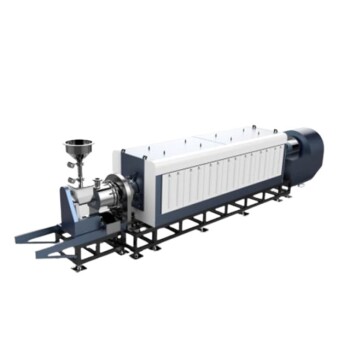
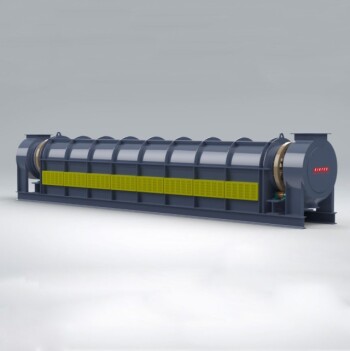
The industrial-grade high-temperature pyrolysis furnace serves as the reactor core for transforming waste tires into valuable carbon black. It functions by subjecting the material to precise heating, typically at 500°C, within a controlled inert atmosphere to facilitate the thermal degradation necessary to separate organic components from solid carbon.
By maintaining a stable, oxygen-free environment and exact temperature control, this furnace ensures the complete decomposition of organic compounds. This hardware precision is the primary driver of the purity and structural integrity of the resulting pyrolysis carbon black.
Orchestrating the Decomposition Environment
Establishing an Inert Atmosphere
The fundamental role of the furnace is to prevent combustion while allowing the material to break down. To achieve this, the equipment generates a controlled inert atmosphere, often utilizing a nitrogen flow.
This oxygen-deprived environment ensures that the waste tires undergo thermal degradation rather than simply burning up. This distinction is vital for recovering solid materials rather than reducing them to ash.
Precise Temperature Regulation
The furnace provides a specific heating environment, with a standard operating temperature targeting 500°C.
Maintaining this specific temperature is not arbitrary; it is the thermal "sweet spot" required to effectively break the chemical bonds within the tire material.
From Waste to Recovered Material
Ensuring Complete Decomposition
The furnace is the essential hardware responsible for the full breakdown of organic components found in tires.
Without the consistent heat application provided by the industrial-grade unit, the degradation process would be incomplete. This would leave unwanted organic matter mixed with the final product.
Extracting Carbonaceous Solids
The ultimate goal of this thermal process is the extraction of residual carbonaceous solids.
These solids are the raw form of pyrolysis carbon black. The furnace facilitates the physical separation of this solid residue from the volatile gases released during heating.
Critical Operational Constraints
The Impact of Thermal Instability
The most significant operational trade-off in this process is the reliance on temperature control precision.
If the furnace cannot maintain exact stability at the target temperature, the quality of the output immediately suffers. Variations in heat directly alter the structural characteristics of the carbon black, rendering it less consistent.
Purity Dependencies
The purity of the final carbon black product is inextricably linked to the furnace's performance.
An industrial-grade unit must eliminate variables in the heating environment. Any fluctuation in the inert atmosphere or temperature profile can result in impurities that degrade the commercial value of the carbon black.
Optimizing Production Outcomes
The effectiveness of your pyrolysis operation depends entirely on the capability of your furnace to maintain strict environmental conditions.
- If your primary focus is Product Purity: Prioritize a furnace with high-precision temperature control mechanisms to ensure consistent structural characteristics in the carbon black.
- If your primary focus is Process Efficiency: Ensure the equipment guarantees a stable nitrogen flow to facilitate rapid and complete thermal degradation of all organic components.
The industrial-grade furnace is not just a heat source; it is the precision instrument that defines the quality of your final yield.
Summary Table:
| Key Feature | Functional Role in Pyrolysis | Impact on Carbon Black Quality |
|---|---|---|
| Inert Atmosphere | Prevents combustion using nitrogen flow | Ensures solid carbon recovery instead of ash |
| 500°C Temp Control | Facilitates thermal degradation of bonds | Determines purity and structural integrity |
| Organic Breakdown | Separates volatiles from solid residues | Eliminates impurities for higher commercial value |
| Thermal Stability | Maintains consistent heat profile | Guarantees product consistency and uniformity |
Maximize Your Recovery Yield with KINTEK Precision
In the demanding field of waste-to-energy, your output quality is only as stable as your thermal environment. KINTEK specializes in advanced industrial-grade solutions, providing high-precision rotary and vacuum furnaces, crushing systems, and high-temperature high-pressure reactors tailored for the most rigorous pyrolysis applications.
Whether you are refining carbon black or developing new battery materials, our equipment ensures the exact temperature regulation and inert atmosphere control necessary for superior structural integrity. Don't let thermal instability compromise your production purity.
Ready to optimize your pyrolysis operation? Contact our laboratory equipment experts today to find the perfect furnace or milling solution for your facility.
References
- Tuba Bahtlı, Serife Yalcin Yasti. The Effect of Carbon Sources on the Thermal Shock Properties of MgO-C Refractories. DOI: 10.13189/ujms.2018.060501
This article is also based on technical information from Kintek Solution Knowledge Base .
Related Products
- Ultra-High Temperature Graphite Vacuum Graphitization Furnace
- 1700℃ Laboratory High Temperature Tube Furnace with Alumina Tube
- 1400℃ Laboratory High Temperature Tube Furnace with Alumina Tube
- Vacuum Heat Treat and Pressure Sintering Furnace for High Temperature Applications
- Horizontal High Temperature Graphite Vacuum Graphitization Furnace
People Also Ask
- What is the disadvantage of graphite furnace? Managing Reactivity and Contamination Risks
- Is a graphite melting point high or low? Discover Its Extreme Thermal Resilience
- What are the advantages and disadvantages of graphite furnace? Unlock Extreme Heat Performance
- What are the disadvantages of graphite furnace? Key Limitations and Operational Costs
- What gas is used in graphite furnace? Maximize Accuracy with the Right Inert Gas