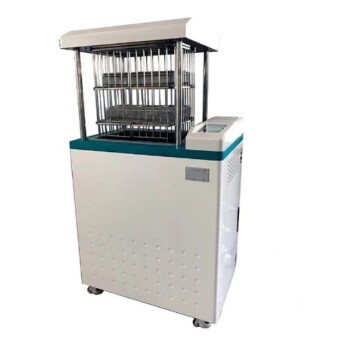
The primary role of an ultrasonic cleaner is to guarantee the surface purity required for valid scientific data. In the context of titanium alloy pretreatment, it utilizes cavitation effects in conjunction with specific solvents to strip away oils, machining particles, and processing residues that would otherwise compromise biological testing.
Core Takeaway: The ultrasonic cleaner does not merely "wash" the sample; it standardizes the surface. By eliminating microscopic contaminants, it ensures that biocompatibility results—such as cell adhesion and growth—reflect the true properties of the titanium alloy, rather than the toxicity of leftover grease or debris.
The Mechanics of Decontamination
The Power of Cavitation
The cleaner operates by generating high-frequency vibrations in a liquid medium. These vibrations create rapid pressure changes that form microscopic bubbles.
When these bubbles collapse (cavitation), they release intense localized energy. This physical force dislodges stubborn micro-debris and contaminants from complex surface geometries where brushes or manual wiping cannot reach.
The Role of Solvents
Mechanical force alone is often insufficient for chemical residues. The process typically employs a sequence of solvents, including acetone, isopropyl alcohol, ethanol, and deionized water.
The ultrasonic energy enhances the solvent's ability to dissolve organic contaminants like grease and machining oils. This combination ensures a "deep clean" that prepares the substrate at a molecular level.
Ensuring Biocompatibility Accuracy
Removing Physical Barriers
Biological testing often measures how well cells can attach to a metal surface. If machining residues remain, they act as a physical barrier between the biological material and the titanium.
Ultrasonic cleaning eliminates these barriers. This allows researchers to observe the actual interaction between the cells and the alloy surface.
Preventing Chemical Interference
Processing residues are often toxic or inhibitory to biological life. Without thorough ultrasonic cleaning, these invisible chemical layers can kill cells or retard their growth.
This leads to false negatives in biocompatibility tests. The cleaner ensures that any observed lack of cell growth is due to the material itself, not the dirt left on top of it.
Critical Considerations and Constraints
Solvent Compatibility
While the ultrasonic mechanism is powerful, the choice of solvent is critical. Using the wrong fluid can fail to dissolve specific processing oils or potentially leave its own residue.
You must ensure the solvent chain (e.g., Acetone to Ethanol to Water) is chemically compatible to prevent cross-contamination during the cleaning stages.
The Risk of Over-Processing
It is vital to balance cleaning duration with sample integrity. While titanium is robust, excessive ultrasonic exposure in harsh solvents can theoretically alter surface passivation layers in some contexts.
However, the primary risk in biological testing is under-cleaning. The priority must always be the complete removal of contaminants to ensure experimental validity.
Making the Right Choice for Your Goal
To ensure your biological testing data is defensible, you must view the ultrasonic cleaner as a precision instrument, not just a washing bucket.
- If your primary focus is removing heavy machining oils: Prioritize the use of stronger solvents like acetone and isopropyl alcohol in the initial ultrasonic cycles to dissolve organic grease.
- If your primary focus is sensitive cell culture assays: Ensure the final ultrasonic stage uses high-purity deionized water to remove all traces of the cleaning solvents themselves, preventing chemical toxicity.
A rigorous ultrasonic cleaning protocol is the baseline requirement for trusting any data derived from titanium biocompatibility experiments.
Summary Table:
| Stage | Action | Primary Goal |
|---|---|---|
| Mechanism | Cavitation Effects | Dislodge micro-debris and physical particles |
| Solvent Chain | Acetone & Ethanol | Dissolve organic oils and machining residues |
| Final Rinse | Deionized Water | Remove chemical traces to prevent cell toxicity |
| Outcome | Standardized Surface | Ensure accurate cell adhesion and growth data |
Elevate Your Research with Precision Cleaning Solutions
Ensure the integrity of your biological testing and material research with KINTEK’s high-performance laboratory equipment. Whether you are preparing titanium alloy samples or sensitive electronic components, our advanced ultrasonic cleaners provide the molecular-level purity required for defensible scientific data.
Beyond cleaning, KINTEK offers a comprehensive range of solutions for demanding lab environments, including:
- High-Temperature Furnaces & Reactors: For advanced material synthesis and processing.
- Hydraulic Presses & Milling Systems: Perfect for sample preparation and pelletizing.
- Specialized Consumables: High-quality PTFE products, ceramics, and crucibles.
Don't let surface contaminants compromise your results. Contact KINTEK today to find the perfect equipment for your lab's specific needs and ensure your research is built on a foundation of absolute purity.
References
- William de Melo Silva, Deílson Elgui de Oliveira. Fibroblast and pre-osteoblast cell adhesive behavior on titanium alloy coated with diamond film. DOI: 10.1590/1980-5373-mr-2016-0971
This article is also based on technical information from Kintek Solution Knowledge Base .
Related Products
- Laboratory Sterilizer Lab Autoclave Pulsating Vacuum Desktop Steam Sterilizer
- Laboratory Oscillating Orbital Shaker
- Custom PTFE Teflon Parts Manufacturer Corrosion Resistant Cleaning Rack Flower Basket
- Laboratory Scientific Electric Heating Blast Drying Oven
- Portable High Pressure Laboratory Autoclave Steam Sterilizer for Lab Use
People Also Ask
- What is the primary function of a laboratory sterilization autoclave? Master the Physics of Wet Heat Sterilization
- In what industries and applications are steam sterilizers or autoclaves used? Discover Key Uses Across 4 Major Sectors
- What precautions should be taken during autoclave in laboratory? A Complete Safety Guide to Prevent Burns and Explosions
- What extreme conditions does a laboratory autoclave simulate? Testing Wear Resistance of Nuclear Fuel Cladding
- What role does a laboratory autoclave play in HEA corrosion research? Key to Validating Advanced Reactor Materials