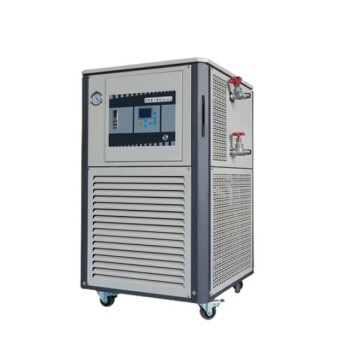
A laboratory high-temperature circulation furnace provides the critical advantage of multi-stage programmable temperature control. This feature allows for the precise execution of complex dual heat treatment cycles, specifically subcritical quenching (750-800°C) followed by high-temperature tempering (635-700°C), which are required to optimize the mechanical properties of 11% Cr steel.
Core Takeaway By enabling exact thermal management, this equipment allows you to independently adjust the strength and toughness of the steel. It achieves this by partitioning the martensitic matrix and eliminating the brittleness associated with fresh martensite formation.
Achieving Microstructural Control
To understand the value of the circulation furnace, one must look beyond simple heating. The primary benefit lies in its ability to manipulate the steel's internal structure through precise thermal staging.
Partitioning the Martensitic Matrix
The specific capability of this furnace to hold temperatures strictly between 750-800°C allows for effective subcritical quenching.
During this phase, the precise heat environment facilitates the partitioning of the martensitic matrix. This divides the microstructure into untransformed regions and newly formed regions, creating a complex foundation that simple quenching cannot achieve.
Eliminating Hardening Effects
Following the subcritical quench, the furnace's programmable logic transitions the steel to a high-temperature tempering phase, typically between 635-700°C.
This secondary stage is vital for stabilizing the material. It targets the "fresh" martensite formed during the previous step, effectively eliminating its hardening effects. This ensures the final product does not suffer from the brittleness often associated with un-tempered martensitic structures.
Independent Property Adjustment
The ultimate technical advantage of this furnace is the decoupling of mechanical properties.
Balancing Strength and Toughness
In standard heat treatments, increasing strength often significantly sacrifices toughness. The dual-cycle approach supported by this furnace allows these two properties to be adjusted independently.
By carefully controlling the multi-stage cycle, you can retain high strength while simultaneously enhancing the material's ability to absorb energy without fracturing.
Optimization of Comprehensive Properties
The result is an optimization of the steel's "comprehensive mechanical properties." Rather than maximizing one metric at the expense of another, the circulation furnace enables a balanced profile suitable for demanding applications.
Understanding the Trade-offs
While the laboratory high-temperature circulation furnace offers precision, effective treatment relies on process continuity and initial material state.
Dependence on Initial Homogeneity
The advanced subcritical quenching process described above is less effective if the starting microstructure is inconsistent.
As noted in supplementary contexts regarding 11% Cr steels (such as 13Kh11N2W2MF), a prior normalization process at 980°C is often required. This ensures full austenitization and carbide dissolution, establishing the "process heredity" needed for the circulation furnace to yield optimal results.
Sensitivity to Temperature Variances
Because subcritical quenching operates within a narrow window (750-800°C), the furnace must maintain exceptional thermal uniformity. Deviating from this range can fail to partition the matrix correctly, rendering the subsequent tempering phase ineffective.
Making the Right Choice for Your Goal
When configuring your heat treatment protocol for 11% Cr steel, consider your specific mechanical requirements.
- If your primary focus is balancing strength and toughness: Utilize the furnace's multi-stage programming to execute the subcritical quench (750-800°C) followed by high-temperature tempering (635-700°C).
- If your primary focus is ensuring process consistency: Verify that the steel has undergone proper normalization (e.g., at 980°C) to dissolve carbides before attempting the subcritical cycle.
Use the furnace's programmable precision to transform raw hardness into durable, resilient performance.
Summary Table:
| Process Phase | Temperature Range | Primary Technical Objective |
|---|---|---|
| Normalization | ~980°C | Carbide dissolution & microstructural homogeneity |
| Subcritical Quench | 750°C - 800°C | Partitioning of the martensitic matrix |
| High-Temp Tempering | 635°C - 700°C | Eliminating fresh martensite hardening/brittleness |
| Final Outcome | Optimized Profile | Independent adjustment of strength and toughness |
Elevate Your Material Research with KINTEK Precision
Unlock the full potential of your alloy development with KINTEK’s high-performance laboratory solutions. Whether you are performing complex dual-cycle heat treatments on 11% Cr steel or developing advanced materials, our high-temperature circulation furnaces and programmable muffle/tube furnaces provide the thermal uniformity and precision control required for success.
From high-pressure reactors and autoclaves to specialized crushing, milling, and pellet pressing systems, KINTEK equips researchers with the durable tools needed to achieve superior mechanical properties.
Ready to optimize your lab’s thermal processing? Contact our experts today to find the perfect furnace configuration for your research goals!
References
- Д. А. Мирзаев, А. Н. Маковецкий. Effect of intercritical quench hardening on mechanical properties of 11% CR steel. DOI: 10.18503/1995-2732-2018-16-4-45-49
This article is also based on technical information from Kintek Solution Knowledge Base .
Related Products
- 1700℃ Laboratory High Temperature Tube Furnace with Alumina Tube
- 1400℃ Laboratory High Temperature Tube Furnace with Alumina Tube
- High Temperature Constant Temperature Heating Circulator Water Bath Chiller Circulator for Reaction Bath
- Ultra-High Temperature Graphite Vacuum Graphitization Furnace
- High Temperature Muffle Oven Furnace for Laboratory Debinding and Pre Sintering
People Also Ask
- What functions does a laboratory high-temperature tube furnace perform? Master Catalyst Synthesis & Carbonization
- What roles does a high-temperature tube furnace play in the synthesis of N/O co-doped carbon? Master Precise Doping
- How does a laboratory tube furnace facilitate methane catalyst evaluation & regeneration? Optimize Thermal Performance
- What are the primary applications of muffle and tube furnaces in photocatalysts? Optimize Metal Loading & Support Synthesis
- How does a high-temperature tube furnace influence 253MA steel? Master Microstructure & High-Temp Creep Resistance