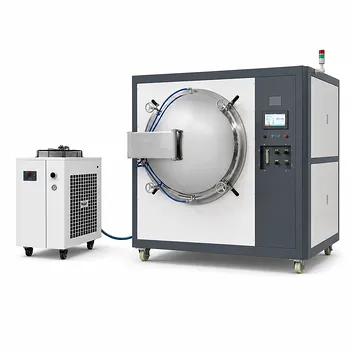
The primary technical advantage of a vacuum hot-pressing furnace for Ti/Al2O3 composites lies in its ability to simultaneously solve the problems of reactivity and porosity. By maintaining a high vacuum, it prevents the rapid oxidation and nitridation of metallic titanium, while the application of significant mechanical pressure (up to 30 MPa) forces plastic flow to achieve near-perfect densification (99%) in a material system that is notoriously difficult to sinter.
Core Insight: The vacuum hot-pressing furnace replaces reliance on thermal energy alone with a dual-force mechanism. It utilizes vacuum protection to preserve the chemical integrity of the titanium matrix and mechanical force to physically close pores, enabling the successful bonding of dissimilar materials (metal and ceramic) that pressureless sintering often fails to consolidate.
Overcoming Chemical Instability
The synthesis of Ti/Al2O3 composites presents a significant chemical challenge due to the high reactivity of titanium. The vacuum environment is the critical control factor here.
Prevention of Matrix Embrittlement
Titanium is highly sensitive to interstitial elements at high temperatures (up to 1420°C). Without a controlled atmosphere, titanium will react instantly with oxygen and nitrogen.
The vacuum environment prevents the formation of oxides and nitrides which would otherwise create brittle phases within the metal matrix, drastically reducing the ductility and fracture toughness of the final composite.
Elimination of Interfacial Contaminants
achieving a strong bond between the metal (Ti) and the ceramic (Al2O3) requires a chemically clean interface.
The vacuum actively removes adsorbed gases and volatiles trapped within the powder gaps. This "degassing" ensures that no gas pockets hinder the contact between particles, allowing for cleaner interfacial bonding and higher material density.
Driving Densification Through Mechanics
While the vacuum protects the chemistry, the mechanical system drives the physical structure. Conventional pressureless sintering often leaves pores in ceramic-metal composites due to the poor wettability between the phases.
Forcing Plastic Flow
The furnace applies uniaxial pressure (typically around 30 MPa) during the heating phase. This stress exceeds the yield strength of the heated materials.
This mechanical force induces plastic flow and particle rearrangement. The ductile titanium matrix is physically forced to flow around the rigid Al2O3 particles, filling voids that surface tension alone could not close.
Achieving Near-Theoretical Density
The combination of heat and pressure facilitates diffusion at a rate significantly higher than thermal diffusion alone.
This process enables the composite to reach extremely high densification levels, often approaching 99% of the theoretical density. This reduction in porosity directly correlates to superior mechanical properties, such as improved hardness and wear resistance.
Understanding the Trade-offs
While vacuum hot-pressing offers superior material quality, it is essential to understand the operational constraints compared to other methods.
Geometric Limitations
The pressure applied is uniaxial (from one direction). This limits the production capabilities to simple shapes, such as plates, discs, or cylinders. Complex geometries with undercuts cannot be manufactured directly and would require post-process machining.
Throughput vs. Quality
This is a batch process that requires significant cycle time for heating, dwelling, and cooling under vacuum. While it produces the highest quality microstructure, it has a lower production throughput compared to continuous sintering methods.
Making the Right Choice for Your Goal
When evaluating this equipment for your specific Ti/Al2O3 application, consider your performance priorities:
- If your primary focus is Maximum Fracture Toughness: The vacuum capability is your most critical asset, as it prevents the oxygen embrittlement that causes premature failure in titanium matrices.
- If your primary focus is Wear Resistance: The mechanical pressure capabilities are paramount, as achieving >99% density is required to prevent grain pull-out during abrasive wear.
Summary: For Ti/Al2O3 composites, the vacuum hot-pressing furnace is not just a heater, but a necessary mechanical tool that forces the coexistence of two chemically and physically distinct materials into a unified, dense structure.
Summary Table:
| Feature | Technical Advantage | Benefit for Ti/Al2O3 |
|---|---|---|
| High Vacuum Environment | Prevents oxidation and nitridation | Maintains titanium ductility and prevents matrix embrittlement. |
| Uniaxial Pressure (30 MPa) | Induces plastic flow and rearrangement | Eliminates porosity and overcomes poor wettability between phases. |
| Integrated Heating/Pressing | Dual-force mechanism | Achieves near-theoretical density (99%) for superior hardness. |
| Atmosphere Control | Degassing of adsorbed gases | Ensures clean interfaces and high-strength bonding between metal and ceramic. |
Elevate Your Advanced Material Sintering with KINTEK
Precision matters when engineering high-performance Ti/Al2O3 composites. KINTEK specializes in cutting-edge laboratory equipment, providing the vacuum hot-pressing furnaces and high-temperature systems necessary to achieve near-perfect densification and chemical purity.
Whether you are focusing on fracture toughness or wear resistance, our comprehensive range of tools—from crushing and milling systems to isostatic presses and vacuum furnaces—is designed to meet the rigorous demands of material science.
Ready to optimize your lab's capabilities? Contact KINTEK experts today to find your perfect solution.
Related Products
- Vacuum Hot Press Furnace Heated Vacuum Press Machine Tube Furnace
- 600T Vacuum Induction Hot Press Furnace for Heat Treat and Sintering
- Vacuum Hot Press Furnace Machine Heated Vacuum Press
- Vacuum Hot Press Furnace Machine for Lamination and Heating
- Vacuum Heat Treat and Pressure Sintering Furnace for High Temperature Applications
People Also Ask
- What advantages does a vacuum hot press furnace provide for LSLBO ceramic electrolytes? Achieve 94% Relative Density
- What role does a Vacuum Hot Press (VHP) furnace play in the densification of austenitic stainless steel 316 composites?
- What are the advantages of using a vacuum hot pressing furnace? Superior Densification for 2024Al/Gr/SiC Composites
- What are the advantages of a vacuum hot press furnace for LTPO solid electrolytes? Boost Density and Conductivity
- What core processing conditions does a vacuum hot press furnace provide? Achieve High-Density Cu-SiC/Diamond Composites