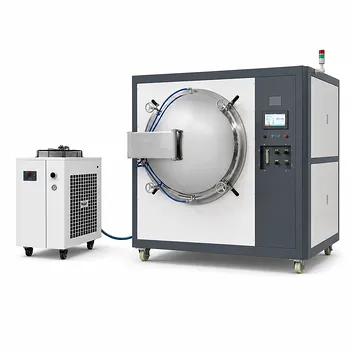
A vacuum hot press sintering furnace creates a specialized fabrication environment defined by the simultaneous application of three technical conditions: a high-vacuum atmosphere, precise thermal control (specifically around 580°C), and continuous uniaxial mechanical pressure (typically up to 100 MPa).
These conditions are engineered to overcome the natural resistance of aluminum alloys to sintering. The vacuum prevents the rapid oxidation inherent to aluminum, while the mechanical pressure physically forces the material to densify, ensuring the Silicon Carbide (SiC) particles are fully encapsulated by the Al-30Si matrix.
Core Takeaway The fabrication of dense SiCp/Al-30Si composites relies on the synergy of heat and force in an oxygen-free environment. While heat softens the matrix, it is the mechanical pressure (100 MPa) that eliminates porosity through plastic flow, a density level that pressureless sintering cannot achieve for this material.
The Critical Environmental Trio
To achieve full density in SiCp/Al-30Si composites, the furnace must provide a tightly coupled environment where temperature, pressure, and atmosphere work in concert.
High-Vacuum Atmosphere
The furnace maintains a vacuum environment to aggressively eliminate oxygen. This is non-negotiable for aluminum-based composites because aluminum oxidizes instantly when exposed to air, forming a barrier that prevents particle bonding.
Precise Thermal Control (580°C)
The system sustains a high temperature, referenced specifically as 580°C for this composite class. This temperature is carefully selected to soften the Al-30Si matrix effectively without causing unwanted degradation, preparing the material for deformation.
Uniaxial Mechanical Pressure (100 MPa)
Unlike standard sintering, this process applies a massive, continuous axial load, often reaching 100 MPa. This external force is the primary driver for densification, mechanically compressing the powder mixture during the heating cycle.
Mechanisms of Densification
The technical conditions provided by the furnace trigger specific physical mechanisms that result in a dense, high-performance composite.
Facilitating Plastic Flow
The combination of 580°C heat and 100 MPa pressure causes the aluminum matrix to undergo plastic flow. The softened metal is physically forced to flow around the rigid Silicon Carbide (SiC) particles, filling voids that would otherwise remain empty.
Particle Rearrangement
The applied pressure forces the SiC particles and the metal powder to rearrange themselves into a tighter packing configuration. This mechanical reorganization minimizes the distance between particles, which is a prerequisite for effective bonding.
Elimination of Internal Porosity
The continuous pressure actively closes internal voids and pores. By mechanically collapsing these gaps during the sintering phase, the furnace eliminates the porosity defects that typically plague pressureless sintering methods.
Enhanced Diffusion Bonding
The vacuum removes adsorbed gases and volatile impurities from the particle surfaces. With clean surfaces brought into intimate contact by the high pressure, atomic diffusion can occur freely, creating strong metallurgical bonds between the matrix and the reinforcement.
Understanding the Trade-offs
While vacuum hot pressing produces superior material properties, it introduces specific constraints that must be managed.
Complexity of Simultaneous Control
Achieving the "coupling effect" of heat and force requires precise synchronization. If the pressure is applied before the temperature is sufficient, the powder may not flow; if applied too late, the microstructure may coarsen.
Interaction Management
The environment must be controlled to prevent excessive interfacial reactions. While bonding is necessary, the high temperature and pressure must be regulated to avoid forming brittle intermetallic phases that could degrade mechanical performance.
Making the Right Choice for Your Goal
The technical conditions of vacuum hot pressing are designed for specific engineering outcomes.
- If your primary focus is Maximum Density: Prioritize the 100 MPa mechanical pressure capability, as this is the dominant factor in eliminating internal porosity and forcing plastic flow.
- If your primary focus is Interfacial Strength: Focus on the quality of the vacuum, as removing adsorbed gases and preventing oxidation is critical for wetting the SiC particles.
- If your primary focus is Dimensional Stability: Ensure the temperature uniformity at 580°C, as uneven heating under pressure can lead to warped components or heterogeneous material properties.
Ultimately, the vacuum hot press furnace provides the brute force required to densify the composite while maintaining the delicate chemical purity needed for strong bonding.
Summary Table:
| Condition | Parameter | Critical Function in SiCp/Al-30Si Fabrication |
|---|---|---|
| Atmosphere | High-Vacuum | Prevents aluminum oxidation and removes adsorbed gases for better bonding. |
| Temperature | 580°C | Softens the Al-30Si matrix to facilitate plastic flow without degradation. |
| Mechanical Pressure | 100 MPa (Uniaxial) | Acts as the primary driver for densification and elimination of internal voids. |
| Mechanism | Plastic Flow | Forces matrix material to encapsulate SiC particles, ensuring full density. |
Elevate Your Material Research with KINTEK
Precision and density are non-negotiable in advanced composite fabrication. KINTEK specializes in high-performance laboratory equipment, providing the rigorous thermal and mechanical control required for successful vacuum hot pressing.
Whether you are developing SiCp/Al-30Si composites or exploring new material boundaries, our comprehensive range of vacuum hot presses, high-temperature furnaces, and hydraulic systems ensures your lab achieves superior metallurgical bonding and zero-porosity results.
Ready to optimize your sintering process? Contact our technical experts today to find the perfect solution for your high-pressure, high-temperature research needs.
Related Products
- 600T Vacuum Induction Hot Press Furnace for Heat Treat and Sintering
- Vacuum Heat Treat and Sintering Furnace with 9MPa Air Pressure
- Vacuum Heat Treat and Pressure Sintering Furnace for High Temperature Applications
- Vacuum Hot Press Furnace Heated Vacuum Press Machine Tube Furnace
- Vacuum Hot Press Furnace Machine Heated Vacuum Press
People Also Ask
- What role does an induction vacuum hot pressing furnace play in sintering? Achieve 98% Density in Carbide Blocks
- What advantages does a vacuum hot press furnace provide for LSLBO ceramic electrolytes? Achieve 94% Relative Density
- What role does a Vacuum Hot Press (VHP) furnace play in the densification of austenitic stainless steel 316 composites?
- What are the advantages of a vacuum hot press furnace for W-50%Cu? Achieve 99.6% Density at Lower Temperatures
- What role does mechanical pressure play during the vacuum diffusion bonding of tungsten and copper? Keys to Solid Bonding