Knowledge engineering ceramics What temperature is alumina activated? Unlock Optimal Porosity for Adsorption
Author avatar

Tech Team · Kintek Solution

Updated 2 months ago

What temperature is alumina activated? Unlock Optimal Porosity for Adsorption


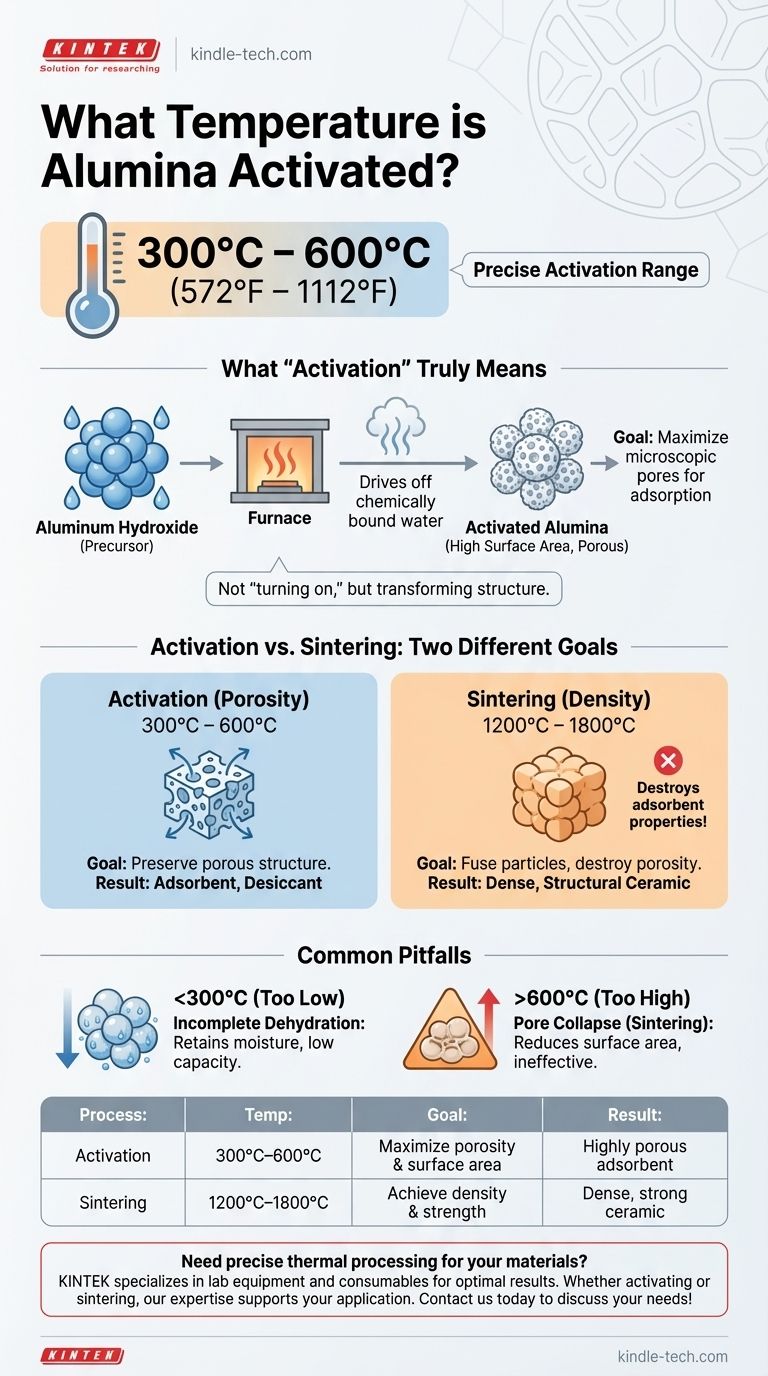
To be precise, alumina is typically activated by heating it to temperatures between 300°C and 600°C (572°F and 1112°F). This specific thermal process is designed to create a highly porous material with a vast internal surface area, making it an excellent adsorbent or catalyst carrier.

The critical concept to grasp is that "activation temperature" and "maximum use temperature" refer to two entirely different processes with opposite goals. Activation creates porosity at lower temperatures, while high-temperature firing creates dense, structural ceramics.
What temperature is alumina activated? Unlock Optimal Porosity for Adsorption

What "Activation" Truly Means for Alumina

The term "activation" can be misleading. It doesn't mean turning the alumina "on." It refers to a specific manufacturing step that transforms aluminum hydroxide into a form of aluminum oxide with unique properties.

The Goal: Maximizing Surface Area

The sole purpose of activation is to create a material with an enormous number of microscopic pores. This network of pores is what gives activated alumina its ability to trap moisture and other substances.

The Mechanism: Driving Off Water

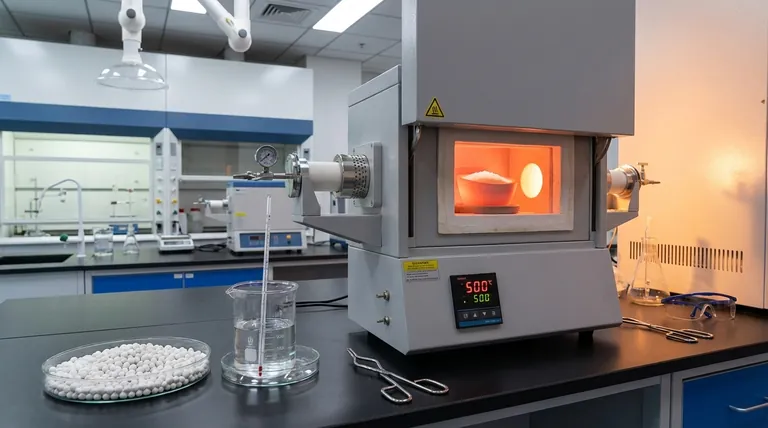
The process starts with a precursor material, typically aluminum hydroxide. Heating it within the activation range drives off chemically bound water molecules.

This water removal leaves behind a rigid, highly porous structure, transforming the material into the familiar white beads of activated alumina used as a desiccant.

Activation vs. Sintering: Two Different Goals

The confusion often arises when comparing the activation temperature with the much higher temperatures alumina can withstand in other applications. These are fundamentally different thermal treatments.

Activation Temperature (300°C – 600°C)

This relatively low temperature range is a carefully controlled balance. It's hot enough to drive off water and form the pore network but cool enough to prevent that network from collapsing.

The goal is to preserve the porous structure and maximize the internal surface area for adsorption.

Sintering/Use Temperature (1200°C – 1800°C)

The extremely high temperatures mentioned for alumina tubes relate to a process called sintering. At these temperatures, the individual alumina particles fuse together.

This process destroys porosity to create a dense, mechanically strong, and chemically resistant ceramic. Heating activated alumina to this range would completely negate its adsorbent properties.

Common Pitfalls to Avoid

Controlling the temperature is the single most important factor in producing effective activated alumina. Deviating from the optimal range has significant consequences.

Heating Too Low (Below 300°C)

If the temperature is too low, the dehydration process will be incomplete. The resulting material will retain moisture, leading to a significantly lower adsorption capacity and poor performance.

Heating Too High (Above 600°C)

Exceeding the activation range causes the pore structure to begin collapsing and fusing, a process known as sintering. This permanently reduces the surface area and destroys the material's ability to act as an effective adsorbent.

Making the Right Choice for Your Goal

The correct thermal treatment for alumina is entirely dependent on your final application.

  • If your primary focus is creating a desiccant, adsorbent, or catalyst carrier: You must heat the material within the precise activation range of 300°C to 600°C to maximize its porosity.
  • If your primary focus is creating a strong, non-porous, high-temperature ceramic component: You must use a much higher sintering temperature (typically above 1200°C) to achieve full density.

Understanding the distinction between activating for porosity and firing for strength is the key to successfully using alumina in any application.

Summary Table:

Process Temperature Range Primary Goal Resulting Material Property
Activation 300°C – 600°C (572°F – 1112°F) Maximize porosity & surface area Highly porous adsorbent (e.g., desiccant)
Sintering 1200°C – 1800°C (2192°F – 3272°F) Achieve density & strength Dense, strong ceramic (e.g., labware)

Need precise thermal processing for your materials? KINTEK specializes in lab equipment and consumables, providing the exact heating solutions your laboratory requires. Whether you're activating adsorbents or sintering advanced ceramics, our expertise ensures you achieve optimal results. Contact us today to discuss how we can support your specific application needs!

Visual Guide
What temperature is alumina activated? Unlock Optimal Porosity for Adsorption Visual Guide

Related Products

People Also Ask

Related Products

High Temperature Alumina (Al2O3) Furnace Tube for Engineering Advanced Fine Ceramics

High Temperature Alumina (Al2O3) Furnace Tube for Engineering Advanced Fine Ceramics

High temperature alumina furnace tube combines the advantages of high hardness of alumina, good chemical inertness and steel, and has excellent wear resistance, thermal shock resistance and mechanical shock resistance.

1400℃ Laboratory High Temperature Tube Furnace with Alumina Tube

1400℃ Laboratory High Temperature Tube Furnace with Alumina Tube

Looking for a tube furnace for high-temperature applications? Our 1400℃ Tube Furnace with Alumina Tube is perfect for research and industrial use.

1700℃ Laboratory High Temperature Tube Furnace with Alumina Tube

1700℃ Laboratory High Temperature Tube Furnace with Alumina Tube

Looking for a high-temperature tube furnace? Check out our 1700℃ Tube Furnace with Alumina Tube. Perfect for research and industrial applications up to 1700C.

Engineering Advanced Fine Alumina Al2O3 Ceramic Crucible for Laboratory Muffle Furnace

Engineering Advanced Fine Alumina Al2O3 Ceramic Crucible for Laboratory Muffle Furnace

Alumina ceramic crucibles are used in some materials and metal melting tools, and flat-bottomed crucibles are suitable for melting and processing larger batches of materials with better stability and uniformity.

Electric Rotary Kiln Small Rotary Furnace for Activated Carbon Regeneration

Electric Rotary Kiln Small Rotary Furnace for Activated Carbon Regeneration

Revitalize your activated carbon with KinTek's Electric Regeneration Furnace. Achieve efficient and cost-effective regeneration with our highly automated rotary kiln and intelligent thermal controller.

Engineering Advanced Fine Ceramics Alumina Al2O3 Crucible With Lid Cylindrical Laboratory Crucible

Engineering Advanced Fine Ceramics Alumina Al2O3 Crucible With Lid Cylindrical Laboratory Crucible

Cylindrical Crucibles Cylindrical crucibles are one of the most common crucible shapes, suitable for melting and processing a wide variety of materials, and are easy to handle and clean.

Vertical High Temperature Graphite Vacuum Graphitization Furnace

Vertical High Temperature Graphite Vacuum Graphitization Furnace

Vertical high temperature graphitization furnace for carbonization and graphitization of carbon materials up to 3100℃.Suitable for shaped graphitization of carbon fiber filaments and other materials sintered in a carbon environment.Applications in metallurgy, electronics, and aerospace for producing high-quality graphite products like electrodes and crucibles.

Engineering Advanced Fine Ceramics Alumina Crucibles (Al2O3) for Thermal Analysis TGA DTA

Engineering Advanced Fine Ceramics Alumina Crucibles (Al2O3) for Thermal Analysis TGA DTA

TGA/DTA thermal analysis vessels are made of aluminum oxide (corundum or aluminum oxide). It can withstand high temperature and is suitable for analyzing materials that require high temperature testing.

Ultra-High Temperature Graphite Vacuum Graphitization Furnace

Ultra-High Temperature Graphite Vacuum Graphitization Furnace

The ultra-high temperature graphitization furnace utilizes medium frequency induction heating in a vacuum or inert gas environment. The induction coil generates an alternating magnetic field, inducing eddy currents in the graphite crucible, which heats up and radiates heat to the workpiece, bringing it to the desired temperature. This furnace is primarily used for graphitization and sintering of carbon materials, carbon fiber materials, and other composite materials.

Advanced Engineering Fine Ceramics Alumina Ceramic Saggar for Fine Corundum

Advanced Engineering Fine Ceramics Alumina Ceramic Saggar for Fine Corundum

Alumina sagger products have the characteristics of high temperature resistance, good thermal shock stability, small expansion coefficient, anti-stripping, and good anti-powdering performance.

Horizontal High Temperature Graphite Vacuum Graphitization Furnace

Horizontal High Temperature Graphite Vacuum Graphitization Furnace

Horizontal Graphitization Furnace: This type of furnace is designed with the heating elements placed horizontally, allowing for uniform heating of the sample. It's well-suited for graphitizing large or bulky samples that require precise temperature control and uniformity.

Vacuum Arc Induction Melting Furnace

Vacuum Arc Induction Melting Furnace

Discover the power of Vacuum Arc Furnace for melting active & refractory metals. High-speed, remarkable degassing effect, and free of contamination. Learn more now!

High Temperature Muffle Oven Furnace for Laboratory Debinding and Pre Sintering

High Temperature Muffle Oven Furnace for Laboratory Debinding and Pre Sintering

KT-MD High temperature debinding and pre-sintering furnace for ceramic materials with various molding processes. Ideal for electronic components such as MLCC and NFC.

Arc-Shaped Alumina Ceramic Crucible High Temperature Resistant for Engineering Advanced Fine Ceramics

Arc-Shaped Alumina Ceramic Crucible High Temperature Resistant for Engineering Advanced Fine Ceramics

In the journey of scientific exploration and industrial production, every detail is crucial. Our arc-shaped alumina ceramic crucibles, with their excellent high temperature resistance and stable chemical properties, have become a powerful assistant in laboratories and industrial fields. They are made of high-purity alumina materials and manufactured through precision processes to ensure excellent performance in extreme environments.

Graphite Vacuum Furnace Bottom Discharge Graphitization Furnace for Carbon Materials

Graphite Vacuum Furnace Bottom Discharge Graphitization Furnace for Carbon Materials

Bottom-out graphitization furnace for carbon materials, ultra-high temperature furnace up to 3100°C, suitable for graphitization and sintering of carbon rods and carbon blocks. Vertical design, bottom discharging, convenient feeding and discharging, high temperature uniformity, low energy consumption, good stability, hydraulic lifting system, convenient loading and unloading.

Lab-Scale Vacuum Induction Melting Furnace

Lab-Scale Vacuum Induction Melting Furnace

Get precise alloy composition with our Vacuum Induction Melting Furnace. Ideal for aerospace, nuclear energy, and electronic industries. Order now for effective smelting and casting of metals and alloys.

1400℃ Controlled Atmosphere Furnace with Nitrogen and Inert Atmosphere

1400℃ Controlled Atmosphere Furnace with Nitrogen and Inert Atmosphere

Achieve precise heat treatment with KT-14A controlled atmosphere furnace. Vacuum sealed with a smart controller, it's ideal for lab and industrial use up to 1400℃.

1200℃ Controlled Atmosphere Furnace Nitrogen Inert Atmosphere Furnace

1200℃ Controlled Atmosphere Furnace Nitrogen Inert Atmosphere Furnace

Discover our KT-12A Pro Controlled atmosphere furnace - high precision, heavy duty vacuum chamber, versatile smart touch screen controller, and excellent temperature uniformity up to 1200C. Ideal for both laboratory and industrial application.

1700℃ Controlled Atmosphere Furnace Nitrogen Inert Atmosphere Furnace

1700℃ Controlled Atmosphere Furnace Nitrogen Inert Atmosphere Furnace

KT-17A Controlled atmosphere furnace: 1700℃ heating, vacuum sealing technology, PID temperature control, and versatile TFT smart touch screen controller for laboratory and industrial use.

Laboratory Muffle Oven Furnace Bottom Lifting Muffle Furnace

Laboratory Muffle Oven Furnace Bottom Lifting Muffle Furnace

Efficiently produce batches with excellent temperature uniformity using our Bottom Lifting Furnace. Features two electric lifting stages and advanced temperature control up to 1600℃.


Leave Your Message