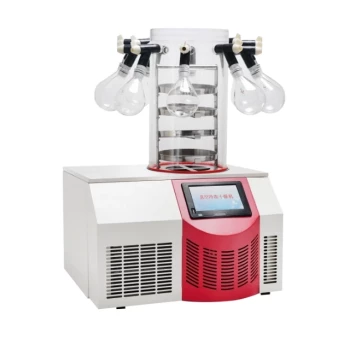
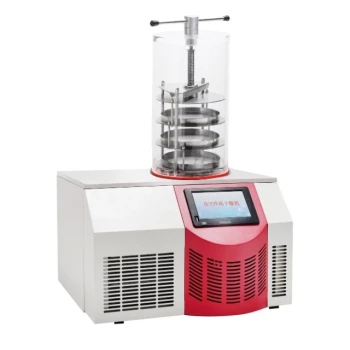
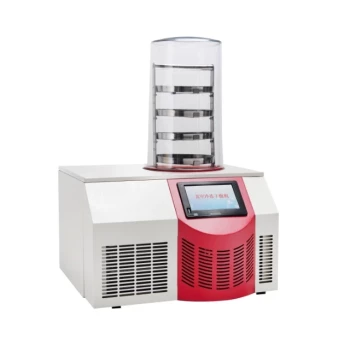
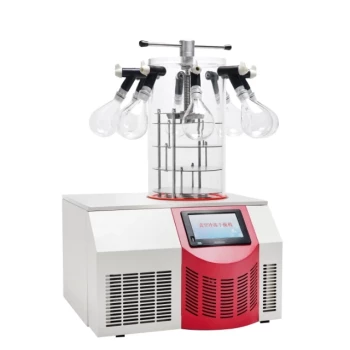
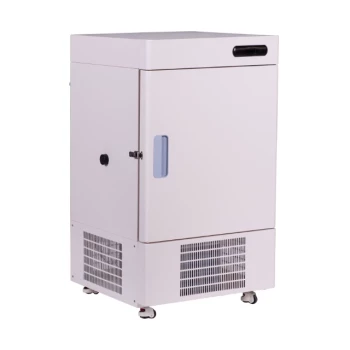
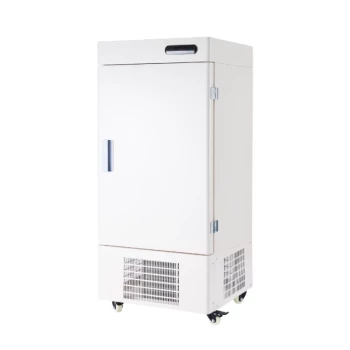
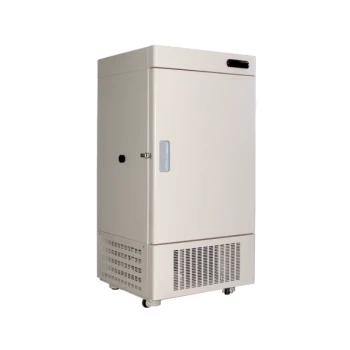
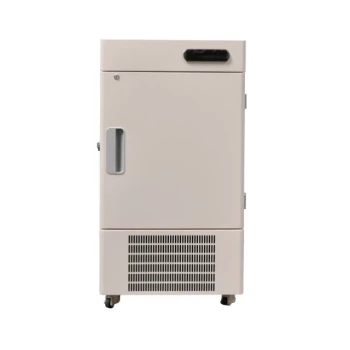
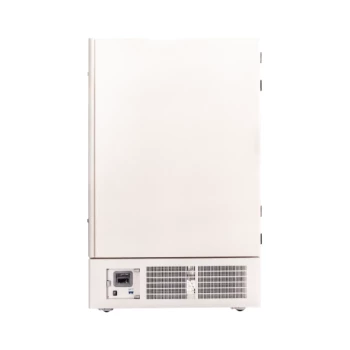
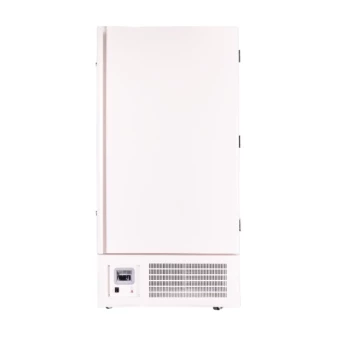
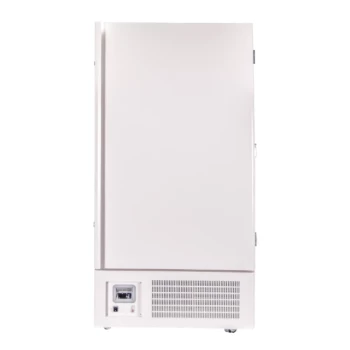
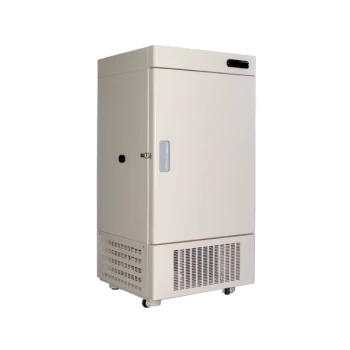
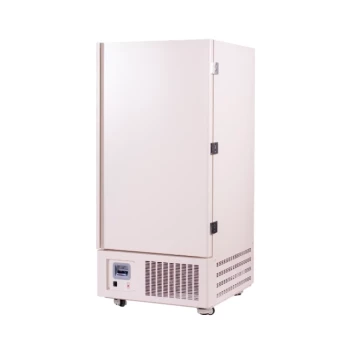
The primary advantage of an industrial freeze dryer in Freeze-Slurry Laminated Object Manufacturing (FS-LOM) is its ability to remove moisture via sublimation rather than evaporation. This process fundamentally alters how internal stress is managed during the drying phase, eliminating the destructive forces associated with traditional thermal debinding.
By bypassing the liquid phase entirely, freeze drying prevents the rapid gas generation that causes bloating and cracking in ceramic bodies, making it the superior method for preserving delicate microporous structures.
The Mechanism of Sublimation vs. Combustion
Bypassing the Liquid Phase
In an industrial freeze dryer, the ice crystals formed between the laminated layers are removed through sublimation.
This means the water transitions directly from a solid state (ice) to a gas (vapor), skipping the liquid phase entirely. This gentle transition protects the internal geometry of the part from capillary forces that often cause deformation.
The Physics of Thermal Debinding
Traditional debinding furnaces rely on heat to drive off moisture and binders.
This process involves evaporation and organic combustion, which can generate gases rapidly within the ceramic body. If the internal pressure builds faster than the gas can escape, the part suffers structural failure.
Structural Integrity and Defect Prevention
Eliminating Bloating
A major risk in traditional thermal processing is bloating, where trapped gases expand and deform the object.
Freeze drying creates a stable environment where these gases are not generated through combustion. This ensures the geometric dimensions remain true to the original design throughout the drying process.
Preventing Cracking
Cracks in ceramic bodies are often caused by the stress of shrinking or the pressure of escaping steam and combustion gases.
By removing the ice crystals via sublimation, the freeze dryer avoids the internal stress caused by rapid gas generation. This results in a defect-free green body ready for final sintering.
Application-Specific Advantages
Stability of Microporous Structures
Freeze drying is uniquely suited for maintaining the stability of microporous structures.
Because the structure is not subjected to the turbulence of boiling or combustion, the microscopic pore network remains intact.
Ideal for Filter Manufacturing
The preservation of these micropores makes freeze drying the preferred method for manufacturing filter materials.
These applications require specific, consistent porosity to function correctly, a requirement that traditional thermal debinding often struggles to meet reliably.
Common Pitfalls of Thermal Methods
The Risk of Rapid Gas Generation
The core trade-off when using traditional furnaces is the management of gas expansion.
Thermal debinding relies on combustion, which inherently produces gas. In dense or complex laminated parts, this creates a high probability of internal rupture or layer delamination.
Compromised Internal Structure
While furnaces are standard for many ceramics, they can degrade the fidelity of the internal pore structure.
For parts requiring precise filtration capabilities, the aggressive nature of thermal evaporation can collapse or distort the fine channels essential for performance.
Making the Right Choice for Your Goal
To select the correct debinding method for your FS-LOM process, consider the specific requirements of your final component.
- If your primary focus is structural integrity: Choose industrial freeze drying to eliminate the risk of bloating and cracking caused by gas expansion.
- If your primary focus is filtration performance: Rely on freeze drying to maintain the specific stability of the microporous structures required for filters.
By utilizing sublimation, you ensure a stable, high-fidelity transition from a frozen slurry to a durable ceramic body.
Summary Table:
| Feature | Industrial Freeze Dryer | Traditional Debinding Furnace |
|---|---|---|
| Phase Transition | Sublimation (Solid to Gas) | Evaporation & Combustion |
| Internal Stress | Minimal (No capillary forces) | High (Gas expansion & steam pressure) |
| Structural Risk | Low (Prevents bloating/cracking) | High (Risk of deformation/delamination) |
| Pore Stability | Excellent (Maintains micropores) | Poor (Risk of pore collapse) |
| Best Use Case | Filters & delicate geometries | Simple, dense ceramic components |
Precision is paramount in FS-LOM. At KINTEK, we understand that maintaining the integrity of microporous structures requires the right equipment. Whether you need advanced cooling solutions like industrial freeze dryers to master sublimation or high-performance sintering furnaces for the final stage, our expertise ensures your ceramic bodies remain defect-free. Contact us today to discover how KINTEK’s comprehensive range of laboratory equipment—from high-temperature furnaces to specialized crushing and milling systems—can optimize your research and production workflow.
References
- Benjamin Dermeik, Nahum Travitzky. Laminated Object Manufacturing of Ceramic‐Based Materials. DOI: 10.1002/adem.202000256
This article is also based on technical information from Kintek Solution Knowledge Base .
Related Products
- High Performance Laboratory Freeze Dryer
- High Performance Laboratory Freeze Dryer for Research and Development
- Benchtop Laboratory Vacuum Freeze Dryer
- Benchtop Laboratory Freeze Dryer for Lab Use
- 108L Vertical Ultra Low Temperature ULT Freezer
People Also Ask
- What role does a laboratory freeze dryer play in the synthesis of graphene-based electrocatalysts? Preserve 3D Structures
- What are the technical advantages of using a laboratory freeze dryer for porous carbon precursors? Preserve 3D Networks
- What types of liquid samples can be processed using a laboratory freeze dryer? Preserve Your Sensitive Materials
- How do laboratory freeze dryers support scientific research? Preserve Sample Integrity for Reproducible Results
- Why is a laboratory freeze dryer preferred over traditional heating? Preserve Biochar Structure & Maximize Porosity