Knowledge Which types of materials are basically polished by electrolytic polishing? A Guide to Metals & Alloys
Author avatar

Tech Team · Kintek Solution

Updated 1 week ago

Which types of materials are basically polished by electrolytic polishing? A Guide to Metals & Alloys


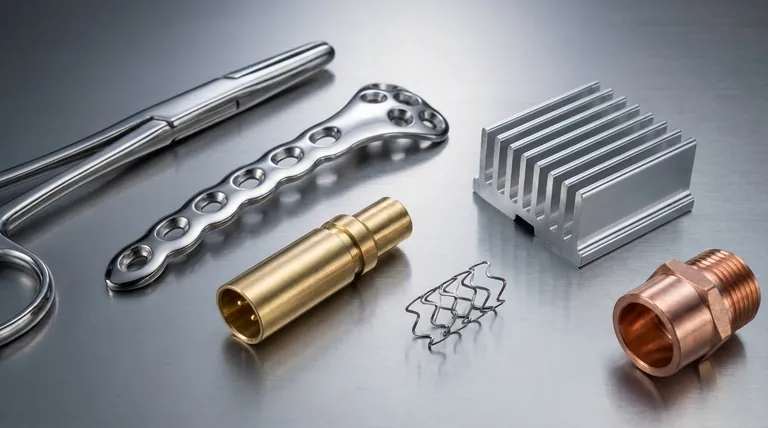
Electrolytic polishing is a highly effective finishing process primarily suited for metals and alloys that can form a stable passive layer in a specific electrolyte. While stainless steel is the most common candidate, the process is also effective for aluminum, brass, carbon steels, cobalt chrome, copper and nickel alloys, titanium, and Nitinol.

The success of electrolytic polishing depends on a material's electrical conductivity and its ability to uniformly dissolve at a microscopic level. It is not a universal solution; it is a specialized electrochemical process tailored to specific metal families.
Which types of materials are basically polished by electrolytic polishing? A Guide to Metals & Alloys

The Science Behind Material Compatibility

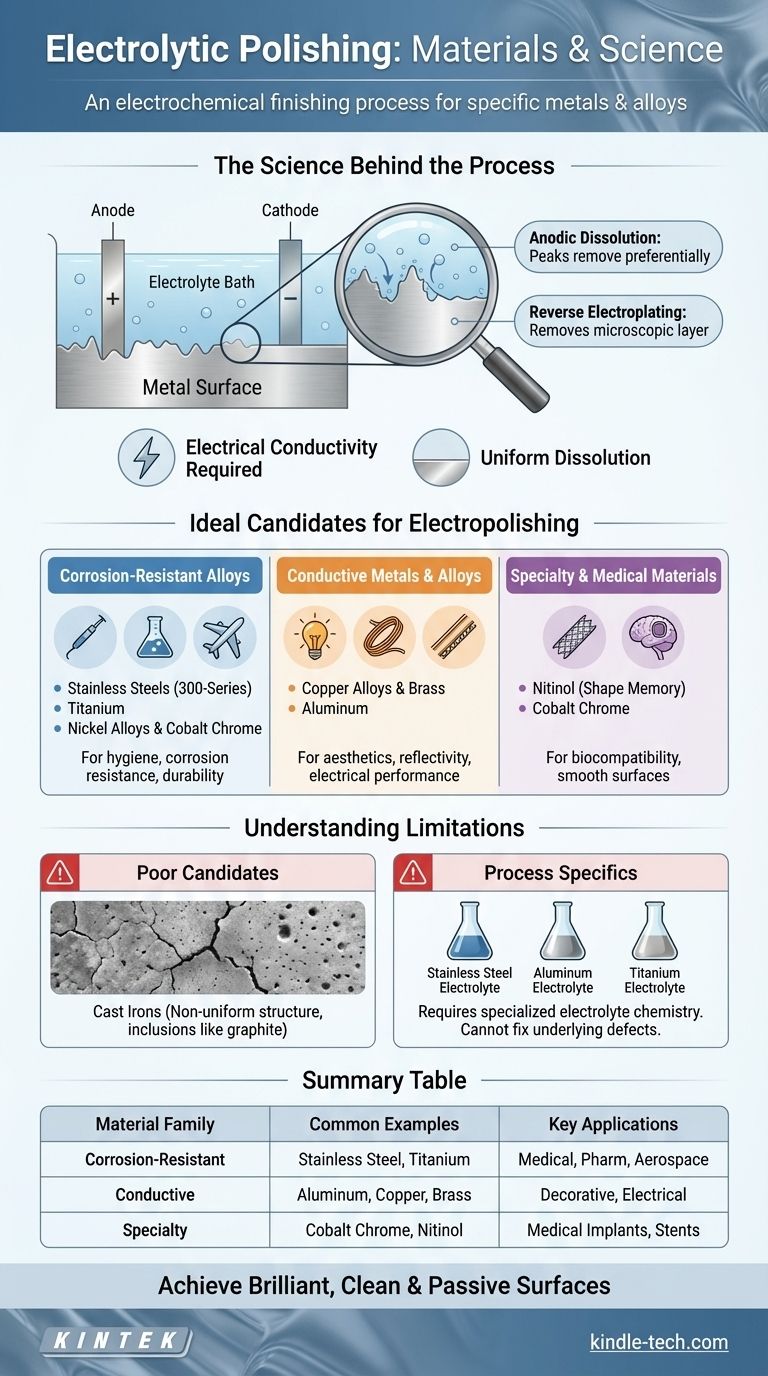
Electrolytic polishing is an electrochemical process, often described as the reverse of electroplating. Instead of adding a layer of material, it precisely removes a microscopic surface layer, smoothing out peaks and valleys to create a brilliant, clean, and passive surface.

Why Metal Conductivity is Essential

The process requires the part to be an anode (the positive electrode) in an electrochemical cell. An electrical current must pass through the part and into the chemical electrolyte.

Therefore, the fundamental requirement for any candidate material is electrical conductivity. Non-conductive materials like plastics or ceramics cannot be electropolished.

The Role of Anodic Dissolution

When current is applied, the metal surface begins to dissolve into the electrolyte. This dissolution happens faster on microscopic high points ("peaks") than in low points ("valleys").

This preferential removal of peaks is what creates the signature smooth, mirror-like finish. The material must be able to dissolve uniformly without creating pits or intergranular attack, which is heavily dependent on its metallurgical structure.

Alloy Composition is Critical

Not all grades of a metal are equally suited for electropolishing. For instance, 300-series stainless steels (like 304 and 316) are ideal because their high chromium and nickel content promotes a stable, passive film.

In contrast, some 400-series stainless steels can be more challenging due to a different crystalline structure and lower nickel content. The success of the process is directly tied to the specific alloy and its homogeneity.

Key Material Families for Electropolishing

Different metals require different electrolyte chemistries and operating parameters, but several families are consistently good candidates.

Corrosion-Resistant Alloys

This is the largest group of electropolished materials.

  • Stainless Steels: Used for hygiene, corrosion resistance, and deburring in medical, pharmaceutical, and food processing industries.
  • Titanium: Valued in aerospace and medical implants for its high strength-to-weight ratio and superior biocompatibility.
  • Nickel Alloys & Cobalt Chrome: Used in high-temperature, high-stress environments like jet engines and for medical implants due to their extreme durability and corrosion resistance.

Conductive Metals and Alloys

This group is often polished for aesthetic appeal, reflectivity, or to improve electrical performance.

  • Copper Alloys & Brass: Electropolishing removes surface oxides and impurities, improving electrical conductivity and providing a bright, decorative finish.
  • Aluminum: Used to create a highly reflective, mirror-like surface for lighting components and decorative trim.

Specialty and Medical Materials

  • Nitinol: A nickel-titanium "shape memory" alloy used for medical devices like stents. Electropolishing is critical for creating a smooth, clean, and biocompatible surface free of micro-cracks.

Understanding the Trade-offs and Limitations

Electropolishing is a powerful tool, but it is not a one-size-fits-all solution. Understanding its limitations is key to using it effectively.

Materials That Are Poor Candidates

Materials that lack a uniform, single-phase structure do not polish well. Cast irons, for example, contain inclusions like graphite flakes that dissolve at different rates than the surrounding iron matrix, resulting in a pitted, uneven surface.

Process-Specific Electrolytes

A material's compatibility is tied to the availability of a suitable electrolyte. The chemistry used for stainless steel is entirely different from what is required for aluminum or titanium. A mismatch will result in pitting, etching, or no polishing at all.

The Myth of "Fixing" Poor-Quality Material

Electropolishing enhances the surface of a quality material; it cannot fix underlying metallurgical defects. Issues like porosity, large non-metallic inclusions, or seams in the base metal will often be exposed and even exaggerated by the process.

Making the Right Choice for Your Goal

Select your material and finishing process based on the final performance you need to achieve.

  • If your primary focus is hygiene and corrosion resistance: Austenitic stainless steels (304, 316L) and titanium are the industry standard for electropolishing.
  • If your primary focus is biocompatibility: Titanium, cobalt chrome, and Nitinol are superior choices, as electropolishing removes contaminants and creates a highly passive surface.
  • If your primary focus is aesthetics or reflectivity: Aluminum and copper alloys like brass provide excellent results when processed with the correct electrolytes.

Ultimately, the suitability of a material for electropolishing depends on its chemical composition, metallurgical uniformity, and your end-use application.

Summary Table:

Material Family Common Examples Key Applications
Corrosion-Resistant Alloys Stainless Steel (304, 316), Titanium Medical, Pharmaceutical, Aerospace
Conductive Metals & Alloys Aluminum, Copper, Brass Decorative, Electrical, Lighting
Specialty & Medical Materials Cobalt Chrome, Nitinol Medical Implants, Stents

Need the perfect surface finish for your metal components?
Electropolishing is a specialized process that requires the right equipment and expertise. At KINTEK, we specialize in providing high-quality lab equipment and consumables for precise electrochemical processes. Whether you're working with stainless steel, titanium, or specialized alloys, our solutions help you achieve brilliant, clean, and passive surfaces every time.
Enhance your lab's capabilities—contact our experts today to discuss your specific needs!

Visual Guide
Which types of materials are basically polished by electrolytic polishing? A Guide to Metals & Alloys Visual Guide

Related Products

People Also Ask

Related Products

HFCVD Machine System Equipment for Drawing Die Nano-Diamond Coating

HFCVD Machine System Equipment for Drawing Die Nano-Diamond Coating

The nano-diamond composite coating drawing die uses cemented carbide (WC-Co) as the substrate, and uses the chemical vapor phase method ( CVD method for short ) to coat the conventional diamond and nano-diamond composite coating on the surface of the inner hole of the mold.

Metallographic Specimen Mounting Machine for Laboratory Materials and Analysis

Metallographic Specimen Mounting Machine for Laboratory Materials and Analysis

Precision metallographic mounting machines for labs—automated, versatile, and efficient. Ideal for sample prep in research and quality control. Contact KINTEK today!

Anti-Cracking Press Mold for Lab Use

Anti-Cracking Press Mold for Lab Use

The anti-cracking press mold is a specialized equipment designed for molding various shapes and sizes of film using high pressure and electric heating.

Lab Plastic PVC Calender Stretch Film Casting Machine for Film Testing

Lab Plastic PVC Calender Stretch Film Casting Machine for Film Testing

The cast film machine is designed for the molding of polymer cast film products and has multiple processing functions such as casting, extrusion, stretching, and compounding.

Laboratory Test Sieves and Sieving Machines

Laboratory Test Sieves and Sieving Machines

Precision lab test sieves & sieving machines for accurate particle analysis. Stainless steel, ISO-compliant, 20μm-125mm range. Request specs now!

Single Punch Electric Tablet Press Machine Laboratory Powder Tablet Punching TDP Tablet Press

Single Punch Electric Tablet Press Machine Laboratory Powder Tablet Punching TDP Tablet Press

The single-punch electric tablet press is a laboratory-scale tablet press suitable for corporate laboratories in pharmaceutical, chemical, food, metallurgical and other industries.

Small Injection Molding Machine for Lab Use

Small Injection Molding Machine for Lab Use

The small injection molding machinehas fast and stable movements; good controllability and repeatability, super energy saving; the product can be automatically dropped and formed; the machine body is low, convenient for feeding, easy to maintain, and no height restrictions on the installation site.

Laboratory Vibratory Sieve Shaker Machine for Dry and Wet Three-Dimensional Sieving

Laboratory Vibratory Sieve Shaker Machine for Dry and Wet Three-Dimensional Sieving

KT-VD200 can be used for sieving tasks of dry and wet samples in the laboratory. The screening quality is 20g-3kg. The product is designed with a unique mechanical structure and an electromagnetic vibrating body with a vibration frequency of 3000 times per minute.

Single Punch Tablet Press Machine and Mass Production Rotary Tablet Punching Machine for TDP

Single Punch Tablet Press Machine and Mass Production Rotary Tablet Punching Machine for TDP

Rotary tablet punching machine is an automatic rotating and continuous tableting machine. It is mainly used for tablet manufacturing in the pharmaceutical industry, and is also suitable for industrial sectors such as food, chemicals, batteries, electronics, ceramics, etc. to compress granular raw materials into tablets.

Inclined Rotary Plasma Enhanced Chemical Vapor Deposition PECVD Equipment Tube Furnace Machine

Inclined Rotary Plasma Enhanced Chemical Vapor Deposition PECVD Equipment Tube Furnace Machine

Introducing our inclined rotary PECVD furnace for precise thin film deposition. Enjoy automatic matching source, PID programmable temperature control, and high accuracy MFC mass flowmeter control. Built-in safety features for peace of mind.

Double Plate Heating Press Mold for Lab

Double Plate Heating Press Mold for Lab

Discover precision in heating with our Double Plate Heating Mold, featuring high-quality steel and uniform temperature control for efficient lab processes. Ideal for various thermal applications.

Laboratory Sterilizer Lab Autoclave Herbal Powder Sterilization Machine for Plant

Laboratory Sterilizer Lab Autoclave Herbal Powder Sterilization Machine for Plant

The herbal powder sterilization autoclave machine for Chinese medicine uses saturated steam for effective sterilization. It utilizes the heat and penetrative properties of steam, achieves sterilization after heat preservation, and maintains a good drying effect with a dedicated drying system.

Ultra-Vacuum Electrode Feedthrough Connector Flange Power Electrode Lead for High-Precision Applications

Ultra-Vacuum Electrode Feedthrough Connector Flange Power Electrode Lead for High-Precision Applications

Discover the Ultra-Vacuum Electrode Feedthrough Connector Flange, perfect for high-precision applications. Ensure reliable connections in ultra-vacuum environments with advanced sealing and conductive technology.

Single Punch Manual Tablet Press Machine TDP Tablet Punching Machine

Single Punch Manual Tablet Press Machine TDP Tablet Punching Machine

Single punch manual tablet punching machine can press various granular, crystal or powdery raw materials with good fluidity into disc-shaped, cylindrical, spherical, convex, concave and other various geometric shapes (such as square, triangle, ellipse, capsule shape, etc.), and can also press products with text and patterns.

Single Punch Electric Tablet Press Machine TDP Tablet Punching Machine

Single Punch Electric Tablet Press Machine TDP Tablet Punching Machine

The electric tablet punching machine is a laboratory equipment designed for pressing various granular and powdery raw materials into discs and other geometric shapes. It is commonly used in pharmaceutical, healthcare products, food, and other industries for small batch production and processing. The machine is compact, lightweight, and easy to operate, making it suitable for use in clinics, schools, laboratories, and research units.

Laboratory Sterilizer Lab Autoclave Pulse Vacuum Lifting Sterilizer

Laboratory Sterilizer Lab Autoclave Pulse Vacuum Lifting Sterilizer

The pulse vacuum lifting sterilizer is a state-of-the-art equipment for efficient and precise sterilization. It uses pulsating vacuum technology, customizable cycles, and a user-friendly design for easy operation and safety.

Vacuum Hot Press Furnace Machine for Lamination and Heating

Vacuum Hot Press Furnace Machine for Lamination and Heating

Experience clean and precise lamination with Vacuum Lamination Press. Perfect for wafer bonding, thin-film transformations, and LCP lamination. Order now!

915MHz MPCVD Diamond Machine Microwave Plasma Chemical Vapor Deposition System Reactor

915MHz MPCVD Diamond Machine Microwave Plasma Chemical Vapor Deposition System Reactor

915MHz MPCVD Diamond Machine and its multi-crystal effective growth, the maximum area can reach 8 inches, the maximum effective growth area of single crystal can reach 5 inches. This equipment is mainly used for the production of large-size polycrystalline diamond films, the growth of long single crystal diamonds, the low-temperature growth of high-quality graphene, and other materials that require energy provided by microwave plasma for growth.

Laboratory Sterilizer Lab Autoclave Vertical Pressure Steam Sterilizer for Liquid Crystal Display Automatic Type

Laboratory Sterilizer Lab Autoclave Vertical Pressure Steam Sterilizer for Liquid Crystal Display Automatic Type

Liquid crystal display automatic vertical sterilizer is a safe, reliable and automatic control sterilization equipment, which is composed of heating system, microcomputer control system and overheating and overvoltage protection system.

Laboratory Vibratory Sieve Shaker Machine Slap Vibrating Sieve

Laboratory Vibratory Sieve Shaker Machine Slap Vibrating Sieve

KT-T200TAP is a slapping and oscillating sieving instrument for laboratory desktop use, with 300 rpm horizontal circular motion and 300 vertical slapping motions to simulate manual sieving to help sample particles pass through better.


Leave Your Message