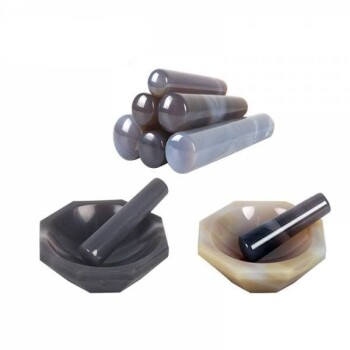
Agate grinding jars are the preferred choice for milling Al-Ti-Zr mixed powders because they eliminate the risk of metallic contamination. Because aluminum and hydride powders exhibit high chemical activity after refinement, they are prone to interacting with their environment; using agate ensures that no foreign metallic impurities, such as iron, compromise the chemical composition of the mixture.
The selection of agate over metal is strictly a measure of contamination control. By using a non-reactive material, you prevent high-activity powders from leaching impurities from the grinding media, preserving the precise stoichiometry of the Al-Ti-Zr ternary system.
The Critical Role of Material Purity
Avoiding Iron Contamination
The primary risk when using metal grinding jars—typically made of steel or similar alloys—is the introduction of iron into your powder mixture.
During the milling process, the grinding media is subjected to intense impact and friction. This naturally causes microscopic amounts of the jar material to wear off and mix with the sample. In a metal jar, this results in significant iron contamination.
The Reactivity of Refined Powders
The Al-Ti-Zr mixture includes aluminum and hydride powders, which change physically and chemically during milling.
As these powders are refined, their particle size decreases and their specific surface area increases. The primary reference notes that these powders exhibit high activity in this refined state. This heightened reactivity makes them much more likely to bond with or absorb contaminants from the jar walls.
Preserving the Al-Ti-Zr System
Maintaining Chemical Accuracy
The goal of milling these specific powders is usually to study or utilize the Al-Ti-Zr ternary system. This system relies on a precise balance of Aluminum, Titanium, and Zirconium.
If metal jars are used, the system is no longer a ternary system; it becomes a quaternary system with the unwanted addition of Iron (Al-Ti-Zr-Fe). Agate, being a naturally hard and chemically inert mineral, prevents this fundamental alteration of the material's identity.
Ensuring Inert Processing
Agate acts as an inert vessel. Unlike metal, which can react with active hydride powders, agate does not chemically interact with the mixture.
This stability allows the powders to undergo necessary physical refinement without suffering from chemical degradation or compositional drift.
Common Pitfalls to Avoid
Underestimating Powder Activity
A common mistake is assuming that because the starting materials are stable, they will remain so during milling.
You must account for the fact that the milling process activates the material. Aluminum and hydrides become more aggressive chemically as they become finer. If you use a metal jar, you are exposing highly reactive materials to a source of metallic impurities at the exact moment they are most susceptible to contamination.
Making the Right Choice for Your Goal
When setting up your milling protocol for Al-Ti-Zr powders, consider your end goals to make the final hardware decision.
- If your primary focus is Chemical Purity: You must use agate jars to ensure the Al-Ti-Zr system remains free of iron and other metallic contaminants.
- If your primary focus is Milling High-Activity Powders: You should prioritize inert materials like agate to prevent the reactive refined powders from interacting with the container.
Success in milling this specific ternary system relies on maintaining a strict barrier between your reactive sample and the grinding media.
Summary Table:
| Feature | Agate Grinding Jars | Metal Grinding Jars |
|---|---|---|
| Contamination Risk | Low (Non-metallic) | High (Iron/Metallic impurities) |
| Chemical Reactivity | Chemically Inert | May react with active hydrides |
| Material Purity | Preserves Al-Ti-Zr system | Creates unwanted quaternary system |
| Best Use Case | High-purity lab refinement | Non-sensitive bulk milling |
Elevate Your Material Purity with KINTEK Precision Solutions
Don't let metallic contamination compromise your Al-Ti-Zr ternary systems. KINTEK specializes in high-quality laboratory equipment designed for the most demanding research environments. Our comprehensive range includes premium agate crushing and milling systems, hydraulic presses, and high-temperature furnaces tailored to preserve the integrity of your reactive powders.
Whether you are refining active hydrides or developing advanced alloys, our team provides the specialized tools—from PTFE and ceramic consumables to high-pressure reactors—that ensure your results remain accurate and uncontaminated.
Ready to optimize your milling protocol? Contact us today to discover how KINTEK's expert solutions can enhance your lab's performance!
Related Products
- Laboratory Jar Mill with Agate Grinding Jar and Balls
- Nature Agate Mortar and Pestle for Grinding and Mixing
- Laboratory Jar Ball Mill with Alumina Zirconia Grinding Jar and Balls
- Laboratory Ball Mill Jar Mill with Metal Alloy Grinding Jar and Balls
People Also Ask
- What are the different types of laboratory mills? Choose the Right Grinder for Your Sample Material
- What is use for grinding in the laboratory? Select the Right Mill for Accurate Sample Prep
- What laboratory apparatus is used for grinding? Match the Right Mill to Your Sample Material
- What is the function of a laboratory grinding mill? Achieve Precise Sample Preparation for Accurate Results
- Why are agate milling jars and balls used for Mo-La2O3 powder mixing? Ensure High-Purity Material Dispersion