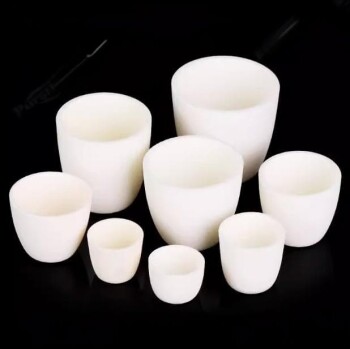
Alumina crucibles are the industry standard for wheat straw pyrolysis because they provide a chemically inert and thermally stable environment that ensures data integrity. In thermogravimetric analysis (TGA), these crucibles withstand temperatures exceeding 1173 K (900°C) without reacting with the biomass or the resulting char. This stability allows researchers to precisely attribute all measured mass changes to the sample’s thermal decomposition rather than container interference.
The selection of alumina crucibles is driven by their unique combination of chemical inertness, high thermal conductivity, and mass stability. These properties ensure that experimental data reflects the true pyrolytic behavior of the wheat straw, free from contamination or measurement artifacts.
The Role of Chemical and Thermal Stability
Preventing Chemical Interference
Alumina ($Al_2O_3$) is highly resistant to chemical reactions with biomass samples and the complex carbonaceous char produced during pyrolysis. This chemical inertness prevents the migration of metal ions or impurities into the sample, ensuring that the structural and chemical characterization of the wheat straw remains accurate.
High-Temperature Durability
Pyrolysis testing often requires temperatures up to 1173 K or higher to fully devolatilize the sample. Alumina maintains its structural integrity and does not deform or degrade at these extremes, making it a reliable vessel for high-heat synthesis and oxidation experiments.
Creating an Oxygen-Deficient Environment
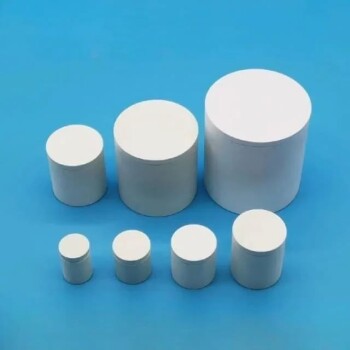
When used with a lid, alumina crucibles create a near-isolated micro-environment that limits air exposure. This design is critical for wheat straw testing, as it ensures the sample undergoes a devolatilization reaction (pyrolysis) rather than direct combustion by preventing external oxygen from entering.
Optimizing Heat and Mass Transfer
Thermal Conductivity and Synchronization
The high thermal conductivity of alumina ensures that heat from the furnace is transferred rapidly and uniformly to the wheat straw sample. This facilitates a tight synchronization between the furnace's temperature recording and the sample's actual mass loss, which is essential for calculating accurate kinetic data.
Maintaining Precision in Gravimetric Analysis
Because alumina crucibles are corrosion-resistant and maintain a stable mass, they do not contribute "noise" to the measurement. This allows the thermogravimetric analyzer to detect minute mass changes with high precision, guaranteeing that the recorded data originates solely from the pyrolytic volatilization of the sample.
Refractoriness and Residue Management
High-purity alumina possesses exceptional refractoriness, allowing it to withstand the thermal stress of coal char or biomass residues without cracking. This durability ensures that the crucible can be reused across multiple testing cycles while maintaining consistent thermal properties.
Understanding the Trade-offs
Sensitivity to Thermal Shock
While alumina is thermally stable, it can be sensitive to thermal shock if subjected to extreme temperature gradients. Rapid heating or cooling cycles can cause micro-cracks, potentially compromising the crucible’s integrity over long-term use.
Interaction with Specific Fluxes
Although inert to wheat straw, alumina can react with certain highly alkaline molten salts or specific metallic fluxes at extreme temperatures. Researchers must verify that the inorganic ash content of their specific biomass variety does not contain unusual concentrations of elements that might degrade the alumina surface.
Applying This to Your Pyrolysis Project
Making the Right Choice for Your Goal
To achieve the most reliable results in your biomass testing, consider the following recommendations:
- If your primary focus is high-precision kinetic modeling: Use high-purity (99%+) alumina crucibles to ensure the most stable mass readings and zero chemical interference.
- If your primary focus is preventing sample combustion: Ensure you utilize a matching alumina lid to maintain an oxygen-deficient micro-environment during the heating cycle.
- If your primary focus is equipment longevity: Avoid rapid quenching of the crucibles after a run to prevent cracking caused by thermal shock.
By prioritizing the material properties of alumina, you ensure that your pyrolysis data is a true reflection of the biomass's potential rather than a product of experimental error.
Summary Table:
| Property | Benefit for Pyrolysis | Impact on Research Quality |
|---|---|---|
| Chemical Inertness | Resists reaction with biomass and char | Prevents sample contamination and artifacts |
| Thermal Stability | Withstands temperatures >1173 K | Ensures structural integrity and mass stability |
| High Conductivity | Rapid, uniform heat transfer | Synchronizes furnace temp with sample mass loss |
| Refractoriness | High resistance to thermal stress | Allows for repeated use with consistent results |
| Oxygen Control | Micro-environment (with lid) | Enables true pyrolysis by preventing combustion |
Elevate Your Pyrolysis Research with KINTEK Precision
Achieving high-precision kinetic modeling requires laboratory consumables that never compromise your data. KINTEK specializes in high-purity alumina crucibles, ceramics, and crucibles specifically engineered for demanding thermogravimetric analysis and biomass testing.
Beyond consumables, we provide a comprehensive suite of laboratory solutions, including:
- High-Temperature Furnaces: Muffle, tube, and vacuum furnaces for controlled heating.
- Sample Preparation: Advanced crushing, milling, and sieving systems.
- Specialized Reactors: High-temperature high-pressure reactors and autoclaves.
Ensure your research reflects true pyrolytic behavior with tools built for durability and accuracy. Contact KINTEK today to discuss your specific testing requirements and discover how our high-performance equipment can streamline your laboratory workflow!
References
- Jialiu Lei, Dongnan Zhao. Insights into Pyrolysis Kinetics, Thermodynamics, and the Reaction Mechanism of Wheat Straw for Its Resource Utilization. DOI: 10.3390/su151612536
This article is also based on technical information from Kintek Solution Knowledge Base .
Related Products
- Arc-Shaped Alumina Ceramic Crucible High Temperature Resistant for Engineering Advanced Fine Ceramics
- Alumina Al2O3 Ceramic Crucible Semicircle Boat with Lid for Engineering Advanced Fine Ceramics
- Engineering Advanced Fine Ceramics Alumina Al2O3 Crucible With Lid Cylindrical Laboratory Crucible
- Engineering Advanced Fine Ceramics Alumina Crucibles (Al2O3) for Thermal Analysis TGA DTA
- Engineering Advanced Fine Alumina Al2O3 Ceramic Crucible for Laboratory Muffle Furnace
People Also Ask
- Why Use Alumina Crucibles & Powder Burial for NaSICON? Ensure Phase Purity and Prevent Elemental Volatilization
- What is the primary purpose of using alumina crucibles for LLTO ceramics? Optimize Your High-Temperature Sintering
- Why are alumina crucibles and mother powder essential for LATP sintering? Optimize Your Solid Electrolyte Performance
- Why are high-purity alumina crucibles used for liquid lead corrosion experiments? Ensure Data Accuracy at 550°C
- Primary considerations for choosing alumina crucibles and quartz tubes in indium intercalation: Ensure Material Purity