Knowledge Why are corundum crucibles preferred for magnesium evaporation? Ensure Purity in High-Temperature Reduction
Author avatar

Tech Team · Kintek Solution

Updated 2 days ago

Why are corundum crucibles preferred for magnesium evaporation? Ensure Purity in High-Temperature Reduction


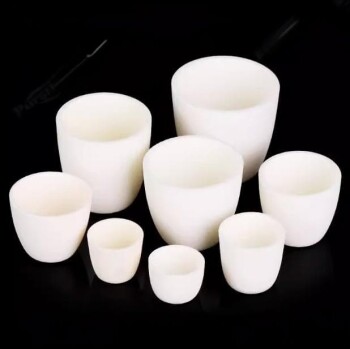
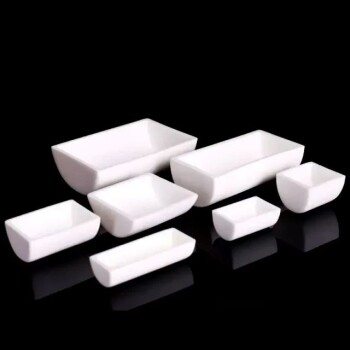
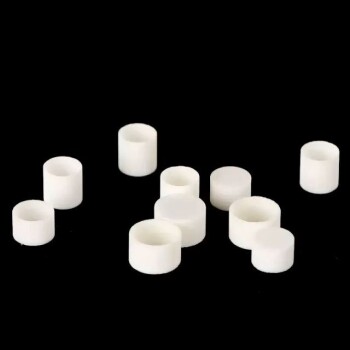
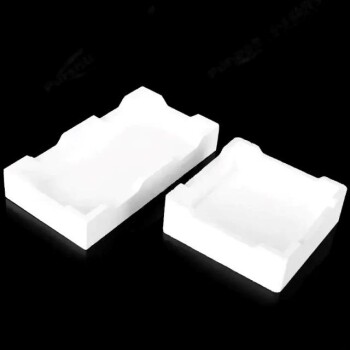
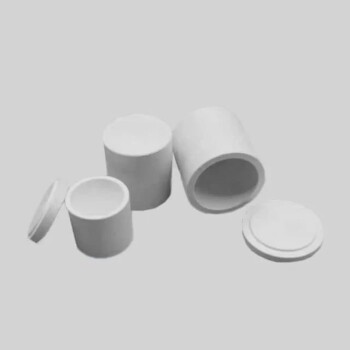
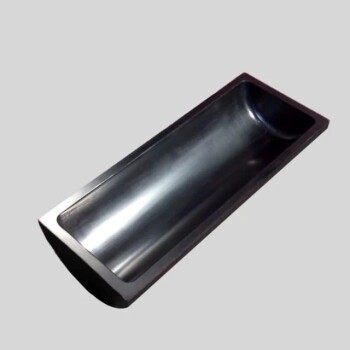
Corundum (alumina) crucibles and boats are preferred primarily for their exceptional thermal stability and chemical inertness. They can withstand the rigorous temperatures required for magnesium processing—specifically between 1273 K and 1473 K—without degrading or reacting with the volatile magnesium.

By utilizing corundum, researchers eliminate the risk of container contamination, ensuring that the high chemical activity of molten magnesium does not compromise the purity of the final product or the accuracy of experimental data.

The Critical Properties of Corundum

Withstanding Extreme Thermal Environments

Magnesium evaporation and reduction require substantial heat inputs to drive phase changes. Corundum containers are capable of maintaining structural integrity at temperatures ranging from 1273 K to 1473 K.

This thermal resilience allows the vessel to hold molten magnesium or reaction pellets stably throughout the heating cycle. It ensures the container does not soften or deform during resistance heating evaporation processes.

Resisting Chemical Attack

Magnesium is a highly active metal, particularly in its molten state. Standard containment materials often fail because the magnesium reacts aggressively with the vessel walls.

Corundum is chemically inert relative to magnesium within the specified temperature range. This inertness prevents the crucible from dissolving into the melt or forming unwanted compounds at the interface.

The Impact on Experimental Outcomes

Preserving Product Purity

The primary goal in evaporation experiments is often the production of materials like ultrafine magnesium powder. Any reaction between the vessel and the liquid magnesium introduces impurities.

By acting as a stable barrier, corundum ensures the high purity of the final magnesium product. It prevents the leaching of oxides or other contaminants from the boat into the magnesium vapor or liquid.

Ensuring Data Accuracy

In scientific experiments, the containment vessel must be a neutral variable. If a crucible reacts or degrades, it alters the mass balance and chemical composition of the system.

Corundum's stability guarantees that the resulting data reflects the actual behavior of the magnesium reduction process, rather than artifacts caused by container failure.

Operational Considerations

While corundum is the superior choice, it is effective only within its operational limits. The material is relied upon specifically for the 1273 K to 1473 K window.

Exceeding this temperature range could theoretically compromise the material's inertness or structural stability. Furthermore, users must ensure the corundum is of high quality to avoid pre-existing contaminants that could negate its inherent benefits.

Making the Right Choice for Your Goal

To ensure the success of your magnesium reduction or evaporation project, align your containment strategy with your specific experimental needs:

  • If your primary focus is Product Purity: Utilize corundum to prevent chemical interactions with highly active molten magnesium, ensuring ultrafine powder quality.
  • If your primary focus is Process Stability: Rely on corundum’s ability to maintain structural integrity under resistance heating between 1273 K and 1473 K.

By selecting corundum, you protect both the integrity of your magnesium and the validity of your scientific results.

Summary Table:

Feature Advantage of Corundum (Alumina)
Temperature Range Stable between 1273 K and 1473 K
Chemical Reactivity High inertness; resists aggressive molten magnesium
Product Integrity Prevents contamination; ensures high-purity ultrafine powders
Structural Stability Maintains shape during intense resistance heating
Data Reliability Eliminates artifacts from vessel-sample reactions

Elevate Your Material Research with KINTEK Precision

Don't let container contamination compromise your high-purity magnesium results. KINTEK specializes in advanced laboratory equipment and high-performance consumables designed for the most demanding thermal processes. Whether you need high-quality corundum crucibles, ceramic boats, or specialized muffle and vacuum furnaces, we provide the tools necessary to ensure experimental accuracy and product integrity.

From crushing and milling systems to high-pressure reactors and battery research consumables, KINTEK is your trusted partner in laboratory excellence.

Ready to optimize your evaporation and reduction experiments? Contact our technical experts today to find the perfect containment solution for your lab!

Related Products

People Also Ask

Related Products

Alumina Al2O3 Ceramic Crucible Semicircle Boat with Lid for Engineering Advanced Fine Ceramics

Alumina Al2O3 Ceramic Crucible Semicircle Boat with Lid for Engineering Advanced Fine Ceramics

Crucibles are containers widely used for melting and processing various materials, and semicircular boat-shaped crucibles are suitable for special smelting and processing requirements. Their types and uses vary by material and shape.

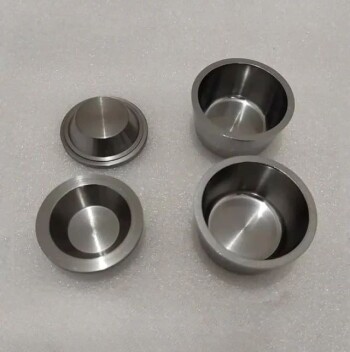
Electron Beam Evaporation Coating Tungsten Crucible and Molybdenum Crucible for High Temperature Applications

Electron Beam Evaporation Coating Tungsten Crucible and Molybdenum Crucible for High Temperature Applications

Tungsten and molybdenum crucibles are commonly used in electron beam evaporation processes due to their excellent thermal and mechanical properties.

Arc-Shaped Alumina Ceramic Crucible High Temperature Resistant for Engineering Advanced Fine Ceramics

Arc-Shaped Alumina Ceramic Crucible High Temperature Resistant for Engineering Advanced Fine Ceramics

In the journey of scientific exploration and industrial production, every detail is crucial. Our arc-shaped alumina ceramic crucibles, with their excellent high temperature resistance and stable chemical properties, have become a powerful assistant in laboratories and industrial fields. They are made of high-purity alumina materials and manufactured through precision processes to ensure excellent performance in extreme environments.

Evaporation Crucible for Organic Matter

Evaporation Crucible for Organic Matter

An evaporation crucible for organic matter, referred to as an evaporation crucible, is a container for evaporating organic solvents in a laboratory environment.

Electron Beam Evaporation Coating Gold Plating Tungsten Molybdenum Crucible for Evaporation

Electron Beam Evaporation Coating Gold Plating Tungsten Molybdenum Crucible for Evaporation

These crucibles act as containers for the gold material evaporated by the electron evaporation beam while precisely directing the electron beam for precise deposition.

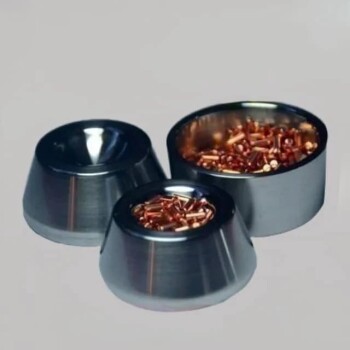
Electron Beam Evaporation Coating Oxygen-Free Copper Crucible and Evaporation Boat

Electron Beam Evaporation Coating Oxygen-Free Copper Crucible and Evaporation Boat

Electron Beam Evaporation Coating Oxygen-Free Copper Crucible enables precise co-deposition of various materials. Its controlled temperature and water-cooled design ensure pure and efficient thin film deposition.

Electron Beam Evaporation Coating Conductive Boron Nitride Crucible BN Crucible

Electron Beam Evaporation Coating Conductive Boron Nitride Crucible BN Crucible

High-purity and smooth conductive boron nitride crucible for electron beam evaporation coating, with high temperature and thermal cycling performance.

Engineering Advanced Fine Ceramics Alumina Crucibles (Al2O3) for Thermal Analysis TGA DTA

Engineering Advanced Fine Ceramics Alumina Crucibles (Al2O3) for Thermal Analysis TGA DTA

TGA/DTA thermal analysis vessels are made of aluminum oxide (corundum or aluminum oxide). It can withstand high temperature and is suitable for analyzing materials that require high temperature testing.

Boron Nitride (BN) Crucible for Phosphorous Powder Sintered

Boron Nitride (BN) Crucible for Phosphorous Powder Sintered

Phosphorus powder sintered boron nitride (BN) crucible has a smooth surface, dense, pollution-free and long service life.

Custom Machined and Molded PTFE Teflon Parts Manufacturer with PTFE Crucible and Lid

Custom Machined and Molded PTFE Teflon Parts Manufacturer with PTFE Crucible and Lid

PTFE crucibles, made from pure Teflon, offer chemical inertness and resistance from -196°C to 280°C, ensuring compatibility with a wide range of temperatures and chemicals. These crucibles feature machine-finished surfaces for easy cleaning and prevention of contamination, making them ideal for precise laboratory applications.

Engineering Advanced Fine Alumina Al2O3 Ceramic Crucible for Laboratory Muffle Furnace

Engineering Advanced Fine Alumina Al2O3 Ceramic Crucible for Laboratory Muffle Furnace

Alumina ceramic crucibles are used in some materials and metal melting tools, and flat-bottomed crucibles are suitable for melting and processing larger batches of materials with better stability and uniformity.

1400℃ Controlled Atmosphere Furnace with Nitrogen and Inert Atmosphere

1400℃ Controlled Atmosphere Furnace with Nitrogen and Inert Atmosphere

Achieve precise heat treatment with KT-14A controlled atmosphere furnace. Vacuum sealed with a smart controller, it's ideal for lab and industrial use up to 1400℃.

Molybdenum Disilicide (MoSi2) Thermal Elements Electric Furnace Heating Element

Molybdenum Disilicide (MoSi2) Thermal Elements Electric Furnace Heating Element

Discover the power of Molybdenum Disilicide (MoSi2) Heating Element for high-temperature resistance. Unique oxidation resistance with stable resistance value. Learn more about its benefits now!

Graphite Vacuum Continuous Graphitization Furnace

Graphite Vacuum Continuous Graphitization Furnace

High-temperature graphitization furnace is a professional equipment for graphitization treatment of carbon materials. It is a key equipment for the production of high-quality graphite products. It has high temperature, high efficiency and uniform heating. It is suitable for various high-temperature treatments and graphitization treatments. It is widely used in metallurgy, electronics, aerospace, etc. industry.

Ultra-High Temperature Graphite Vacuum Graphitization Furnace

Ultra-High Temperature Graphite Vacuum Graphitization Furnace

The ultra-high temperature graphitization furnace utilizes medium frequency induction heating in a vacuum or inert gas environment. The induction coil generates an alternating magnetic field, inducing eddy currents in the graphite crucible, which heats up and radiates heat to the workpiece, bringing it to the desired temperature. This furnace is primarily used for graphitization and sintering of carbon materials, carbon fiber materials, and other composite materials.

Bomb Type Probe for Steelmaking Production Process

Bomb Type Probe for Steelmaking Production Process

Bomb-type probe for precise steelmaking control: measures carbon content (±0.02%) and temperature (20℃ accuracy) in 4-8s. Boost efficiency now!

Laboratory High Pressure Horizontal Autoclave Steam Sterilizer for Lab Use

Laboratory High Pressure Horizontal Autoclave Steam Sterilizer for Lab Use

The horizontal autoclave steam sterilizer adopts the gravity displacement method to remove the cold air in the inner chamber, so that the inner steam and cold air content is less, and the sterilization is more reliable.

Metal Disc Electrode Electrochemical Electrode

Metal Disc Electrode Electrochemical Electrode

Elevate your experiments with our Metal Disk Electrode. High-quality, acid and alkali resistant, and customizable to fit your specific needs. Discover our complete models today.

Laboratory Oscillating Orbital Shaker

Laboratory Oscillating Orbital Shaker

Mixer-OT orbital shaker uses brushless motor, which can run for a long time. It is suitable for vibration tasks of culture dishes, flasks and beakers.

Desktop Fast Laboratory Autoclave Sterilizer 35L 50L 90L for Lab Use

Desktop Fast Laboratory Autoclave Sterilizer 35L 50L 90L for Lab Use

The desktop fast steam sterilizer is a compact and reliable device used for rapid sterilization of medical, pharmaceutical, and research items. It efficiently sterilizes surgical instruments, glassware, medicines, and resistant materials, making it suitable for various applications.


Leave Your Message