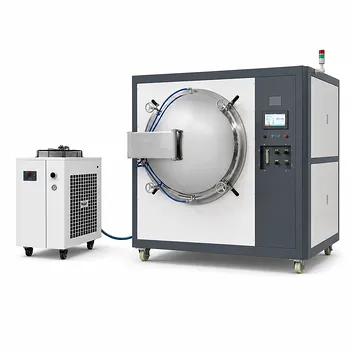
Annealing Eu:GAP and Eu:GLAP single crystals in a weak reducing atmosphere is the standard procedure for maximizing their luminescence efficiency. This specific thermal treatment, typically conducted at 1000°C in a tube furnace using an Ar + 5% H₂ gas mixture, alters the internal defect chemistry and activator coordination to significantly boost both photoluminescence (PL) and radioluminescence (XEL) intensities.
The core purpose of this process is to optimize the crystal's electronic environment for high-performance optical applications. By carefully controlling the furnace atmosphere, researchers can manipulate defect energy levels and the local surroundings of europium ions, turning these crystals into highly efficient red phosphors and scintillators.
Enhancing Luminescence Efficiency
Modifying the Local Coordination Environment
The high-temperature treatment allows activator ions (Europium) within the GAP and GLAP lattices to settle into more favorable coordination environments. This structural refinement reduces non-radiative transitions, ensuring that more energy is released as visible light.
Adjusting Defect Energy Levels
Annealing helps redistribute or eliminate defect energy levels that can trap charge carriers. By clearing these "traps," the process facilitates a more direct path for energy transfer to the luminescence centers, resulting in much higher intensity for PL and XEL.
Optimizing for Scintillator Applications
For crystals used as scintillators or red phosphors, the intensity of the light output is the primary metric of success. The weak reducing atmosphere is the catalyst that enables these materials to meet the rigorous brightness requirements of medical imaging and radiation detection.
The Role of the Weak Reducing Atmosphere
Prevention of Surface Oxidation
Operating at 1000°C makes materials highly susceptible to surface oxidation and the formation of unwanted scale. A controlled atmosphere, such as Ar + 5% H₂, acts as a protective shield that prevents oxygen from degrading the crystal surface and altering its stoichiometry.
Maintaining Chemical Stability
The introduction of hydrogen provides a reductive environment that prevents the abnormal precipitation of ions or oxidative decomposition. This ensures that the europium ions remain in the correct oxidation state required for efficient red light emission.
Ensuring Material Uniformity
Using a tube atmosphere furnace allows for a highly stable and reproducible thermal environment. This consistency is vital for driving the rearrangement of internal grains and eliminating internal stresses, which enhances the overall crystallinity of the final product.
Understanding the Trade-offs
The Risk of Excessive Reduction
While a weak reducing atmosphere is beneficial, an overly aggressive reduction process can lead to the formation of oxygen vacancies or metallic precipitates. These defects can act as new quenching centers, paradoxically lowering the luminescence efficiency if the hydrogen concentration is too high.
Precise Temperature Control
Annealing at 1000°C requires a delicate balance between providing enough thermal energy to fix defects and avoiding thermal degradation. If the cooling phase is not managed correctly, new internal stresses can be introduced, potentially cracking the single crystal.
Applying This to Your Material Research
How to Apply This to Your Project
To achieve the best results with Eu:GAP/Eu:GLAP or similar scintillator materials, your protocol should be tailored to your specific performance requirements.
- If your primary focus is Maximum Luminescence (PL/XEL): Use a 1000°C soak in a weak Ar + H₂ atmosphere to optimize the activator environment and clear defect traps.
- If your primary focus is Material Purity and Stability: Prioritize a strictly controlled tube furnace environment to prevent surface oxidation and ensure chemical homogeneity throughout the crystal.
- If your primary focus is Structural Integrity: Implement a slow, controlled cooling ramp after the 1000°C soak to eliminate internal stresses without inducing thermal shock.
Correctly executed atmosphere annealing transforms these crystals from inert materials into high-performance optical components.
Summary Table:
| Process Parameter | Action / Mechanism | Key Benefit for Crystals |
|---|---|---|
| Atmosphere | Ar + 5% H₂ (Weak Reducing) | Prevents oxidation and maintains chemical stoichiometry |
| Temperature | 1000°C Thermal Soak | Modifies coordination and clears defect energy traps |
| Equipment | Tube Atmosphere Furnace | Ensures uniform heating and stable gas environment |
| Cooling Phase | Controlled Ramp | Eliminates internal stresses and prevents cracking |
Elevate Your Material Science with KINTEK Precision
Achieving peak luminescence in scintillators like Eu:GAP and Eu:GLAP requires more than just heat—it requires absolute control. At KINTEK, we specialize in high-performance laboratory equipment designed for rigorous research environments. Our advanced tube atmosphere furnaces and vacuum furnaces provide the precise temperature uniformity and gas flow management essential for maximizing photoluminescence (PL) and radioluminescence (XEL) intensities.
From high-temperature furnaces (CVD, PECVD, atmosphere) to essential ceramic consumables and crucibles, our portfolio supports every stage of your crystal growth and annealing workflow.
Ready to optimize your crystal performance? Contact KINTEK today for a customized solution!
References
- Tong Wu, Jianding Yu. Eu3+-Doped (Gd, La)AlO3 Perovskite Single Crystals: Growth and Red-Emitting Luminescence. DOI: 10.3390/ma16020488
This article is also based on technical information from Kintek Solution Knowledge Base .
Related Products
- Controlled Nitrogen Inert Hydrogen Atmosphere Furnace
- 1200℃ Controlled Atmosphere Furnace Nitrogen Inert Atmosphere Furnace
- 1700℃ Controlled Atmosphere Furnace Nitrogen Inert Atmosphere Furnace
- Mesh belt controlled atmosphere furnace
- 1200℃ Split Tube Furnace with Quartz Tube Laboratory Tubular Furnace
People Also Ask
- Why is hydrogen used in furnaces? Achieve Superior Purity and Bright Finishes
- What is the role of a hydrogen atmosphere furnace in diamond/copper composites? Enhance Your Material Purity
- What are the characteristics and risks of a hydrogen atmosphere in a furnace? Master the Balance of Power and Control
- What role does an atmosphere furnace utilizing hydrogen gas play in Cu-Cr-Nb alloy powder pretreatment? (Key Insights)
- What is the use of hydrogen in furnace? A Key to Oxygen-Free High-Temperature Processing