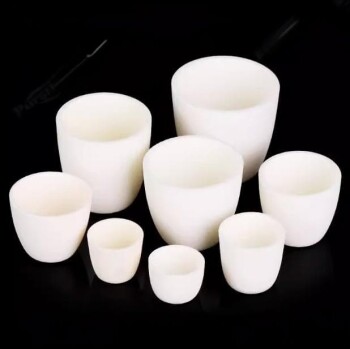
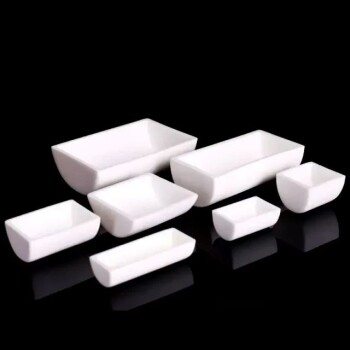
High-purity alumina crucibles are the industry standard for high-temperature processes because they provide an unparalleled combination of thermal stability and chemical inertness. These properties ensure that the crucible does not react with catalysts, samples, or atmospheric gases at temperatures often exceeding 1500°C. By acting as a neutral vessel, they guarantee that experimental results reflect the true behavior of the material under study rather than contamination from the container.
Core Takeaway: High-purity alumina crucibles are essential for ensuring experimental integrity in high-temperature environments. Their ability to resist chemical reactions with aggressive reagents and maintain structural form under extreme heat makes them the definitive choice for precision research and high-purity material production.
The Critical Role of Chemical Inertness
Resisting Alkali and Catalyst Interactions
In processes like petroleum coke catalytic gasification, the presence of alkali metal catalysts (such as $K_2CO_3$) can be highly corrosive to standard containers. High-purity alumina remains chemically indifferent to these catalysts and the minerals within the coke.
This inertness prevents the crucible from participating in the reaction, which is vital for maintaining the accuracy of gasification kinetics. Without this stability, the data would be skewed by side reactions between the vessel and the sample.
Protecting Sample Purity in Specialized Synthesis
When producing high-purity materials like optical-grade phosphors, any introduction of impurities can ruin the batch. Alumina crucibles do not react with phosphor precursor materials, even during prolonged heat treatments at 1530°C.
Similarly, in metallurgy, these crucibles prevent contamination of molten steel. This allows researchers to accurately measure trace elements like aluminum, calcium, and oxygen content, which are critical for understanding how inclusions behave in the steel.
Maintaining Structural Integrity at Extreme Temperatures
Precision in Gravimetric Analysis
Many high-temperature experiments rely on gravimetric methods, where the change in a sample's mass is measured to determine oxidation or gasification rates. Alumina crucibles are preferred because they do not gain or lose mass through reactions with the atmosphere or the sample.
In oxidation studies of graphite or metal coatings, the crucible serves as a reliable "collector." It catches any oxide scale that might peel off (spallation), ensuring that the final weight measurement captures the total mass change of the sample alone.
Withstanding Harsh Gaseous and Thermal Environments
Alumina maintains its structural strength and shape even at temperatures reaching 1600°C. This prevents the crucible from deforming under the weight of heavy samples or pack-cementation mixtures during long-duration thermal cycles.
Furthermore, it remains stable in diverse environments, including steam, oxygen, and inert gases. This versatility allows researchers to use a single type of vessel across a wide range of atmospheric conditions without fear of material degradation.
Understanding the Trade-offs and Limitations
Thermal Shock Sensitivity
While alumina is exceptionally stable at high temperatures, it is susceptible to thermal shock. Rapid heating or cooling can cause the material to crack or shatter due to internal stresses.
To avoid failure, these crucibles must be heated and cooled at controlled, gradual rates. This requirement can increase the overall duration of experimental cycles compared to materials with higher thermal shock resistance.
Cost and Material Grades
The "high-purity" designation (often 99% or higher) comes at a significant price premium compared to lower-grade alumina or ceramic alternatives. For routine, low-temperature applications, the extreme performance of high-purity alumina may be an unnecessary expense.
However, using lower-purity versions in sensitive processes introduces silica or iron impurities. These impurities can leach into the sample or lower the melting point of the crucible itself, leading to catastrophic failure in extreme heat.
How to Apply This to Your Project
Making the Right Choice for Your Goal
Choosing the right container depends entirely on the chemical environment and the level of precision required for your data.
- If your primary focus is kinetic data accuracy: Use high-purity alumina to ensure that mass changes are derived solely from the sample and not from crucible-sample interactions.
- If your primary focus is high-purity material production: Select crucibles with at least 99% purity to prevent trace element contamination in phosphors or specialized alloys.
- If your primary focus is cost-efficiency in routine heating: Consider lower-grade ceramics if the temperature remains below 1000°C and chemical purity is not a critical factor.
- If your primary focus is longevity and reuse: Always implement strict ramp-up and ramp-down temperature protocols to prevent cracking from thermal shock.
By prioritizing the chemical compatibility and thermal limits of your vessel, you ensure that your high-temperature processes yield reliable, repeatable, and uncontaminated results.
Summary Table:
| Feature | Benefit | Key Application |
|---|---|---|
| Chemical Inertness | Resists alkali catalysts and corrosive reagents | Catalytic gasification & Metallurgy |
| Thermal Stability | Maintains structural integrity up to 1600°C | Gravimetric analysis & Sintering |
| High Purity (99%+) | Prevents trace element contamination | Phosphor synthesis & Steel research |
| Atmospheric Versatility | Stable in steam, oxygen, and inert gases | Oxidation studies & Pack cementation |
Elevate Your Research Precision with KINTEK
Ensure the integrity of your high-temperature experiments with KINTEK’s premium high-purity alumina crucibles and ceramic consumables. Designed to withstand extreme environments up to 1600°C, our solutions provide the chemical inertness and thermal stability required for accurate gasification kinetics and high-purity material synthesis.
As a comprehensive provider of laboratory equipment, KINTEK offers more than just crucibles; we supply a full range of high-temperature furnaces (muffle, tube, vacuum, and CVD), hydraulic presses, and cooling solutions tailored for demanding research and industrial production.
Ready to eliminate contamination and improve your data accuracy?
Contact our experts today to find the perfect high-temperature solutions for your lab!
References
- Man Zhang, Qian Zhang. Catalytic Gasification of Petroleum Coke with Different Ratios of K2CO3 and Evolution of the Residual Coke Structure. DOI: 10.3390/molecules28196779
This article is also based on technical information from Kintek Solution Knowledge Base .
Related Products
- Arc-Shaped Alumina Ceramic Crucible High Temperature Resistant for Engineering Advanced Fine Ceramics
- Engineering Advanced Fine Alumina Al2O3 Ceramic Crucible for Laboratory Muffle Furnace
- Engineering Advanced Fine Ceramics Alumina Al2O3 Crucible With Lid Cylindrical Laboratory Crucible
- Engineering Advanced Fine Ceramics Alumina Crucibles (Al2O3) for Thermal Analysis TGA DTA
- Alumina Al2O3 Ceramic Crucible Semicircle Boat with Lid for Engineering Advanced Fine Ceramics
People Also Ask
- Why Use Alumina Crucibles & Powder Burial for NaSICON? Ensure Phase Purity and Prevent Elemental Volatilization
- What is the primary purpose of using alumina crucibles for LLTO ceramics? Optimize Your High-Temperature Sintering
- Why are alumina crucibles and mother powder essential for LATP sintering? Optimize Your Solid Electrolyte Performance
- Why are high-purity alumina crucibles used for liquid lead corrosion experiments? Ensure Data Accuracy at 550°C
- Primary considerations for choosing alumina crucibles and quartz tubes in indium intercalation: Ensure Material Purity