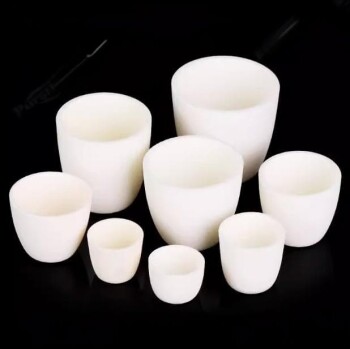
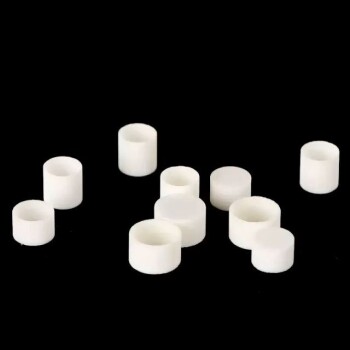
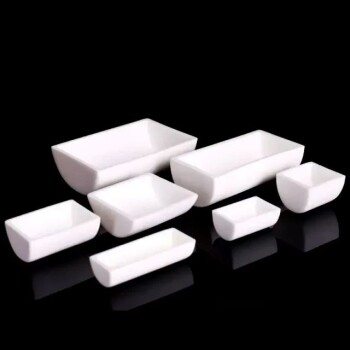
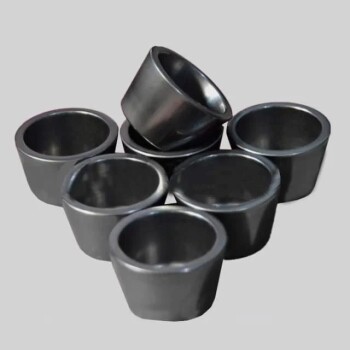
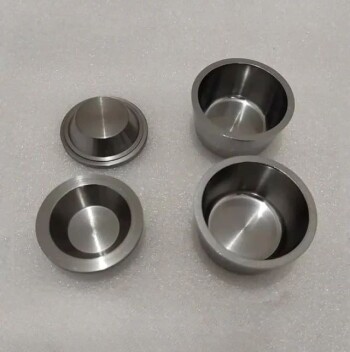
High-purity alumina crucibles are the definitive choice for oxidation tests of Fe-Cr-Al ODS alloys at 1200°C due to their rigid chemical inertness and exceptional thermal stability. These vessels ensure that the experimental environment remains neutral, preventing any chemical reaction between the container and the alloy specimen that could skew results. Furthermore, their ability to maintain a constant mass at extreme temperatures is vital for accurately tracking the minute weight changes inherent in oxidation studies.
Core Takeaway The selection of high-purity alumina is not merely about temperature resistance; it is about establishing a "zero-interference" baseline. By maintaining absolute mass stability and chemical neutrality, these crucibles ensure that any measured data represents only the oxidation of the alloy, eliminating variables caused by container degradation or cross-contamination.
The Critical Role of Chemical Inertness
Preventing Specimen-Container Reactions
At temperatures as high as 1200°C, many standard materials become reactive. High-purity alumina is selected because it remains chemically inert when in contact with Fe-Cr-Al Oxide Dispersion Strengthened (ODS) alloys.
This inertness prevents the crucible material from fusing with or chemically altering the alloy specimen. Consequently, the structural and chemical integrity of the Fe-Cr-Al ODS sample is preserved throughout the duration of the test.
Eliminating Environmental Interference
In high-temperature oxidation tests, the goal is to evaluate how the alloy reacts with the atmosphere (such as air or steam), not the container. Alumina’s resistance to reaction ensures the test environment remains pure.
This isolation allows researchers to attribute corrosion behavior or oxide formation exclusively to the interaction between the alloy and the oxidizing environment.
Ensuring Data Integrity and Mass Accuracy
Stability of the Crucible Mass
A critical metric in oxidation testing is the change in the specimen's weight (mass gain) as it forms an oxide scale. For these measurements to be valid, the mass of the container itself must remain perfectly static.
High-purity alumina demonstrates a stable mass profile at 1200°C. It does not lose weight via evaporation or gain weight via its own oxidation, ensuring that electronic balance readings reflect only changes in the alloy.
Capturing Oxide Scale Spallation
During oxidation, the oxide scale forming on the alloy surface may crack or peel off (spallation). The crucible serves a secondary physical role by collecting these detached fragments.
Because the crucible does not react with this debris, the total mass of the system (specimen + spallation) can be weighed accurately. This ensures that the total extent of oxidation is captured, even if the physical scale has detached from the base metal.
Understanding the Trade-offs
Thermal Shock Susceptibility
While alumina is excellent for steady-state high-temperature stability, it is a ceramic material prone to thermal shock. Rapid heating or cooling cycles can cause the crucibles to crack or fracture.
Purity Requirements
Not all alumina is created equal; "high-purity" is the operative specification. Lower-grade alumina may contain binders or impurities (such as silica) that could leach out at 1200°C, potentially contaminating the sample or altering the local atmosphere.
Making the Right Choice for Your Goal
To maximize the accuracy of your Fe-Cr-Al ODS oxidation tests, apply the following principles:
- If your primary focus is Mass Gain Kinetics: Rely on high-purity alumina to ensure that real-time weight changes are derived solely from the alloy's oxidation, not container interference.
- If your primary focus is Oxide Scale Analysis: Use the crucible to collect any spalling scale, ensuring you can analyze the full volume of oxide formed during the exposure period.
By utilizing high-purity alumina, you transform the sample container from a potential variable into a reliable constant, securing the validity of your high-temperature data.
Summary Table:
| Feature | Benefit for 1200°C Oxidation Testing |
|---|---|
| Chemical Inertness | Prevents reactions between the crucible and Fe-Cr-Al ODS alloys, ensuring specimen integrity. |
| Thermal Stability | Maintains a constant mass profile; no evaporation or self-oxidation at extreme temperatures. |
| Purity (99.9%+) | Eliminates silica or binder leaching that could contaminate the sample or local atmosphere. |
| Spallation Collection | Captures detached oxide scales for accurate total mass gain and kinetic analysis. |
Precision is non-negotiable in high-temperature material science. KINTEK specializes in premium laboratory equipment and consumables, offering the high-purity alumina crucibles and ceramic tools essential for your oxidation studies. Whether you are conducting Fe-Cr-Al ODS alloy research or require advanced high-temperature furnaces and hydraulic presses, our solutions provide the "zero-interference" environment your data demands. Contact KINTEK today to equip your lab with the industry's most reliable consumables and thermal processing systems.
References
- Zhengyuan Li, Siyu Liu. High-Temperature Oxidation Properties and Microstructural Evolution of Nanostructure Fe-Cr-Al ODS Alloys. DOI: 10.3390/ma14030526
This article is also based on technical information from Kintek Solution Knowledge Base .
Related Products
- Arc-Shaped Alumina Ceramic Crucible High Temperature Resistant for Engineering Advanced Fine Ceramics
- Engineering Advanced Fine Alumina Al2O3 Ceramic Crucible for Laboratory Muffle Furnace
- Engineering Advanced Fine Ceramics Alumina Al2O3 Crucible With Lid Cylindrical Laboratory Crucible
- Engineering Advanced Fine Ceramics Alumina Crucibles (Al2O3) for Thermal Analysis TGA DTA
- Alumina Al2O3 Ceramic Crucible Semicircle Boat with Lid for Engineering Advanced Fine Ceramics
People Also Ask
- Why Use Alumina Crucibles & Powder Burial for NaSICON? Ensure Phase Purity and Prevent Elemental Volatilization
- What is the primary purpose of using alumina crucibles for LLTO ceramics? Optimize Your High-Temperature Sintering
- Why are alumina crucibles and mother powder essential for LATP sintering? Optimize Your Solid Electrolyte Performance
- Why are high-purity alumina crucibles used for liquid lead corrosion experiments? Ensure Data Accuracy at 550°C
- Primary considerations for choosing alumina crucibles and quartz tubes in indium intercalation: Ensure Material Purity